All species › Swifts › Hummingbirds › Golden-tailed Starfrontlet
Golden-tailed Starfrontlet | Coeligena eos
Goudstaartincakolibrie | Inca colidorado | Inca-de-cauda-dourada
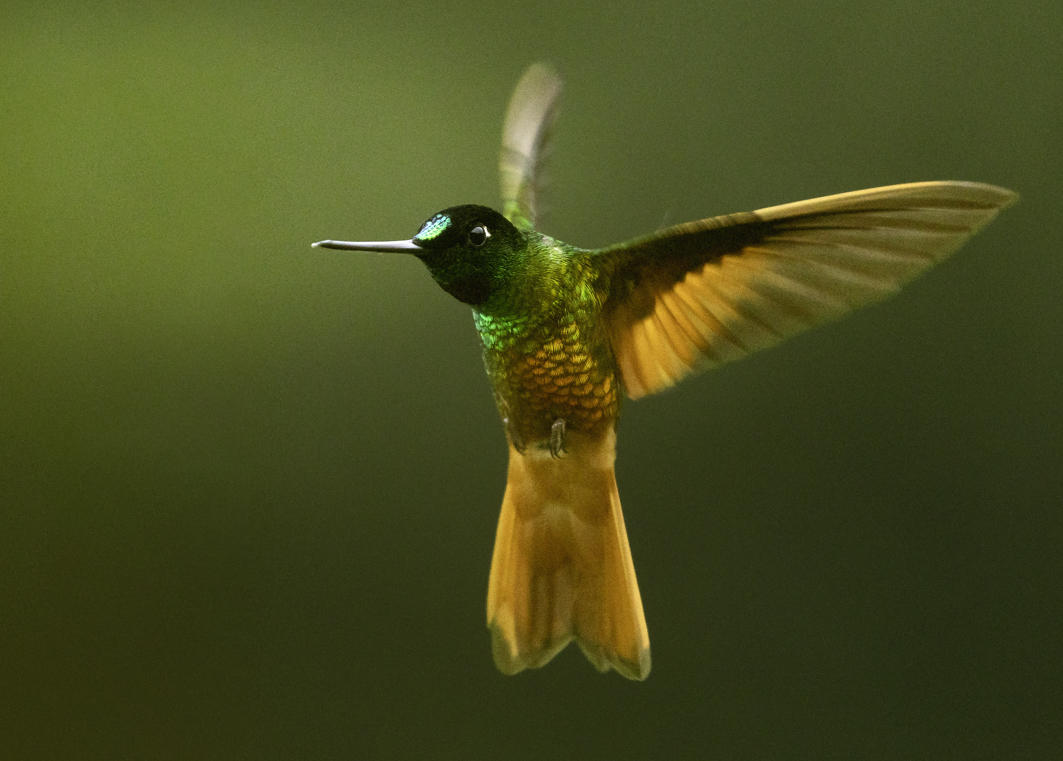
The Golden-tailed Starfrontlet lives only in the Andes of western Venezuela and is therefore endemic to the guide area. The male grades from front to rear from glittering green to gold and coppery red. It was long regarded as a subspecies of Golden-bellied Starfrontlet and is now treated as a separate species by most checklists.
Voice
Hardly described; high tsit notes are known from related incas.
No recording with a suitable Creative Commons licence is available for this species yet.
Identification
13–14 cm, with a long, straight, black bill of about 3 cm and a small white spot behind the eye. The male has a blackish crown and a glittering green forehead. The upper back is golden green, changing to a gold to golden-orange rump. Throat and breast are glittering green with a small violet throat patch, the belly is glittering coppery red to reddish gold and the undertail coverts are pale cinnamon. The wings are dark, with a rufous patch on the tertials; the slightly forked tail is rufous with golden-bronze tips. The female is duller, with a plain green forehead, a cinnamon-buff throat with green spots on the sides, a mottled breast and mostly cinnamon underparts with a golden gloss on the belly.
Confusion species
Perija Starfrontlet Coeligena consita is very similar but lives only in the Serranía de Perijá; Golden-bellied Starfrontlet Coeligena bonapartei lives in the Eastern Andes of Colombia and has not been reliably recorded in Venezuela. Bronzy Inca Coeligena coeligena is uniformly bronzy brown, without golden gloss. Green Inca Coeligena conradii has a white breast shield and much white in the tail.
Habitat
Mainly the interior and edges of humid montane forest, also dwarf forest and more open terrain with scattered vegetation, at roughly 1400 to 3200 m. In the rainy season it apparently moves higher. It visits long, tubular flowers on low to mid-height plants, such as heaths, Centropogon and fuchsias, and catches small arthropods. It probably breeds from January to March; the small cup of moss, lichen and rootlets is attached to a vertical branch.
Where the bird is most at home, classified by the vegetation units of Amazonia and the Guianas.

Range and movements
Only in Venezuela, in the Andes of the west, from Lara through Trujillo and Mérida to Táchira. Absent from the Serranía de Perijá, the coastal range, Brazil and the Guianas. Does not occur outside the guide area.
- Resident
- dark = core range, pale = thinly spread
How and when to look
Search forest edges and scrub in the cloud forest of the Sierra Nevada de Mérida, for example at La Mucuy, and in dwarf forest up to the edge of the páramo. Flowering fuchsias and heaths along trails are good places to wait.
Conservation status
Least Concern. The range is small and the population is thought to be declining. No direct threats are known, but the area overlaps with new settlements and with areas of interest for mining.
Scientific name
Coeligena eos | (Gould, 1848) (GBIF: Coeligena bonapartei)
Gould described the species in 1848 as Helianthea Eos; because it was later moved to another genus, the author and year stand in brackets. The genus Coeligena was introduced in 1833 by Lesson. Coeligena is Latin for 'heaven-born', from caelum 'heaven' and -gena 'born'. eos refers to Ēōs, the Greek goddess of the dawn, after the bird's golden-orange tones. The specimen the first description was based on came from highlands of Venezuela.