All species › Passerines › New World blackbirds, troupials and allies › Golden-tufted Mountain Grackle
Golden-tufted Mountain Grackle | Macroagelaius imthurni
Goudokseltroepiaal | Chango de tepuí | Iraúna-da-guiana
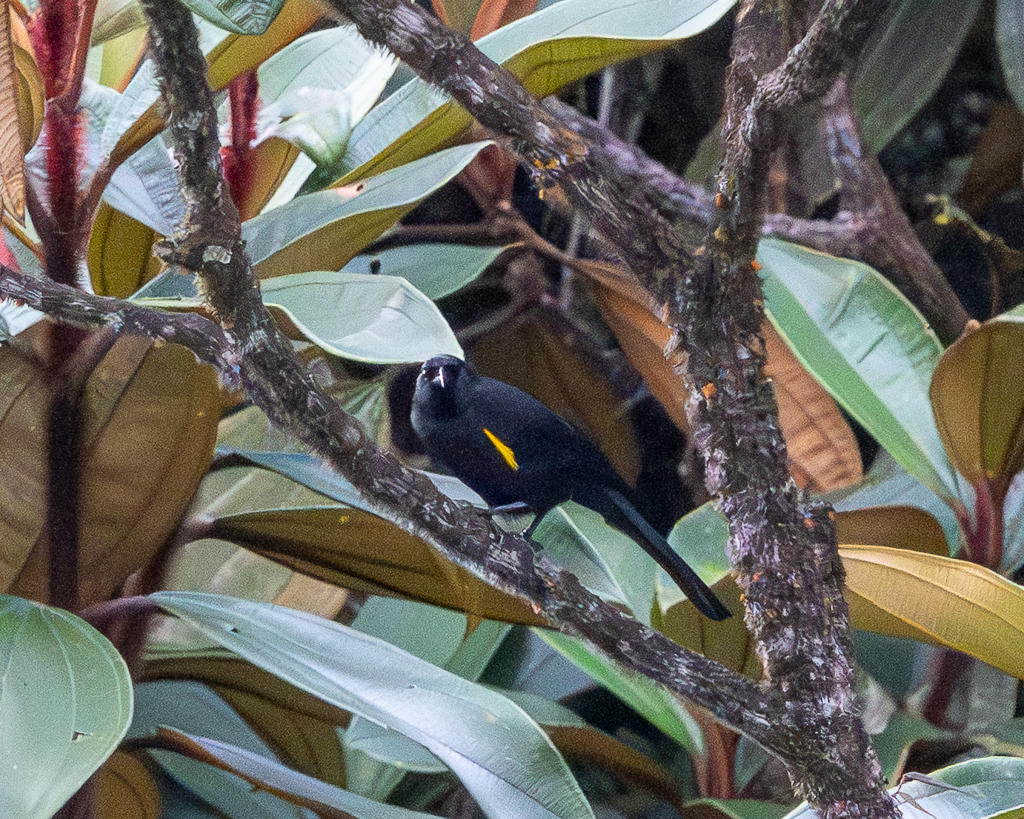
The Golden-tufted Mountain Grackle is a slender, long-tailed black icterid of the montane forest of the tepuis. Its name refers to the golden-yellow tufts on the sides of the breast, which are usually hidden under the wing. It lives in noisy groups and occurs only in the Guiana Highlands.
Voice
A varied repertoire of loud, clear whistles, ringing notes and hoarse, cackling sounds, often from several birds at once; groups can be heard from far away.
Recording: Felipe Arantes — CC BY-NC-SA 4.0 · xeno-canto
Identification
25–28 cm; the male is larger than the female. Entirely black with a slight steel-blue gloss, a fairly long, rounded tail and a slender, pointed black bill. On the sides of the breast is a tuft of golden-yellow feathers, visible only when the bird raises its wings or preens. The eye is dark. The sexes are otherwise alike; juveniles are duller and browner black.
Confusion species
Giant Cowbird Molothrus oryzivorus is larger and heavier, with a red eye, a shorter tail and an erectile ruff of neck feathers. Shiny Cowbird Molothrus bonariensis is smaller, with a shorter tail, and forages mainly on the ground in open country. Carib Grackle Quiscalus lugubris has a pale eye and lives in open lowlands.
Habitat
Humid montane forest, forest edges and tall trees at the edge of savannas on the slopes and plateaus of the tepuis, mostly between about 500 and 2000 m. It lives in groups of five to twenty birds in the canopy and eats insects, fruit and nectar. Little is known about the nest.
Where the bird is most at home, classified by the vegetation units of Amazonia and the Guianas.


Range and movements
Venezuela: the tepuis of the south-east, in Bolívar, including the Gran Sabana and the Sierra de Lema, and in Amazonas. Guyana: the Pakaraima Mountains, including the area around Kaieteur Falls. Brazil: only the far north of Roraima, near the border with Venezuela and Guyana; few records. Not in Suriname and French Guiana. Does not occur outside the guide area.
- Resident
- dark = core range, pale = thinly spread
How and when to look
In Venezuela along the road through the Sierra de Lema between El Dorado and the Gran Sabana, where groups move through the treetops along the forest edge. Look for the long tail and listen for the loud, varied calls.
Conservation status
Least Concern. The range is small, but the montane forest of the tepuis is largely intact; mining and fires are local threats.
Scientific name
Macroagelaius imthurni | (Sclater, 1881)
Sclater described the species in 1881 as Agelaeus imthurni; because it was later moved to another genus, the author and year stand in brackets. The genus Macroagelaius was introduced in 1866 by Cassin. Macroagelaius combines Greek makros 'long' with the genus Agelaius: a 'long' blackbird, perhaps after the longer, grackle-like tail. imthurni honours the British explorer and administrator Everard im Thurn (1852–1932), who explored British Guiana and later governed Fiji. The specimen the first description was based on came from Kaieteur Falls, Potaro River, Guyana.