All species › Swifts › Hummingbirds › Gould's Jewelfront
Gould's Jewelfront | Heliodoxa aurescens
Goulds juweelkolibrie | Brillante frentijoya | Beija-flor-estrela
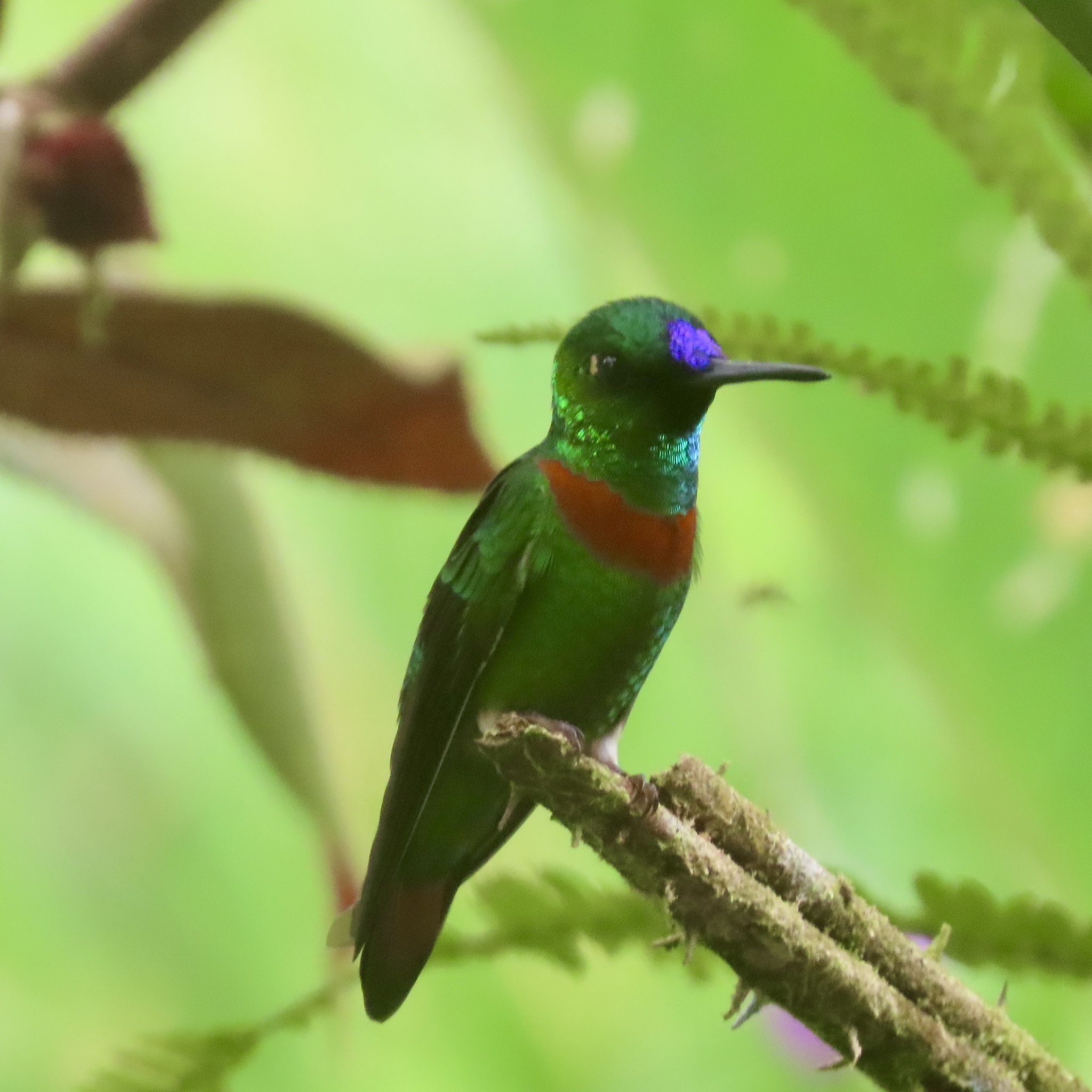
Gould's Jewelfront is a brilliant of western and southern Amazonia, recognisable by the broad rufous band across the breast. The male has a glittering violet-blue patch on the forehead, to which the English name 'jewelfront' refers. The species lives in the lower strata of the forest and flies fixed routes along flowering plants.
Voice
High, thin tsip calls, singly or in short series; poorly described.
Recording: Sidnei Dantas — CC BY-NC-SA 4.0 · xeno-canto
Identification
12–13 cm, with a straight black bill and a small white spot behind the eye. The male is dark green above, with a glittering violet-blue forehead patch, a glittering green throat and a broad orange-rufous band across the breast; the belly is green. The tail is mostly rufous, with bronzy green central feathers. The female resembles the male, but lacks the forehead patch and has a duller throat; she also has the rufous breast band and tail.
Confusion species
Black-throated Brilliant Heliodoxa schreibersii, in the guide area only in the far west of Brazil, is larger and darker, with a black throat, a long, deeply forked black tail and no rufous breast band. The male Fork-tailed Woodnymph Thalurania furcata has a violet belly and a forked blue-black tail, without rufous on the breast or tail.
Habitat
The interior and edges of humid terra firme lowland forest, also várzea and the lower foothills, up to about 1000 m. It feeds in the lower strata at flowers such as heliconias, often along a regular route, and catches small insects. Little is known about its breeding biology.
Where the bird is most at home, classified by the vegetation units of Amazonia and the Guianas.



Range and movements
In Brazil in western and southern Amazonia, in Amazonas, Acre and Rondônia, and south of the Amazon east to the Tapajós region and northern Mato Grosso. In Venezuela scarce in southern Amazonas. Absent from the Guianas. Outside the guide area in the Amazonian lowlands of Colombia, Ecuador, Peru and Bolivia.
- Resident
- dark = core range, pale = thinly spread
How and when to look
Along trails in the interior of terra firme forest, at flowering heliconias and other understorey flowers, for example in Acre, Rondônia and around Alta Floresta in Mato Grosso. Waiting at a group of flowering plants is often most productive, because the bird returns along the same route.
Conservation status
Least Concern. The species is widespread but not numerous; deforestation affects its habitat locally.
Scientific name
Heliodoxa aurescens | (Gould, 1846)
Gould described the species in 1846 as Trochilus (Lampornis) aurescens; because it was later moved to another genus, the author and year stand in brackets. The genus Heliodoxa was introduced in 1850 by Gould. Heliodoxa is Greek, from hēlios 'sun' and doxa 'glory': 'sun-glory', after the brilliant plumage. aurescens is Latin for 'golden, becoming golden', after the golden sheen of the plumage. The specimen the first description was based on came from given as Rio Negro, Brazil (probably eastern Peru).