All species › Swifts › Hummingbirds › Green-throated Mango
Green-throated Mango | Anthracothorax viridigula
Groenkeelmango | Mango gorjiverde | Beija-flor-de-veste-verde
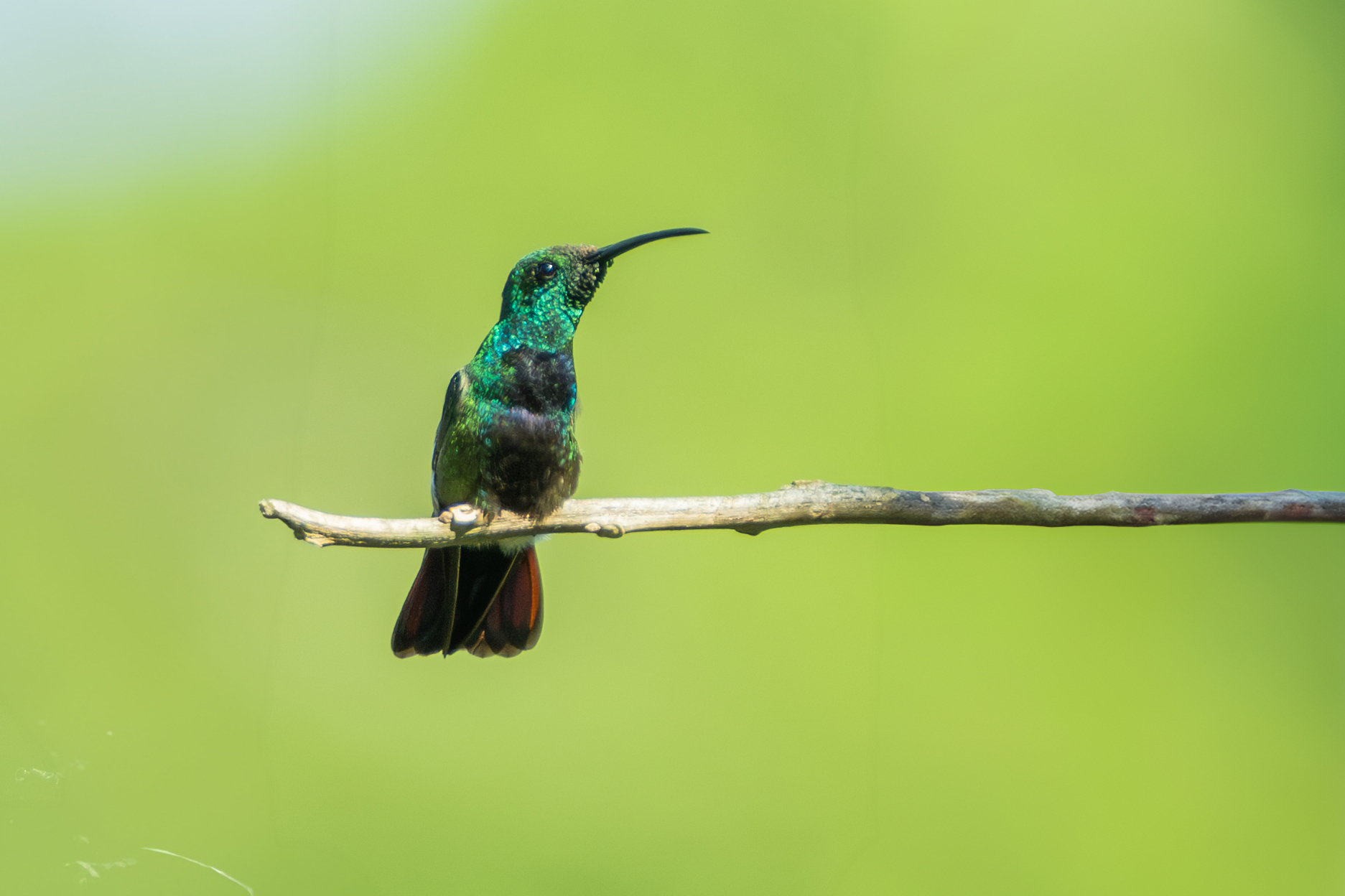
The Green-throated Mango is a mango of coastal mangroves, wet savannas and open country along the large rivers of north-eastern South America. Its range lies almost entirely within the guide area, from the Orinoco Delta through the Guianas to Maranhão. Unlike its relatives, the male has a green throat.
Voice
Not very vocal. When feeding and in flight a dry chep; the song is a very high, slightly descending trill.
Recording: Dante Buzzetti — CC BY-NC-SA 4.0 · xeno-canto
Identification
11–12 cm, with a long, slightly decurved black bill. The male is bronze-green above, with a glittering green throat and breast and a black central stripe down the breast and belly. The outer tail feathers are purple with dark blue tips, the central ones dark bronze-green. The female is bronze-green above and white below, with a black central stripe and white tips to the outer tail feathers. Young birds resemble the female, with more rufous on the underparts.
Confusion species
Black-throated Mango Anthracothorax nigricollis occurs in the same area; the male has a velvety black throat and reddish-purple outer tail feathers. The females of the two species are very similar; a female can therefore often be named only when a male is present. Fiery-tailed Awlbill Avocettula recurvirostris is much smaller, with an upturned bill tip.
Habitat
Mangroves, wet savannas, marshes and open country with scattered large trees, mainly along the coast and large rivers, from sea level to about 500 m. It takes nectar from flowering trees and catches insects in flight.
Where the bird is most at home, classified by the vegetation units of Amazonia and the Guianas.





Range and movements
In Venezuela in the north-east, along the coast of Sucre and Monagas and in the Orinoco Delta, scarce. In Guyana, Suriname and French Guiana in the coastal belt, mainly in mangroves and coastal savannas. In Brazil in the north, in Amapá, in Pará including Marajó island and in western Maranhão, and locally inland along the Amazon. Outside the guide area only on Trinidad.
- Resident
- dark = core range, pale = thinly spread
How and when to look
In mangroves and in gardens with flowering trees along the coast of Suriname and French Guiana, for example around Paramaribo and Cayenne. A mango with a green throat calls for a good look at the throat, breast and tail, because Black-throated Mango lives in the same area.
Conservation status
Least Concern. Loss of mangroves and coastal marshes affects its habitat locally.
Scientific name
Anthracothorax viridigula | (Boddaert, 1783)
Boddaert described the species in 1783 as Trochilus viridigula; because it was later moved to another genus, the author and year stand in brackets. The genus Anthracothorax was introduced in 1831 by Boie. Anthracothorax is Greek, from anthrax 'coal' (i.e. 'black') and thōrax 'chest', after the black central stripe on breast and belly. viridigula is Latin, from viridis 'green' and gula 'throat', after the green throat. The specimen the first description was based on came from Cayenne, French Guiana.