All species › Passerines › Ovenbirds and woodcreepers › Grey-bellied Spinetail
Grey-bellied Spinetail | Synallaxis cinerascens
Grijsbuikstekelstaart | Pijuí negruzco | Pi-puí
The Grey-Bellied Spinetail is a spinetail of the interior of the Atlantic Forest and adjacent forests in south-eastern Brazil. Unlike most Synallaxis species it avoids forest edges and lives in the shade of dense undergrowth. Its high, piercing whistle is often the only sign of its presence in those forests.
Voice
The song is a very high, piercing two-note whistle, the first note higher than the second, rendered as weeet-sweet or pi-puí. Also short, sharp calls.
Recording: Marcelo J Feliti — CC BY-NC-SA 4.0 · shortened to the first 60 s, mono · xeno-canto
Identification
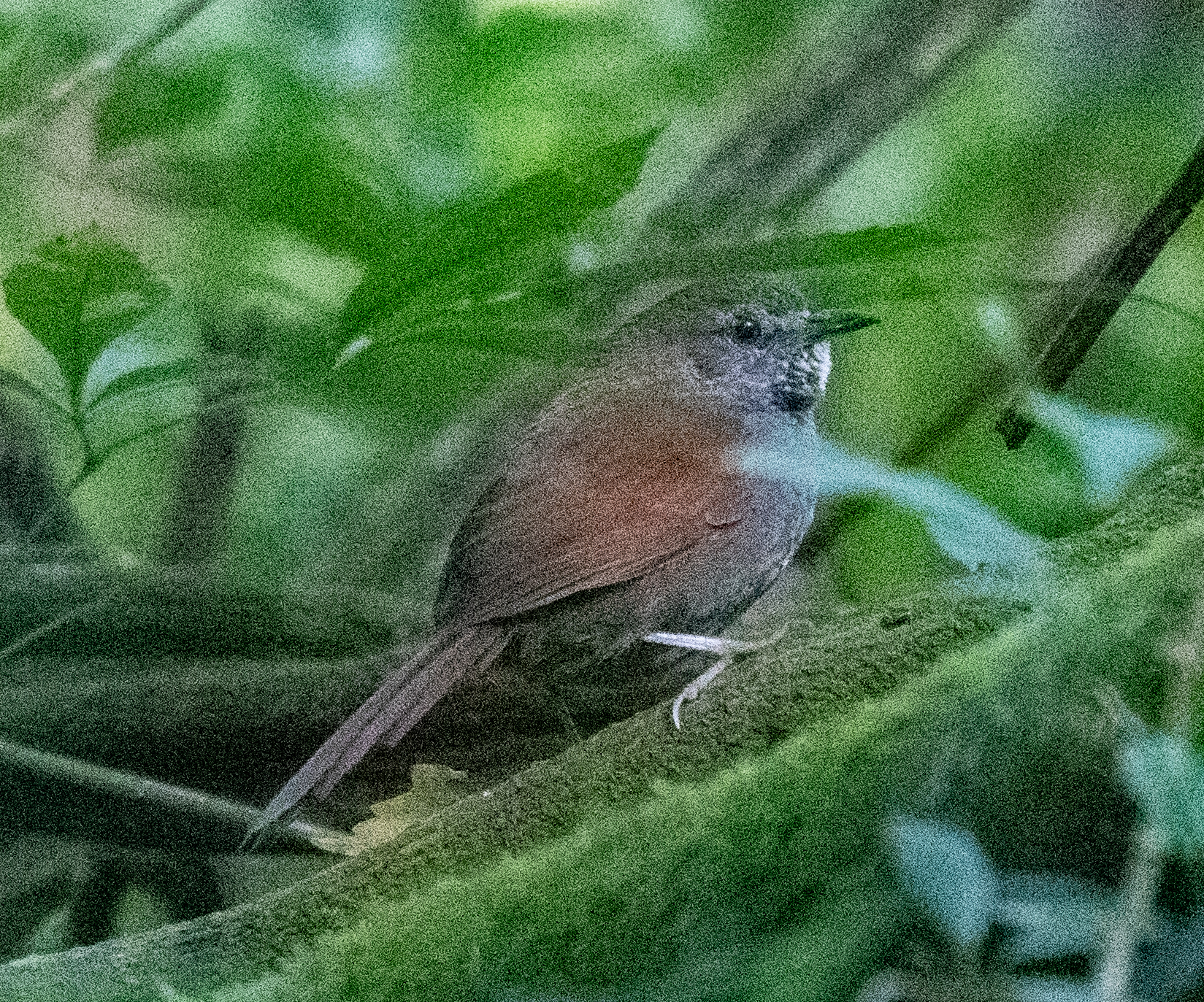
13–15 cm, with a relatively short, dark chestnut tail with spiny feather tips. The face is greyish brown with a faint grey line behind the eye. The crown is dark brownish olive, without rufous; back and rump are warmer brown. The wings are mostly rufous to chestnut. The throat is mottled black and pale grey, the rest of the underparts brownish grey. The sexes are alike. Juveniles have a less distinct throat patch and paler, mottled underparts.
Confusion species
Rufous-Capped Spinetail Synallaxis ruficapilla in the same forest has a rufous crown, a pale supercilium and a pale grey throat. Spix's Spinetail Synallaxis spixi has a rufous crown and shoulder, a longer greyish-brown tail and lives in scrub at forest edges. Sooty-Fronted Spinetail Synallaxis frontalis has a rufous crown and paler underparts, and lives in drier scrub.
Habitat
The interior of dense evergreen and semi-deciduous forest, in lowlands and highlands, and mature secondary forest, from sea level to about 1150 m; it avoids forest edges. It forages low in the undergrowth and in tangled lianas for insects and spiders. The nest is a ball of twigs with a side entrance, low in the undergrowth.
Where the bird is most at home, classified by the vegetation units of Amazonia and the Guianas.




Range and movements
Brazil: in the Atlantic Forest and the seasonal forests of the interior in the south-east and south, from Minas Gerais and Espírito Santo south to Rio Grande do Sul, and locally in Goiás. Not in Venezuela and the Guianas. Outside the guide area in eastern Paraguay, north-eastern Argentina (Misiones and Corrientes) and northern Uruguay.
- Resident
- dark = core range, pale = thinly spread
How and when to look
In the interior of well-developed forest, for example in the forests of the Serra do Mar or Turvo State Park, on trails through dense undergrowth. The high pi-puí is heard mainly in the early morning; the bird usually stays low and in the shade.
Conservation status
Least Concern (IUCN). The population depends on continuous forest; fragmentation of the Atlantic Forest is a threat.
Scientific name
Synallaxis cinerascens | Temminck, 1823
Temminck described the species in 1823 and placed it straight away in the genus where it still stands. The genus Synallaxis was introduced in 1818 by Vieillot. Synallaxis is Greek, from sunallaxis 'exchange'; why Vieillot chose the name is unclear. cinerascens is Latin for 'greyish, becoming ash-grey', after the grey underparts. The specimen the first description was based on came from Ipanema (Iperó), São Paulo, Brazil.