All species › Parrots › African and New World parrots › Grey-breasted Parakeet
Grey-breasted Parakeet | Pyrrhura griseipectus
Grijsborstparkiet | Cotorra pechigrís | Tiriba-de-peito-cinza
The Grey-breasted Parakeet is a Pyrrhura parakeet of north-eastern Brazil that now lives at only a few sites in Ceará, mainly in the Serra de Baturité. It formerly also occurred in Pernambuco, Alagoas and Rio Grande do Norte. The population numbers a few hundred birds and is increasing again thanks to a conservation programme with nest boxes. It was long treated as a form of White-eared Parakeet.

Voice
Shrill, grating calls such as kreek-kreek, mainly in flight, and soft chattering from groups that are feeding.
Recording: GABRIEL LEITE — CC BY-NC-SA 4.0 · converted to mono · xeno-canto
Identification
22 cm, slim, with a long, graduated tail. The plumage is mostly green. The crown is brown, the face dark reddish brown, with a white ear patch. The throat, breast and sides of the neck are grey with pale edges, giving a scaly pattern. There is a reddish-brown patch in the centre of the belly, and the rump is also reddish brown. The bend of the wing is red, the primaries bluish. The tail is reddish brown. There is a bare, grey ring around the eye. The sexes are alike; juveniles resemble adults.
Confusion species
White-eared Parakeet Pyrrhura leucotis is very similar, but has a greener, less grey breast; it lives further south, in the Atlantic Forest from Bahia to Rio de Janeiro. Caatinga Parakeet Eupsittula cactorum lives in the lower caatinga around it and has a plain brown throat, a yellow belly and no reddish-brown belly patch.
Habitat
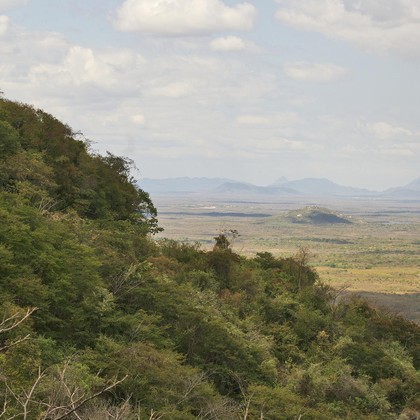
Humid, evergreen forest on the ridges within the caatinga, usually above 500 m, also shade coffee plantations and forest edges; at Quixadá in forest and scrub around granite rock domes. It feeds on fruit, seeds and blossoms. It lives in flocks of five to fifteen birds. The nest is in a tree cavity; nest boxes are widely used.
Where the bird is most at home, classified by the vegetation units of Amazonia and the Guianas.


Range and movements
Only in Brazil, in northern Ceará: in the Serra de Baturité and around Quixadá and Ibaretama. A flock reported in 2022 in southern Bahia, far from these sites, is still under study. Formerly also in Pernambuco, Alagoas and Rio Grande do Norte. Absent from Venezuela, Guyana, Suriname and French Guiana. Does not occur outside the guide area.
- Resident
- dark = core range, pale = thinly spread
How and when to look
Search in the Serra de Baturité around Guaramiranga and Pacoti, where flocks forage along forest edges and in coffee plantations; they are also seen around the rock domes near Quixadá.
Conservation status
Endangered, after earlier being listed as Critically Endangered. The forest on the ridges has largely been converted to coffee plantations and fields, and the species was long trapped for the cage-bird trade. A conservation programme with nest boxes and outreach has increased the population at all known sites.
Scientific name
Pyrrhura griseipectus | Salvadori, 1900
Salvadori described the species in 1900 and placed it straight away in the genus where it still stands. The genus Pyrrhura was introduced in 1856 by Bonaparte. Pyrrhura is Greek, from purrhos 'red' and oura 'tail', after the maroon tail of many species. griseipectus is Modern Latin, from griseus 'grey' and pectus 'breast', after the grey, scaled breast. The specimen the first description was based on came from Ceará, Brazil (originally unknown).