All species › Parrots › African and New World parrots › White-eared Parakeet
White-eared Parakeet | Pyrrhura leucotis
Witoorparkiet | Cotorra orejiblanca | Tiriba-de-orelha-branca
The White-eared Parakeet is a small Pyrrhura parakeet of the Atlantic Forest of eastern Brazil, from southern Bahia to Rio de Janeiro. It lives mainly in lowland forest, most of which has disappeared. Grey-breasted Parakeet, Pfrimer's Parakeet and Venezuelan Parakeet were formerly included in this species. Flocks fly fast and low through the forest.
Voice
Shrill, grating calls such as kreet-kreet, mainly in flight, and soft chattering from groups that are feeding.
Recording: Odirlei Vieira da Fonseca — CC BY-NC-SA 4.0 · converted to mono · xeno-canto
Identification
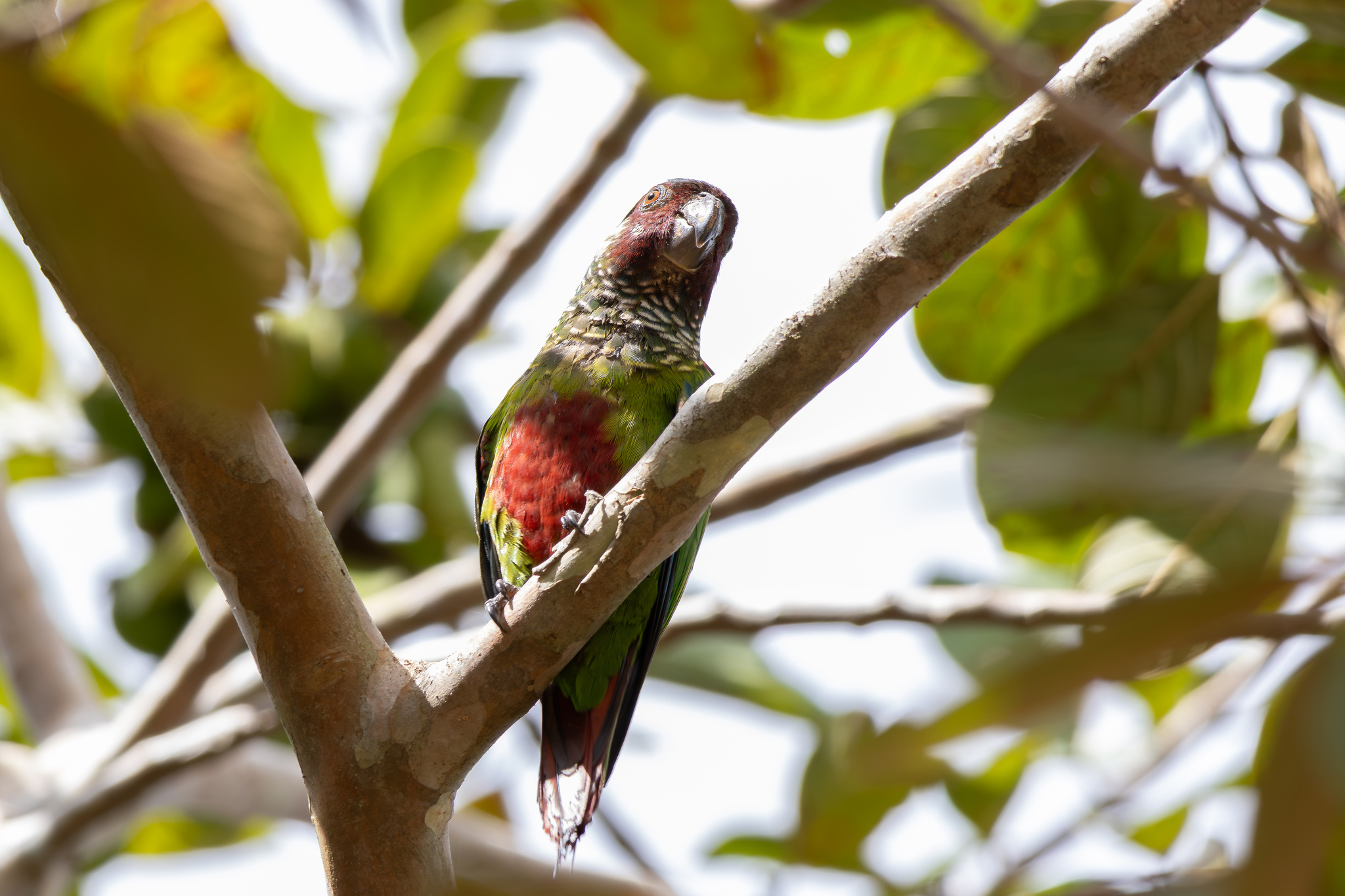
21 cm, slim, with a long, graduated tail. The plumage is mostly green. The forehead and face are dark reddish brown, the crown is brown and the nape has a bluish tinge. There is a white to yellowish-white patch on the ear region. The throat and breast are greenish with dark and pale barring. There is a reddish-brown patch in the centre of the belly, and the rump is also reddish brown. The bend of the wing is red, the primaries blue. The tail is reddish brown. There is a bare, grey ring around the eye. The sexes are alike; juveniles have less red on the bend of the wing.
Confusion species
Maroon-bellied Parakeet Pyrrhura frontalis is larger, with a brown instead of white ear patch, a green face and no red bend of the wing. Ochre-marked Parakeet Pyrrhura cruentata is larger, with a blue collar, an orange ear patch and a red rump. Grey-breasted Parakeet Pyrrhura griseipectus has a greyer breast and lives far to the north, in Ceará; Pfrimer's Parakeet Pyrrhura pfrimeri has no white ear patch and lives in Goiás and Tocantins.
Habitat
Humid coastal lowland forest and semi-deciduous forest further inland, also forest edges, secondary forest and cacao grown in the shade of old trees (cabruca), mainly below 600 m, locally higher. It feeds on fruit, seeds and blossoms in the canopy. It lives in flocks of five to fifteen birds. The nest is in a tree cavity.
Where the bird is most at home, classified by the vegetation units of Amazonia and the Guianas.




Range and movements
Only in Brazil: in the Atlantic Forest of southern Bahia, eastern Minas Gerais, Espírito Santo and Rio de Janeiro. Absent from Venezuela, Guyana, Suriname and French Guiana; the birds of northern Venezuela are treated here as a separate species, Venezuelan Parakeet. Does not occur outside the guide area.
- Resident
- dark = core range, pale = thinly spread
How and when to look
Search in the forest reserves of Espírito Santo, such as Sooretama and Linhares, or in the cabruca and forest remnants of southern Bahia; flocks give themselves away by their calls as they fly over the forest.
Conservation status
Vulnerable. The lowland forest of the Atlantic Forest has largely been cleared for agriculture, plantations and cities, and the remaining forest is fragmented. Birds are also trapped for the cage-bird trade.
Scientific name
Pyrrhura leucotis | (Kuhl, 1820)
Kuhl described the species in 1820 as Psittacus leucotis; because it was later moved to another genus, the author and year stand in brackets. The genus Pyrrhura was introduced in 1856 by Bonaparte. Pyrrhura is Greek, from purrhos 'red' and oura 'tail', after the maroon tail of many species. leucotis is Greek, from leukos 'white' and ous, ōtos 'ear', after the pale ear patch. The specimen the first description was based on came from Brazil (not specified).