All species › Passerines › New World warblers › Grey-headed Warbler
Grey-headed Warbler | Myiothlypis griseiceps
Grijswangzanger | Reinita cabecigrís | Pula-pula-de-cabeça-cinza
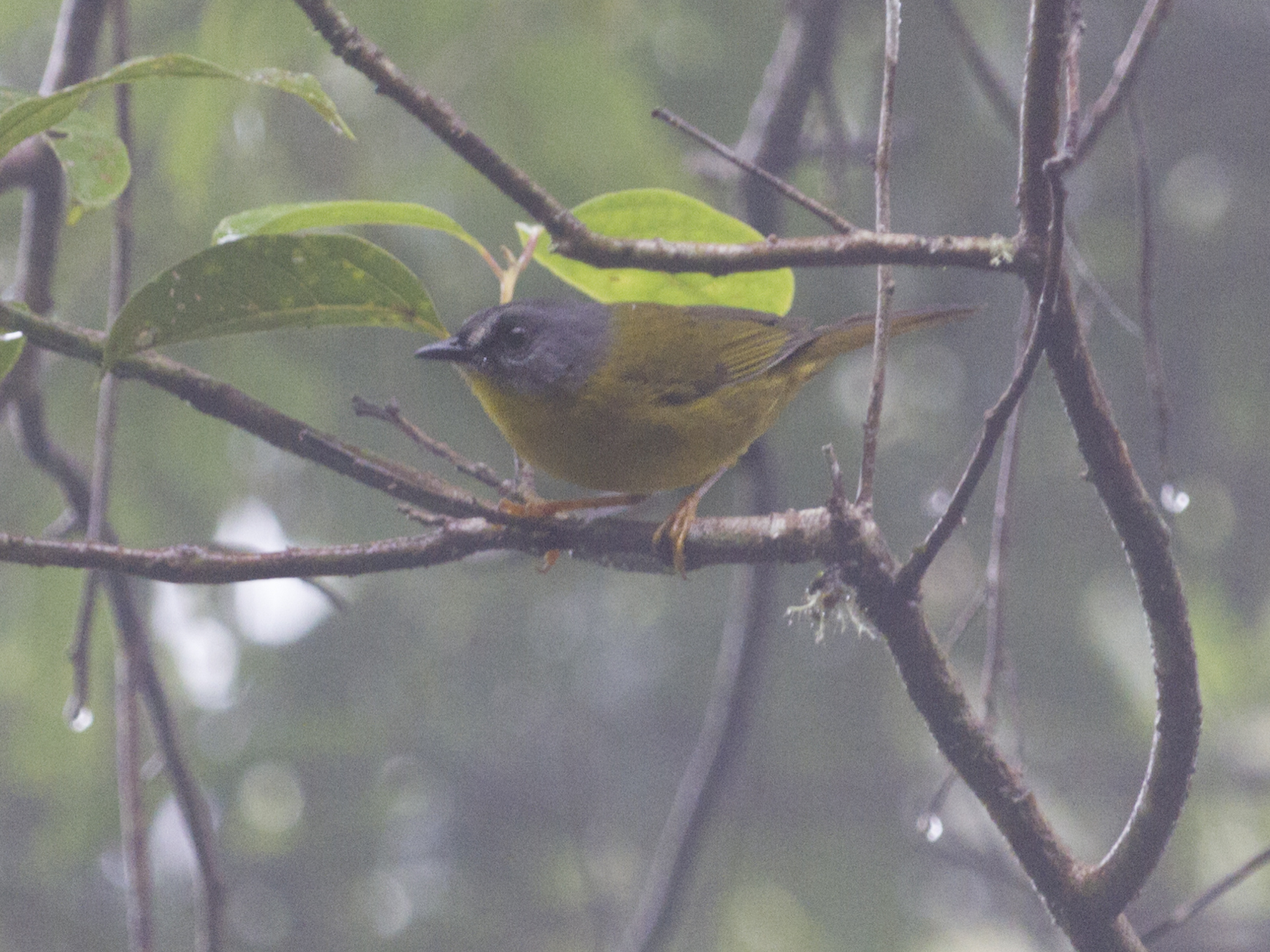
The Grey-headed Warbler is a warbler with a dark grey head and yellow underparts found only in the mountains of north-eastern Venezuela. Its entire range is limited to a small massif around Turimiquire, where it lives in cloud forest. This makes it one of the species with the smallest range in the guide area.
Voice
The song is a lively, slurred, melodious whistled phrase, repeated a few times. Calls are a thin tsip, a harsher tseck or chack when excited and a tseng in response to song.
Recording: Nick Athanas — CC BY-NC-SA 3.0 · xeno-canto
Identification
14 cm. The head is dark grey, with a short white line above the lores, white flecks on the ear coverts and a white chin. Throat and underparts are yellow; upperparts, wings and tail olive-green. The bill is blackish, the legs dusky pink. The sexes are alike. Young birds have an all-grey hood down to the breast, brownish upperparts and pale brownish underparts.
Confusion species
No similar Myiothlypis occurs within its small range. Golden-crowned Warbler Basileuterus culicivorus is smaller and has a yellow to orange crown stripe between black stripes. Slate-throated Whitestart Myioborus miniatus has a slate-grey head and back and white outer tail feathers, which it fans constantly. Grey-throated Warbler Myiothlypis cinereicollis of Perijá and the Andes has a grey throat and a yellow crown stripe, and does not occur in the north-east.
Habitat
Undisturbed mature cloud forest and adjoining secondary and regenerating forest, roughly between 1200 and 2600 m. It forages from the understorey into the lower canopy for insects, often with mixed flocks. In degraded forest it is only found close to undisturbed forest. Little is known about the nest.
Where the bird is most at home, classified by the vegetation units of Amazonia and the Guianas.

Range and movements
Venezuela: only in the Turimiquire massif in the north-east, on the borders of Anzoátegui, Sucre and Monagas, including Cerro Turimiquire and Cerro Negro in El Guácharo National Park; known from only a few sites. Not in Brazil, Guyana, Suriname and French Guiana. Does not occur outside the guide area.
- Resident
- dark = core range, pale = thinly spread
How and when to look
In cloud forest on Cerro Negro near Caripe, in El Guácharo National Park, where it moves with mixed flocks through the understorey and lower canopy. The repeated whistled phrase and the thin tsip indicate its presence.
Conservation status
Near Threatened. The range is very small and numbers are thought to be declining. Much of the montane forest in the Turimiquire massif has been cleared for fields and pasture, and even within El Guácharo National Park forest and understorey are removed and burned for coffee.
Scientific name
Myiothlypis griseiceps | (Sclater & Salvin, 1868)
Sclater & Salvin described the species in 1868 as Basileuterus griseiceps; because it was later moved to another genus, the author and year stand in brackets. The genus Myiothlypis was introduced in 1851 by Cabanis. Myiothlypis is Greek, from muia 'fly' and thlupis, an unidentified small bird: 'fly-warbler'. griseiceps is Modern Latin for 'grey-headed', from griseus 'grey' and -ceps '-headed', after the grey head. The specimen the first description was based on came from Caripe, Monagas, Venezuela.