All species › Tinamous › Tinamous › Grey-legged Tinamou
Grey-legged Tinamou | Crypturellus duidae
Grijspoottinamoe | Tinamú patigrís | Inhambu-de-pé-cinza
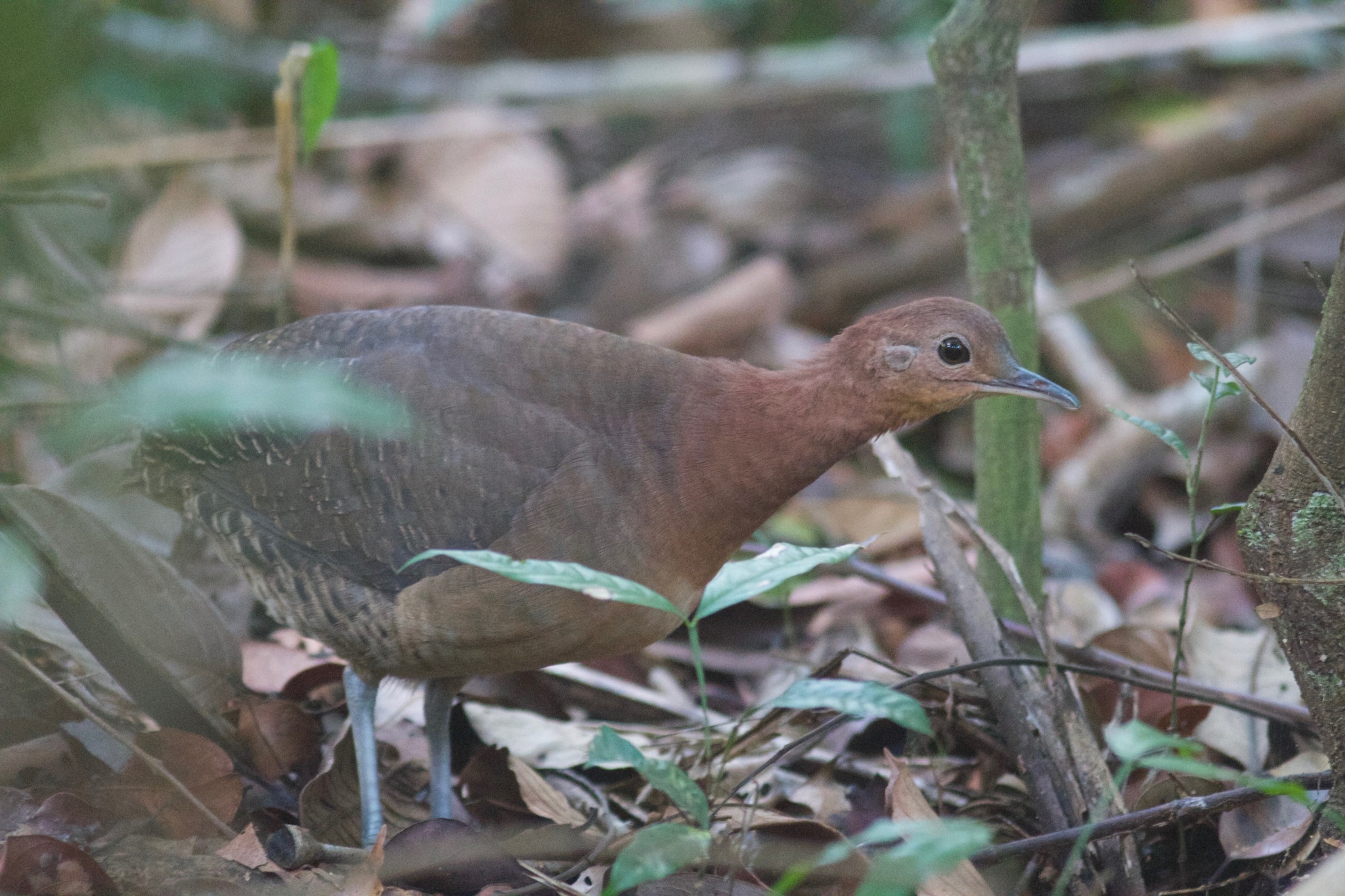
The Grey-legged Tinamou is a rufous-brown tinamou of the upper Orinoco and upper Rio Negro drainages. It closely resembles Red-legged Tinamou, but has grey legs. It lives mainly in low forest on white sand.
Voice
A clear, plaintive whistle, repeated at intervals, mainly in the early morning and at dusk.
Recording: Jaime Suárez — CC BY-NC-SA 4.0 · converted to mono · xeno-canto
Identification
28–31 cm, with a small head, a thin neck and almost no tail. The head and neck are rufous, the throat paler, the upperparts dark brown; the female has black barring on the wings and lower back. The breast is warm rufous, grading into a paler, creamy belly; the flanks are barred dark. The legs are grey.
Confusion species
Red-legged Tinamou Crypturellus erythropus has pink to red legs and a greyer breast and lives mainly further north and east. Variegated Tinamou Crypturellus variegatus has a black cap, a white throat and a heavily barred back. Little Tinamou Crypturellus soui is smaller and unbarred. Barred Tinamou Crypturellus casiquiare, which lives in the same area, is smaller, with a rufous head and a sharply black-and-buff barred back.
Habitat
Low, open forest and scrub on white sand (campina and campinarana), forest edges and the transition from forest to savanna, in the lowlands up to about 500 m. It walks on the ground, taking seeds, fruit and invertebrates. Little is known about its breeding biology; as in related species, the male probably incubates the eggs.
Where the bird is most at home, classified by the vegetation units of Amazonia and the Guianas.



Range and movements
In Venezuela in the south, in Amazonas, among others around Cerro Duida and along the upper Orinoco. In Brazil in the far northwest, in the upper Rio Negro drainage in Amazonas. Absent from the Guianas. Outside the guide area in eastern Colombia.
- Resident
- dark = core range, pale = thinly spread
How and when to look
Listen in the early morning in low forest on sandy soil along the upper Rio Negro, for example around São Gabriel da Cachoeira, or in the south of the Venezuelan state of Amazonas for the whistles. The bird usually stays under the cover of the undergrowth.
Conservation status
Least Concern (IUCN). Its range is remote and little disturbed; the species is hunted locally. Its habits and population are poorly studied.
Scientific name
Crypturellus duidae | Zimmer, 1938
Zimmer described the species in 1938 and placed it straight away in the genus where it still stands. The genus Crypturellus was introduced in 1914 by Brabourne, WWK-H & Chubb. Crypturellus is a diminutive of the older tinamou genus Crypturus (Greek kruptos 'hidden' and oura 'tail'): 'little hidden-tail'. duidae refers to Cerro Duida in Amazonas (Venezuela), where the species was discovered. The specimen the first description was based on came from Cerro Duida, Amazonas, Venezuela.