All species › Tinamous › Tinamous › Red-legged Tinamou
Red-legged Tinamou | Crypturellus erythropus
Roodpoottinamoe | Tinamú patirrojo | Inhambu-de-perna-vermelha
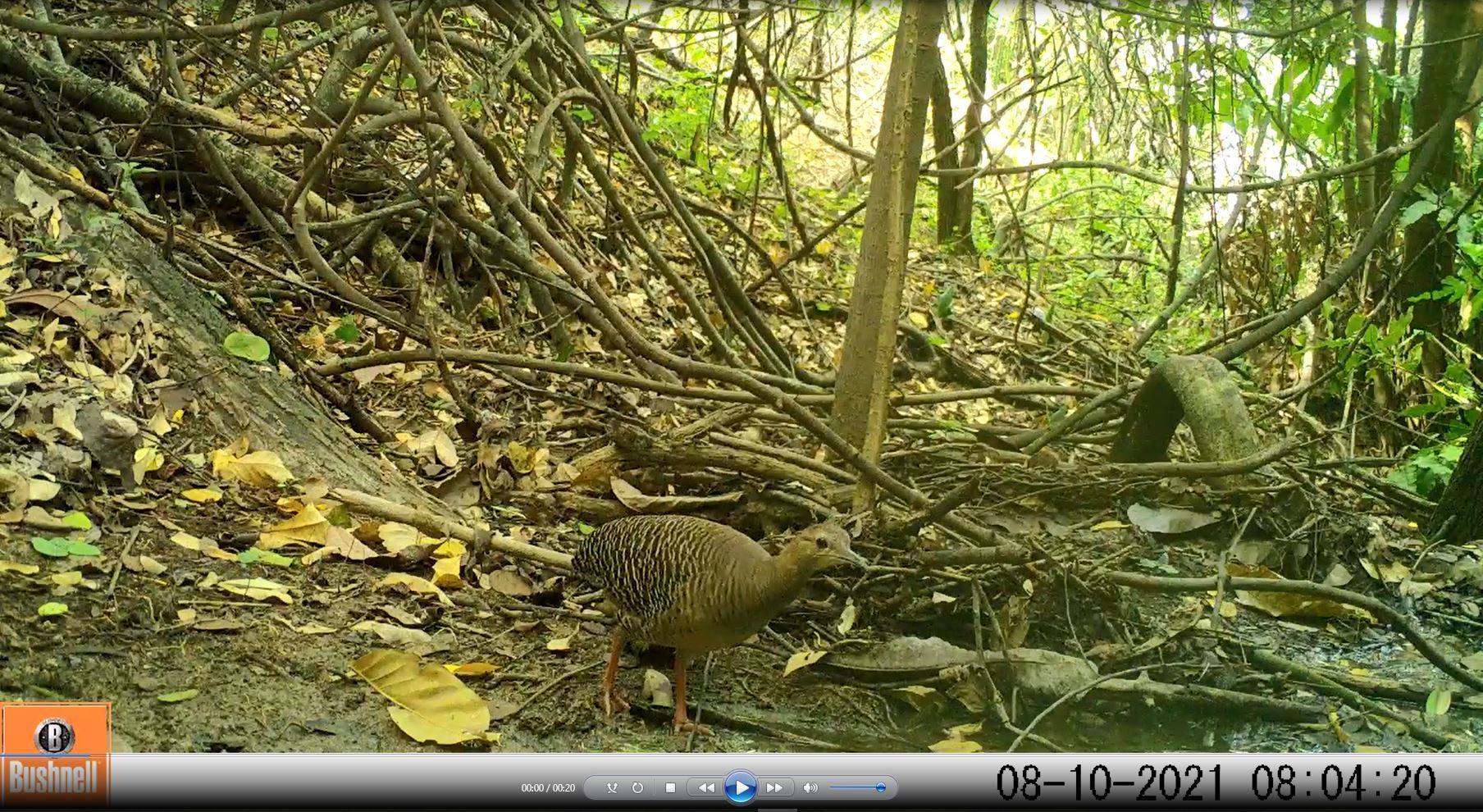
The Red-legged Tinamou is a tinamou of dry and semi-humid forest, gallery forest and forest edges in the north of the guide area, from Venezuela to the Guianas and northern Brazil. It is named after its pink to red legs. Several isolated forms, including that of Margarita Island, were formerly regarded as separate species.
Voice
A short series of two or three pure, plaintive whistles, repeated at intervals, mainly in the early morning and at dusk.
Recording: Dante Buzzetti — CC BY-NC-SA 4.0 · shortened to the first 60 s, mono · xeno-canto
Identification
28–32 cm, with a small head, a thin neck and almost no tail. The upperparts are brown to olive-brown; the female has distinct black-and-buff barring on the wings and lower back, the male weaker barring. The head and foreneck are rufous, the throat pale, the breast greyish to brown, the belly paler with barred flanks. The legs are pink to red. The forms differ in the tone of the crown and breast.
Confusion species
Grey-legged Tinamou Crypturellus duidae has grey legs and a warmer rufous breast and lives further southwest. Little Tinamou Crypturellus soui is smaller, without red legs and without barring. Undulated Tinamou Crypturellus undulatus has greyish green legs and finely vermiculated upperparts. Great Tinamou Tinamus major is much larger and olive-brown, with grey legs.
Habitat
Dry deciduous forest, gallery forest, forest edges and dense thickets, also woodland patches in savannas and older secondary forest, from sea level to about 1500 m. It walks on the ground, taking seeds, fruit and invertebrates. The nest is on the ground; the male incubates the eggs.
Where the bird is most at home, classified by the vegetation units of Amazonia and the Guianas.





Range and movements
In Venezuela widespread north of the Orinoco, in the dry forest of the north, the coastal mountains, gallery forest in the Llanos and on Margarita Island, and south of the Orinoco in northern Bolívar. In Guyana and Suriname mainly in the savanna regions and the forest along their edges; few records from French Guiana. In Brazil in the north, mainly in the savannas of Roraima. Outside the guide area in northern and eastern Colombia.
- Resident
- dark = core range, pale = thinly spread
How and when to look
Listen in the early morning in dry forest at the foot of the coastal mountains in Venezuela, in gallery forest in the Llanos or in woodland around the Rupununi savanna in Guyana for the whistles. On quiet forest trails the bird sometimes walks slowly away over the forest floor.
Conservation status
Least Concern (IUCN). Locally declining through clearance of dry forest and hunting. The Margarita form (margaritae) has a small range.
Scientific name
Crypturellus erythropus | (Pelzeln, 1863)
Pelzeln described the species in 1863 as Tinamus erythropus; because it was later moved to another genus, the author and year stand in brackets. The genus Crypturellus was introduced in 1914 by Brabourne, WWK-H & Chubb. Crypturellus is a diminutive of the older tinamou genus Crypturus (Greek kruptos 'hidden' and oura 'tail'): 'little hidden-tail'. erythropus is Greek, from eruthros 'red' and pous 'foot', after the red legs. The specimen the first description was based on came from Brazil (not specified further).