All species › Passerines › Tanagers and allies › Grey-throated Warbling Finch
Grey-throated Warbling Finch | Microspingus cabanisi
Grijsborstboomgors | Monterita de Cabanis | Quete
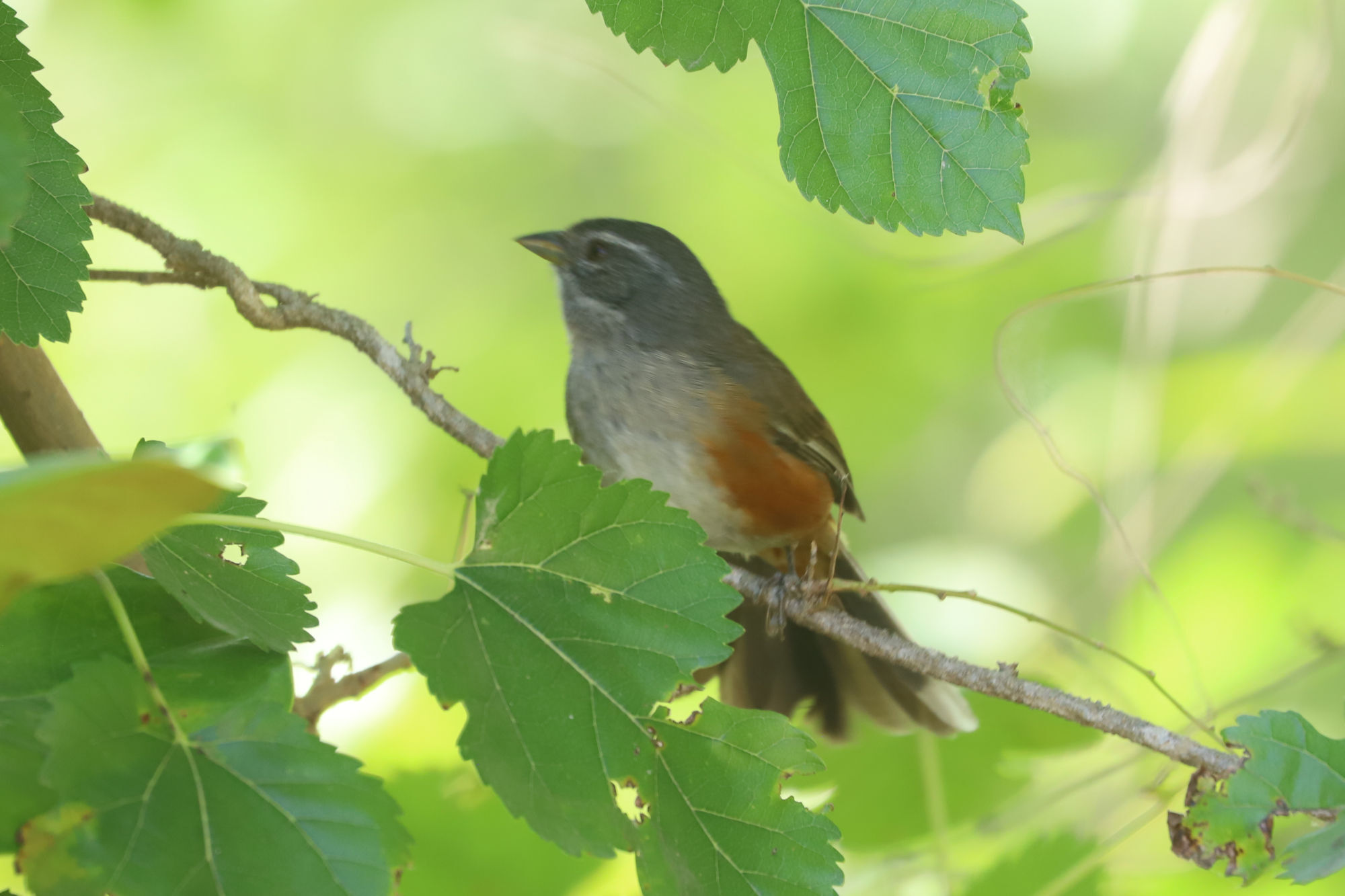
Grey-throated Warbling Finch is a warbling finch of forest edges and scrub in southern Brazil and neighbouring countries. It has a grey head and breast with a white supercilium, rufous flanks and white tail corners. It was formerly treated as one species together with the more northerly Buff-throated Warbling Finch.
Voice
The song is a short, clear series of whistled and twittering notes, often from a shrub. Contact calls are high, sharp tsip notes.
Recording: JAYRSON ARAUJO DE OLIVEIRA — CC BY-NC-SA 4.0 · xeno-canto
Identification
15 cm, with a pointed dark bill and a fairly long tail with white corners. Head, throat and breast are grey, the throat sometimes paler to whitish; a long white supercilium extends behind the eye. The back is olive-brown to greyish brown. Flanks and undertail coverts are rufous, the centre of the belly whitish. The sexes are alike. Young birds are browner and less clearly marked.
Confusion species
Buff-throated Warbling Finch Microspingus lateralis has a buff throat, a browner, often chestnut-tinged back and a rufous rump, and lives in the mountains of the southeast; in the contact zone range is a useful guide. Bay-chested Warbling Finch Castanozoster thoracicus has a white throat with a chestnut breast band and no white supercilium. Black-and-rufous Warbling Finch Poospiza nigrorufa is darker, with a rufous throat and breast and a white moustachial stripe.
Habitat
Shrub layer of forest edges, secondary forest and scrub, edges of araucaria and semi-deciduous forest, also bamboo and overgrown field margins, from the lowlands to the plateaus. It lives in pairs or small groups, forages low in shrubs for insects and seeds and joins mixed flocks outside the breeding season. The nest is an open cup low in a shrub.
Where the bird is most at home, classified by the vegetation units of Amazonia and the Guianas.




Range and movements
Brazil: in the south, from southern São Paulo through Paraná and Santa Catarina to Rio Grande do Sul, both in the interior and in the mountains. Absent from Venezuela, Guyana, Suriname and French Guiana. Outside the guide area in eastern Paraguay and northeastern Argentina.
- Resident
- dark = core range, pale = thinly spread
How and when to look
On the plateaus of Paraná, Santa Catarina and Rio Grande do Sul, search forest edges and shrubby roadsides for groups foraging low in the scrub; the white tail corners show in flight.
Conservation status
Least Concern (IUCN). The species is fairly common in southern Brazil and tolerates secondary scrub and plantation edges; loss of forest edges and shrubbery reduces its habitat locally.
Scientific name
Microspingus cabanisi | (Bonaparte, 1850)
Bonaparte described the species in 1850 as Poospiza cabanisi; because it was later moved to another genus, the author and year stand in brackets. The genus Microspingus was introduced in 1874 by Taczanowski. Microspingus is Greek, from mikros 'small' and the genus Chlorospingus (spingos 'finch'): a 'little Chlorospingus'. cabanisi honours the German ornithologist Jean Louis Cabanis (1816–1906), long-time curator at the Berlin museum. The specimen the first description was based on came from Bonpland, Misiones, Argentina.