All species › Passerines › Tyrant flycatchers and allies › Greyish Mourner
Greyish Mourner | Rhytipterna simplex
Grijze treurtiran | Plañidera gris | Vissiá
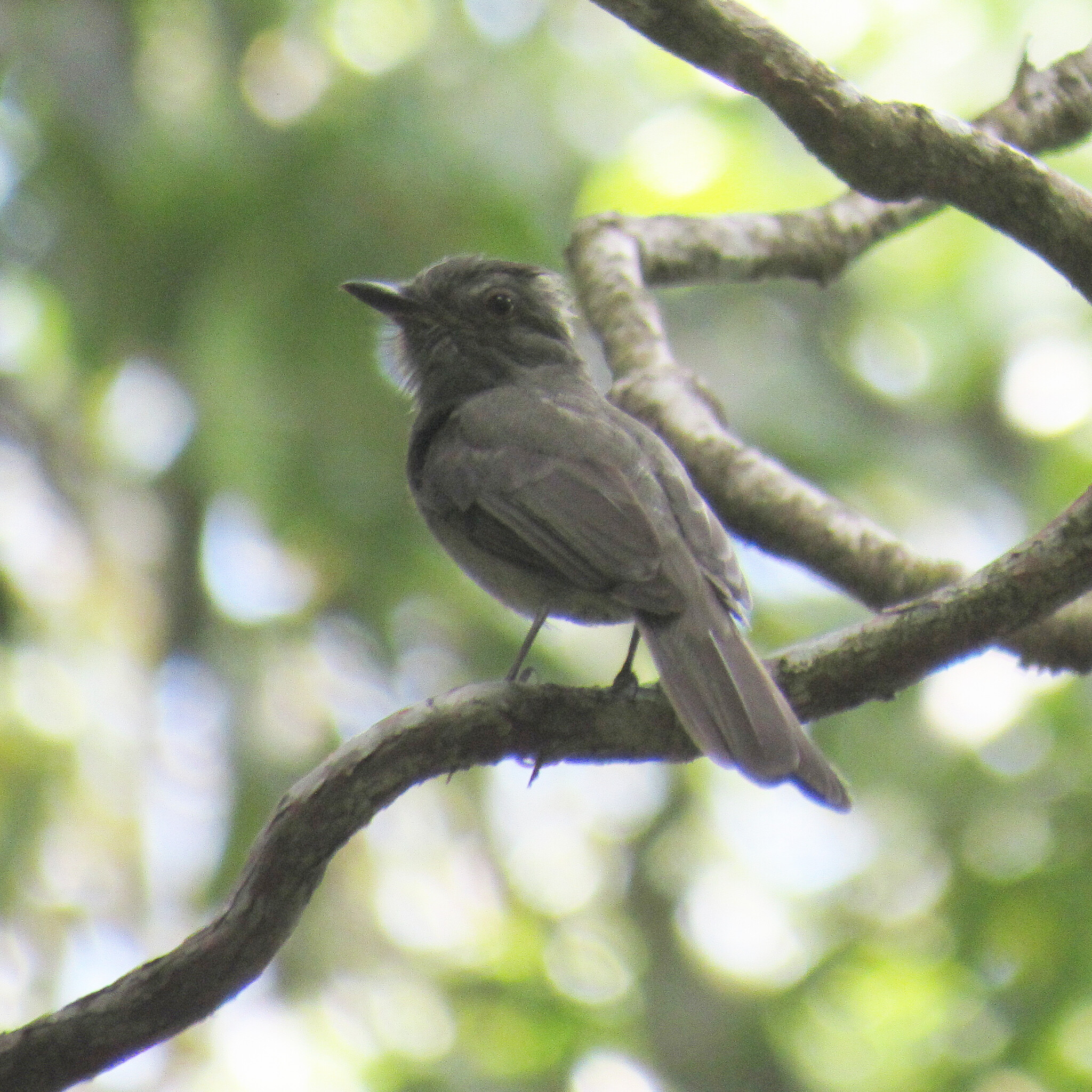
Greyish Mourner is a uniformly grey flycatcher of the middle storey of humid lowland forest, in Amazonia and in the Atlantic Forest. Its plumage offers little to go on, but its song, a rising and accelerating series of notes with a sharp ending, is a familiar sound in the forest. It often travels with mixed flocks.
Voice
A rising, accelerating series of short notes ending in a sharp, explosive chew-eet or wi-choo; also a rolling, husky prrr. It calls frequently, even in the middle of the day.
Recording: JAYRSON ARAUJO DE OLIVEIRA — CC BY-NC-SA 4.0 · xeno-canto
Identification
20–21 cm. Entirely grey with a faint olive tinge, the belly slightly paler and sometimes yellowish grey. Crown feathers slightly erectile, giving the head a full look. Wings and tail darker greyish brown, without wing bars. Iris reddish brown in adults. Bill blackish, fairly broad with a small hook. Sexes alike; juveniles have rufous edges to wing and tail feathers and a dark iris.
Confusion species
Cinereous Mourner Laniocera hypopyrra has rows of cinnamon spots on the wing coverts and a dark iris. Screaming Piha Lipaugus vociferans is larger and longer-tailed, with a much louder, whistled call. Pale-bellied Mourner Rhytipterna immunda is browner, with rufous edges to wings and tail and a yellowish belly, and lives in white-sand forest. Cinereous Becard Pachyramphus rufus is smaller, with a black cap.
Habitat
Middle storey and lower canopy of humid terra firme forest, less in várzea and older secondary forest; in the Atlantic Forest in lowland forest and low hills. Mostly below 1000 m. It sits still for long periods and catches insects in short sallies to leaves and branches; it also eats fruit. Often with mixed middle-storey flocks. It nests in a tree cavity.
Where the bird is most at home, classified by the vegetation units of Amazonia and the Guianas.




Range and movements
Brazil: throughout Amazonia and, as a separate population, in the Atlantic Forest from eastern Pernambuco and Alagoas south to about Rio de Janeiro. Venezuela: in the south (Amazonas and Bolívar) and locally in the north-east. Guyana, Suriname and French Guiana: widespread in lowland forest. Outside the guide area from eastern Colombia to Ecuador, Peru and Bolivia.
- Resident
- dark = core range, pale = thinly spread
How and when to look
In terra firme forest around Manaus, in French Guiana or in Atlantic Forest reserves in Bahia, listen for the rising series with the sharp ending. Then follow the mixed flock in the middle storey and look for a quiet, uniformly grey bird on a horizontal branch.
Conservation status
Least Concern. In Amazonia the species is widespread. The Atlantic Forest population is fragmented by deforestation and lives mainly in larger forest remnants.
Scientific name
Rhytipterna simplex | (Lichtenstein, 1823)
Lichtenstein described the species in 1823 as M[uscicapa] simplex; because it was later moved to another genus, the author and year stand in brackets. The genus Rhytipterna was introduced in 1850 by Reichenbach. Rhytipterna is Greek, from rhutis 'wrinkle' and pterna 'heel', after the corrugations Reichenbach depicted on the rear of the tarsus. simplex is Latin for 'simple, plain', after the uniform grey plumage without markings. The specimen the first description was based on came from Bahia, Brazil.