All species › Passerines › Tyrant flycatchers and allies › Guianan Tyrannulet
Guianan Tyrannulet | Zimmerius acer
Guyanavliegenpikker | Mosquerito guayanés | Poiaeiro-da-guiana
The Guianan Tyrannulet is a small, olive-green tyrant flycatcher of the canopy of humid lowland forest in northeastern South America, and endemic to the guide area. It was long treated as a subspecies of Slender-footed Tyrannulet, but differs mainly in voice; a DNA study from 2008 led to its recognition as a separate species. It usually sits high in the canopy and eats many mistletoe berries.
Voice
The dawn song is a fast series of cricket-like notes. By day it gives a repeated series of two to four short, hard whistles, the first descending and the last ones higher. The call north of the Amazon is a double chu-chup, south of the river a single chup.
Recording: JAYRSON ARAUJO DE OLIVEIRA — CC BY-NC-SA 4.0 · xeno-canto
Identification
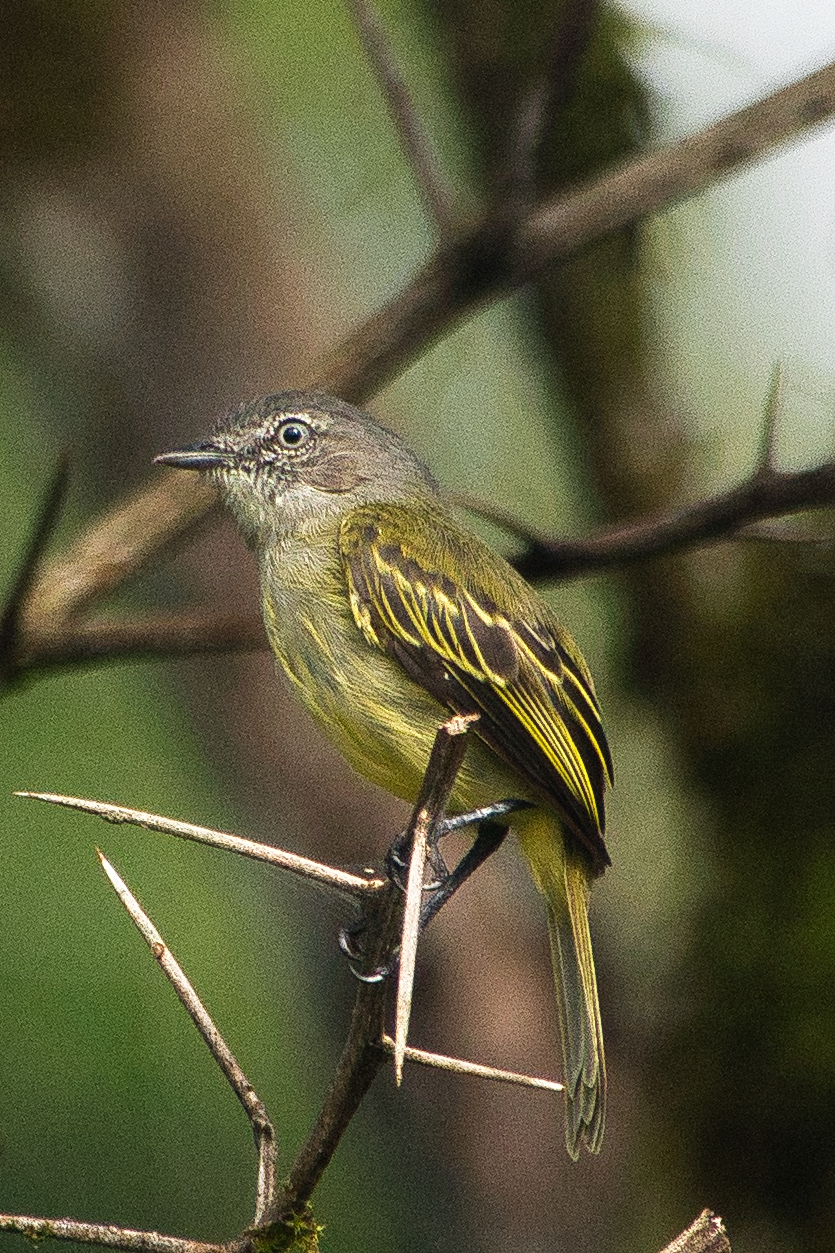
10–11.5 cm, with a small, rounded black bill and a fairly long tail that is often slightly cocked. Forehead and crown are grey, with a thin whitish supercilium and a dark eye-stripe on an almost white face. Back and rump are dull olive-green. The wings are dusky with thin yellow edges to the coverts and flight feathers, without true wing bars. The throat is almost pure white, the breast pale olive-yellow, belly and undertail coverts pale yellow. The iris is grey or dark brown. The sexes are alike.
Confusion species
Slender-footed Tyrannulet Zimmerius gracilipes is very similar and in the field is told mainly by voice and range; it lives west of the Rio Negro and the Rio Tapajós and has a more yellowish throat. Sooty-headed Tyrannulet Phyllomyias griseiceps has a greyer head without a distinct supercilium and lacks the yellow edges on the wings. Southern Beardless Tyrannulet Camptostoma obsoletum has a ragged crest, ochre wing bars and a pale bill base.
Habitat
The canopy and edges of humid lowland forest, both terra firme and várzea, as well as clearings, secondary forest and trees in towns and cities; mostly below 500 m, in Venezuela to about 1000 m and locally to 1400 m. It eats small insects and many berries, especially of mistletoes, and often joins mixed flocks in the canopy. The nest is a ball with a side entrance, often in moss or epiphytes.
Where the bird is most at home, classified by the vegetation units of Amazonia and the Guianas.






Range and movements
Venezuela: in the east and southeast, in Bolívar. Guyana, Suriname and French Guiana: throughout the forested area, from the coastal plain to the interior. Brazil: in northern and eastern Amazonia, north of the Amazon east of the Rio Negro, and south of the river east of the Rio Tapajós to Maranhão and the coast of Ceará, south to northern Mato Grosso; also isolated populations in the Atlantic Forest from Rio Grande do Norte to Alagoas. Does not occur outside the guide area.
- Resident
- dark = core range, pale = thinly spread
How and when to look
Found by its call in the canopy along forest edges, clearings and forest trails, for example around Manaus, near Belém or in the forests of Suriname and French Guiana. It often sits high in trees with mistletoe; a canopy tower helps.
Conservation status
Least Concern. Widespread and fairly common; it also uses secondary forest and trees in built-up areas. The isolated populations in northeastern Brazil depend on small forest remnants.
Scientific name
Zimmerius acer | (Salvin & Godman, 1883) (GBIF: Zimmerius gracilipes)
Salvin & Godman described the species in 1883 as Tyranniscus acer; because it was later moved to another genus, the author and year stand in brackets. The genus Zimmerius was introduced in 1977 by Traylor. Zimmerius honours the American ornithologist John Todd Zimmer (1889–1957), an authority on South American birds. acer is Latin for 'sharp, shrill, penetrating', probably after the call. The specimen the first description was based on came from Bartica Grove, Guyana.