All species › Woodpeckers and allies › Woodpeckers › Helmeted Woodpecker
Helmeted Woodpecker | Celeus galeatus
Helmspecht | Carpintero cara canela | Pica-pau-de-cara-canela
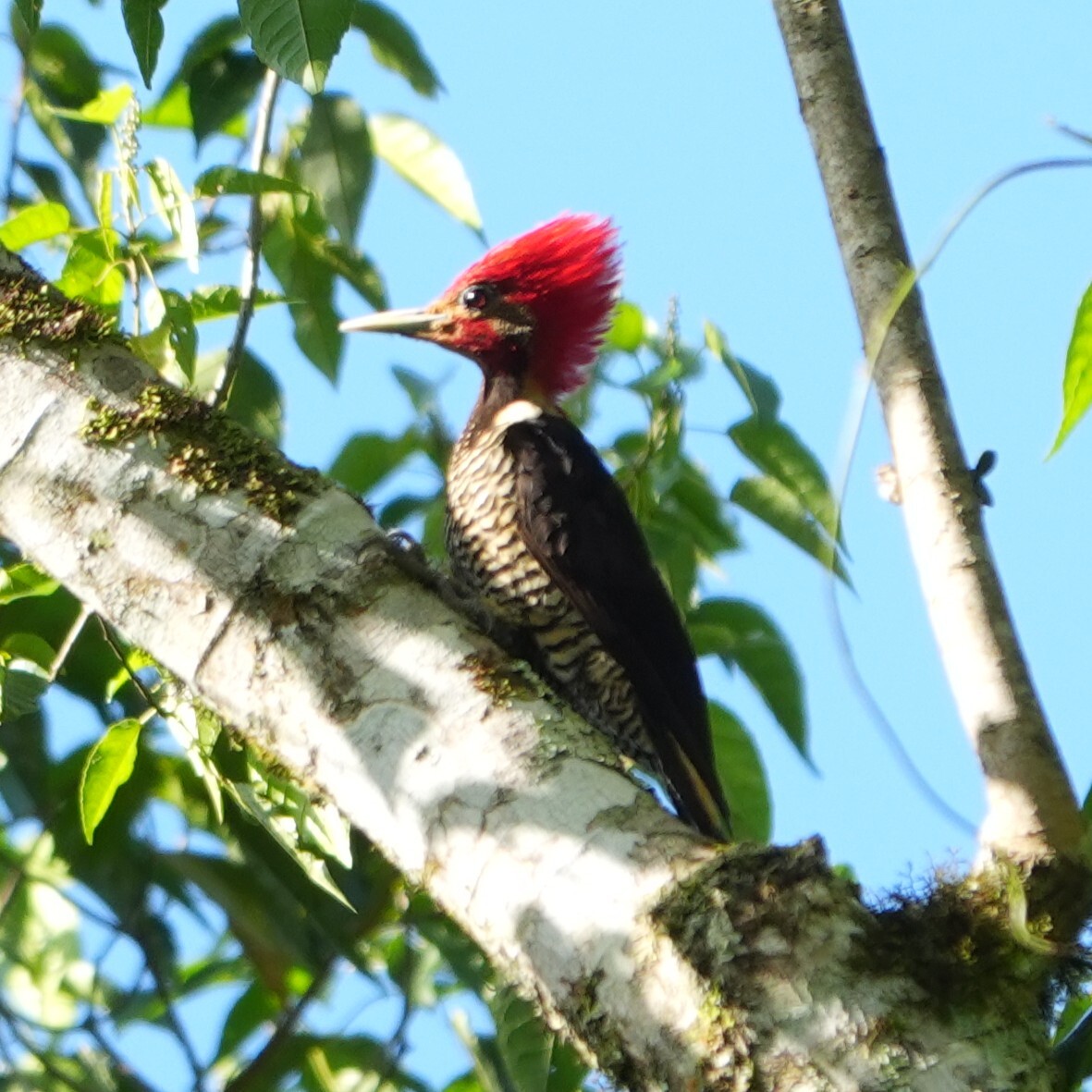
Helmeted Woodpecker is a medium-sized woodpecker of the interior Atlantic Forest, with a red crest and a cinnamon face. It closely resembles the larger Lineated and Robust Woodpeckers, which live in the same forest. It occurs only in large, unbroken forests and is vulnerable to forest loss.
Voice
Calls infrequently. The long call is a loud series of four to ten notes that carries more than 500 m; also a mournful, descending call. Drums softly and briefly.
Recording: Fabrice Schmitt — CC BY-NC-SA 4.0 · xeno-canto
Identification
25–27 cm, with a long red crest and a pale, horn-coloured bill. The face is cinnamon, the throat and hindneck are black, with a white stripe along the side of the neck. The back is dark, the lower back and rump pale cream-yellow. The underparts are pale yellow to cream with dense black bars. The tail is black. The male has a red malar stripe that runs along the sides of the throat and joins the crest behind the head; the female has only the red crest.
Confusion species
Lineated Woodpecker Dryocopus lineatus is larger, with a black face with a white stripe, white lines on the back and an unbarred black breast. Robust Woodpecker Campephilus robustus is much larger, with an all-red head and a pale cream back. Blond-crested Woodpecker Celeus flavescens has a pale yellow head and crest with no red, except the male's malar stripe.
Habitat
Large tracts of humid and seasonal Atlantic Forest and araucaria forest, from sea level up to about 1000 m; rarely in fragmented or disturbed forest and plantations of exotic trees. It forages mainly in the mid-storey, alone or in pairs, sometimes with mixed flocks, and probes soft, decaying wood. It eats insect larvae, less often ants and berries. It nests in a self-excavated hole in a dead branch or trunk, 2 to 5 m up; egg laying probably begins in late September.
Where the bird is most at home, classified by the vegetation units of Amazonia and the Guianas.




Range and movements
In Brazil only in the south and south-east: in interior São Paulo, in Paraná and Santa Catarina; formerly possibly also in Rio Grande do Sul. Not in Venezuela or the Guianas. Outside the guide area in the eastern half of Paraguay and in Misiones in north-eastern Argentina.
- Resident
- dark = core range, pale = thinly spread
How and when to look
Search large forest areas, such as around the Iguaçu Falls in Paraná and the large forest reserves of interior São Paulo. The bird often sits still in the mid-storey; the loud call series gives it away more often than its drumming.
Conservation status
Vulnerable. The world population is estimated at about 3600 mature birds and is declining. The Atlantic Forest has been cleared and fragmented on a large scale for timber, farming, ranching and pine plantations, and the species depends on large dead trees for foraging and nesting.
Scientific name
Celeus galeatus | (Temminck, 1822)
Temminck described the species in 1822 as Picus galeatus; because it was later moved to another genus, the author and year stand in brackets. The genus Celeus was introduced in 1831 by Boie. Celeus comes from Greek keleos, a name for a green woodpecker. galeatus is Latin for 'helmeted', from galea 'helmet', after the tall red crest. The specimen the first description was based on came from Brazil (not specified further).