All species › Passerines › Ovenbirds and woodcreepers › Hoffmanns's Woodcreeper
Hoffmanns's Woodcreeper | Dendrocolaptes hoffmannsi
Hoffmanns' muisspecht | Trepatroncos de Hoffmanns | Arapaçu-marrom
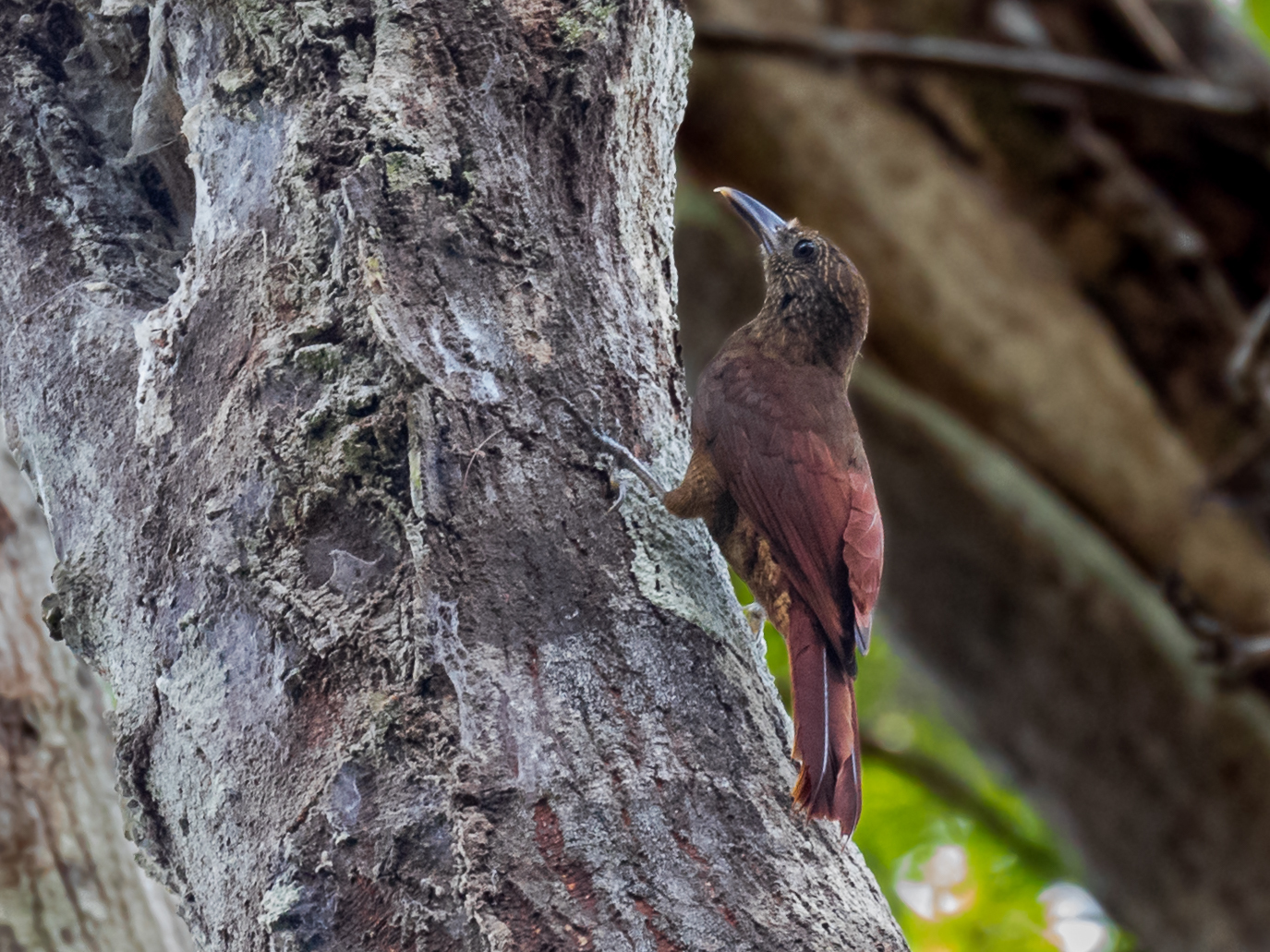
Hoffmanns's Woodcreeper is a large, almost uniformly rufous-brown woodcreeper found only in Brazil, south of the Amazon between the Rio Madeira and the Tapajós and Xingu region. It regularly follows army-ant swarms. Because of rapid deforestation in its small range it was listed as Vulnerable on the Red List for years.
Voice
The song is an even, fast series of up to about twenty short wut-wut-wut notes, mainly at dawn. Also short, nasal calls and snarling sounds at ant swarms.
Recording: Dante Buzzetti — CC BY-NC-SA 4.0 · shortened to the first 60 s, mono · xeno-canto
Identification
27–29 cm, with a straight, stout, dark bill. Forehead and crown reddish brown with blackish feather tips, grading to rufous-brown on the nape and back; rump, wings and tail cinnamon to chestnut. Face dark ochre with a faint supercilium. Throat and underparts dull ochre-brown, with faint pale streaks on the breast and faint dusky bars on the belly and flanks. The sexes are alike; juveniles are redder above.
Confusion species
Amazonian Barred Woodcreeper Dendrocolaptes certhia occurs in the same area; birds there are faintly barred, but have a less reddish crown and a plain brown face. Black-banded Woodcreeper Dendrocolaptes picumnus has a clearly streaked head and breast and black bars on the belly. Red-billed Woodcreeper Hylexetastes perrotii has a thick, red bill.
Habitat
The interior of humid lowland forest, both terra firme and várzea, also forest edges and older secondary forest. It forages in the lower and middle strata, often at army-ant swarms together with other woodcreepers and antbirds. It nests in a tree cavity.
Where the bird is most at home, classified by the vegetation units of Amazonia and the Guianas.



Range and movements
Brazil: only south of the Amazon, from the Rio Madeira east to the Tapajós and Xingu region, south into Rondônia and northern Mato Grosso; endemic to Brazil. Absent from Venezuela, Guyana, Suriname and French Guiana.
- Resident
- dark = core range, pale = thinly spread
How and when to look
Look at army-ant swarms in large, undisturbed forest in Rondônia, southern Amazonas or northern Mato Grosso, for example along the Tapajós. The even song at dawn helps to find it.
Conservation status
Least Concern according to the most recent assessment; previously assessed as Vulnerable. Its range lies largely in the arc of deforestation along the southern edge of the Amazon basin, where roads, cattle ranching and soy farming are rapidly fragmenting the forest.
Scientific name
Dendrocolaptes hoffmannsi | Hellmayr, 1909
Hellmayr described the species in 1909 and placed it straight away in the genus where it still stands. The genus Dendrocolaptes was introduced in 1804 by Hermann. Dendrocolaptes is Greek, from dendron 'tree' and kolaptēs 'chiseller, pecker': 'tree-pecker', after its foraging on trunks. hoffmannsi is after the German collector Wilhelm Hoffmanns (1865–1909), who collected birds in Peru and Brazil. The specimen the first description was based on came from Calama, Rio Madeira at the mouth of the Ji-Paraná, Rondônia, Brazil.