All species › Passerines › Ovenbirds and woodcreepers › Hudson's Canastero
Hudson's Canastero | Asthenes hudsoni
Hudsons canastero | Espartillero pampeano | João-platino
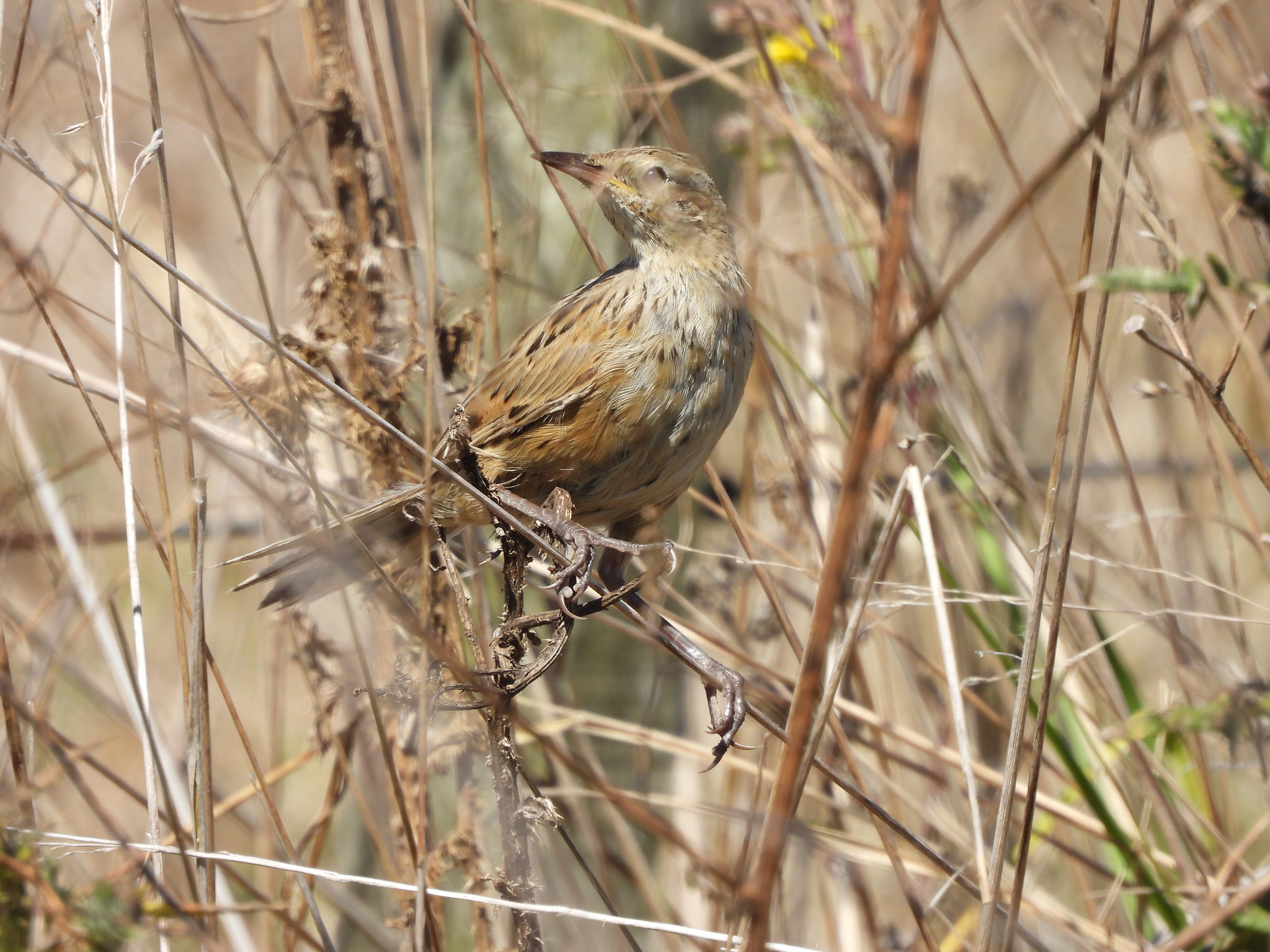
Hudson's Canastero is a streaked canastero of tall grassland near marshes in the pampas. In the guide area a small, isolated breeding population lives in south-eastern Rio Grande do Sul. The species was long considered resident, but research has shown that a large part of the Argentine birds moves north in the austral winter.
Voice
The song is a short, ascending trill, given from a grass stem or small shrub.
Recording: Bernabe Lopez-Lanus — CC BY-NC-SA 3.0 · shortened to the first 60 s, mono · xeno-canto
Identification
18 cm, with a rather long bill and a long, pointed tail. The upperparts are drab sandy brown with conspicuous blackish and silvery streaks. A narrow pale buff supercilium. Throat, breast and belly are buff, richer on the sides and flanks, which are streaked blackish. The sexes are alike. Juveniles have blackish-brown streaks on the breast and sides.
Confusion species
Bay-capped Wren-Spinetail Spartonoica maluroides is smaller, with a rufous crown, and lives in reeds and rushes. Wren-like Rushbird Phleocryptes melanops has a shorter tail, a white supercilium and a black-and-white patterned back. Straight-billed Reedhaunter Limnoctites rectirostris has a long, straight bill and an unstreaked back. Grass Wren Cistothorus platensis is smaller, with a short, barred tail that is often cocked.
Habitat
Grassland with tall tussocks, such as Paspalum quadrifarium, and sedges, usually near fresh or brackish marshes, interspersed with short turf or bare ground, in the lowlands. It forages low in the grass and on the ground for insects and usually stays hidden. Little is known about its nest in the guide area.
Where the bird is most at home, classified by the vegetation units of Amazonia and the Guianas.


Range and movements
Brazil: only in south-eastern Rio Grande do Sul, on the coastal plain, as a small, isolated breeding population. Not in Venezuela or the Guianas. Outside the guide area in Uruguay, mainly as a winter visitor, and in eastern Argentina, where most birds breed in the pampas of Buenos Aires.
- Resident
- dark = core range, pale = thinly spread
How and when to look
Search in south-eastern Rio Grande do Sul in grassland with tall tussocks along marshes. In the breeding season (about Sep–Jan) the bird sings its short trill from a protruding grass stem; at other times it stays low in the grass.
Conservation status
Near Threatened. The population is unknown and probably declining. Grassland is lost to drainage, conversion to cropland and rice fields, and building. The discovery that the species migrates calls for a new assessment of its population.
Scientific name
Asthenes hudsoni | (Sclater, 1874)
Sclater described the species in 1874 as Synallaxis hudsoni; because it was later moved to another genus, the author and year stand in brackets. The genus Asthenes was introduced in 1853 by Reichenbach. Asthenes is Greek for 'insignificant, weak', from a- 'not' and sthenos 'strength', after the drab little brown birds. hudsoni honours the Anglo-Argentine naturalist and writer William Henry Hudson (1841–1922), who grew up on the pampas. The specimen the first description was based on came from Conchitas, Buenos Aires province, Argentina.