All species › Passerines › Tyrant flycatchers and allies › Large-headed Flatbill
Large-headed Flatbill | Ramphotrigon megacephalum
Wenkbrauwbreedbektiran | Picoplano cabezón | Maria-cabeçuda
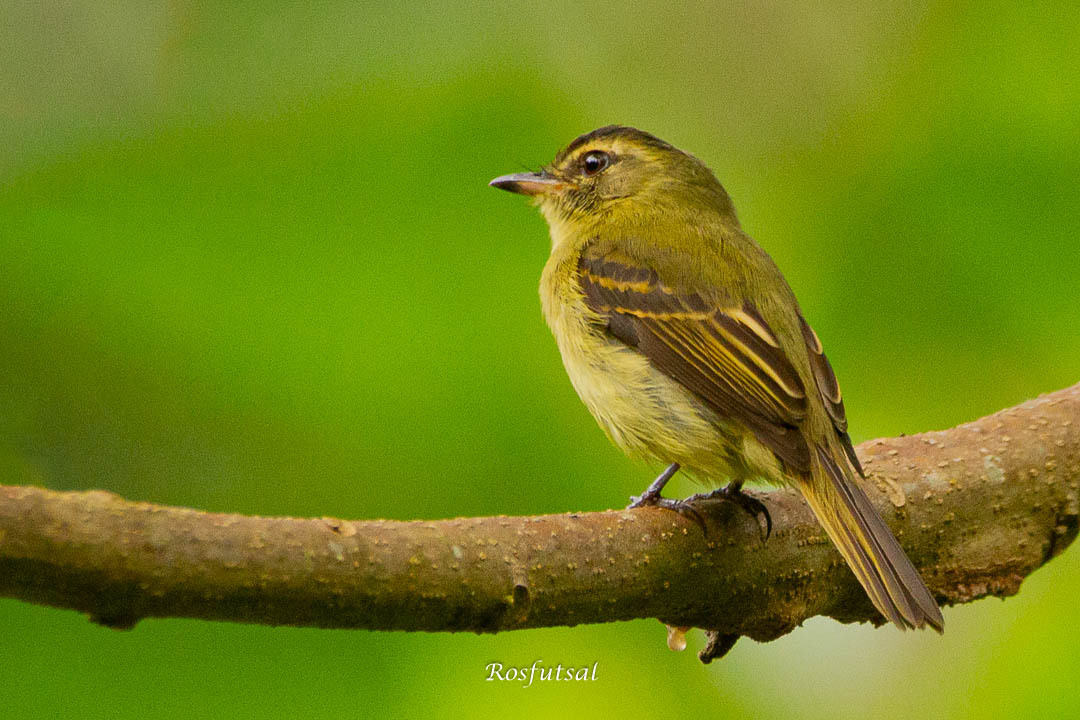
The Large-headed Flatbill is an olive tyrant flycatcher with a large head, a broad, flat bill and a pale streak above the lores. It is almost always found in or near bamboo. It often sits still for long periods and is mostly noticed by its soft, two-note call.
Voice
The dawn song is a rapid, continuous series of whistles such as tee-tu-twit or whu hu-hoowhip; the call is a soft, mournful whistled wheé-whoo, often rendered as bam-boo.
Recording: Juan Freile — CC BY-NC-SA 4.0 · shortened to the first 60 s, mono · xeno-canto
Identification
13 cm, with a relatively large head and a flat black bill with a dull pinkish base to the lower mandible. Crown and upperparts dark olive; lores dusky, with a whitish to yellowish streak above them and a whitish to yellowish eye-ring. Wings dark with yellow-olive edges to the flight feathers and two ochraceous wing bars; tail dark with yellow-olive edges. Throat whitish to yellowish, breast greyish-olive with faint yellow streaks, belly yellow. Iris brown. Sexes alike.
Confusion species
Rufous-tailed Flatbill Ramphotrigon ruficauda is larger, with rufous wing edgings and tail. Dusky-tailed Flatbill Ramphotrigon fuscicauda is larger and darker, with cinnamon wing bars and a less distinct streak above the lores; it too often lives in bamboo. Yellow-margined Flatbill Tolmomyias assimilis has a greyer head, a yellow patch at the base of the primaries and a different voice. Flammulated Bamboo Tyrant Hemitriccus flammulatus, also in bamboo, is smaller, with a narrow bill and a streaked breast.
Habitat
Bamboo (mainly Guadua in western Amazonia, other bamboos in the Atlantic Forest and the interior) in humid forest, seasonal forest and gallery forest, and at forest edges; from the lowlands into the low mountains. It perches for long periods in the understorey and middle storey and takes insects from leaves and branches after a short sally, often hovering briefly; usually alone, sometimes in mixed flocks. The nest is a bulky structure of plant material in a cavity in a tree or bamboo stem; the clutch is usually two eggs.
Where the bird is most at home, classified by the vegetation units of Amazonia and the Guianas.





Range and movements
Brazil: in three parts: western Amazonia (Acre, southern Amazonas, Rondônia and Mato Grosso), the interior (Goiás, Distrito Federal, Tocantins and Minas Gerais) and the Atlantic Forest from Bahia south to Santa Catarina; most records come from São Paulo and Minas Gerais. Venezuela: locally at the foot of the Andes in the west and in the south in Amazonas and Bolívar. Guyana and Suriname: a few records. Not known from French Guiana. Outside the guide area in Colombia, Ecuador, Peru, Bolivia, Paraguay and Misiones in Argentina.
- Resident
- dark = core range, pale = thinly spread
How and when to look
Search bamboo thickets at forest edges and along streams in the interior of São Paulo or Minas Gerais, or the Guadua bamboo forest of Acre, and listen for the soft, two-note call.
Conservation status
Least Concern. The range is very large, but the population is thought to be decreasing through forest loss. The species depends on bamboo, which dies back locally after mass flowering.
Scientific name
Ramphotrigon megacephalum | (Swainson, 1835)
Swainson described the species in 1835 as Tyrannula megacephala; because it was later moved to another genus, the author and year stand in brackets. The genus Ramphotrigon was introduced in 1855 by Gray. Ramphotrigon is Greek, from rhamphos 'bill' and trigōnon 'triangle', after the broad, triangular bill. megacephalum is Greek for 'large-headed', from megas 'great' and kephalē 'head', after the conspicuously large head. The specimen the first description was based on came from São Paulo, Brazil.