All species › Swifts › Swifts › Lesser Swallow-tailed Swift
Lesser Swallow-tailed Swift | Panyptila cayennensis
Cayennegierzwaluw | Vencejo tijereta menor | Andorinhão-estofador
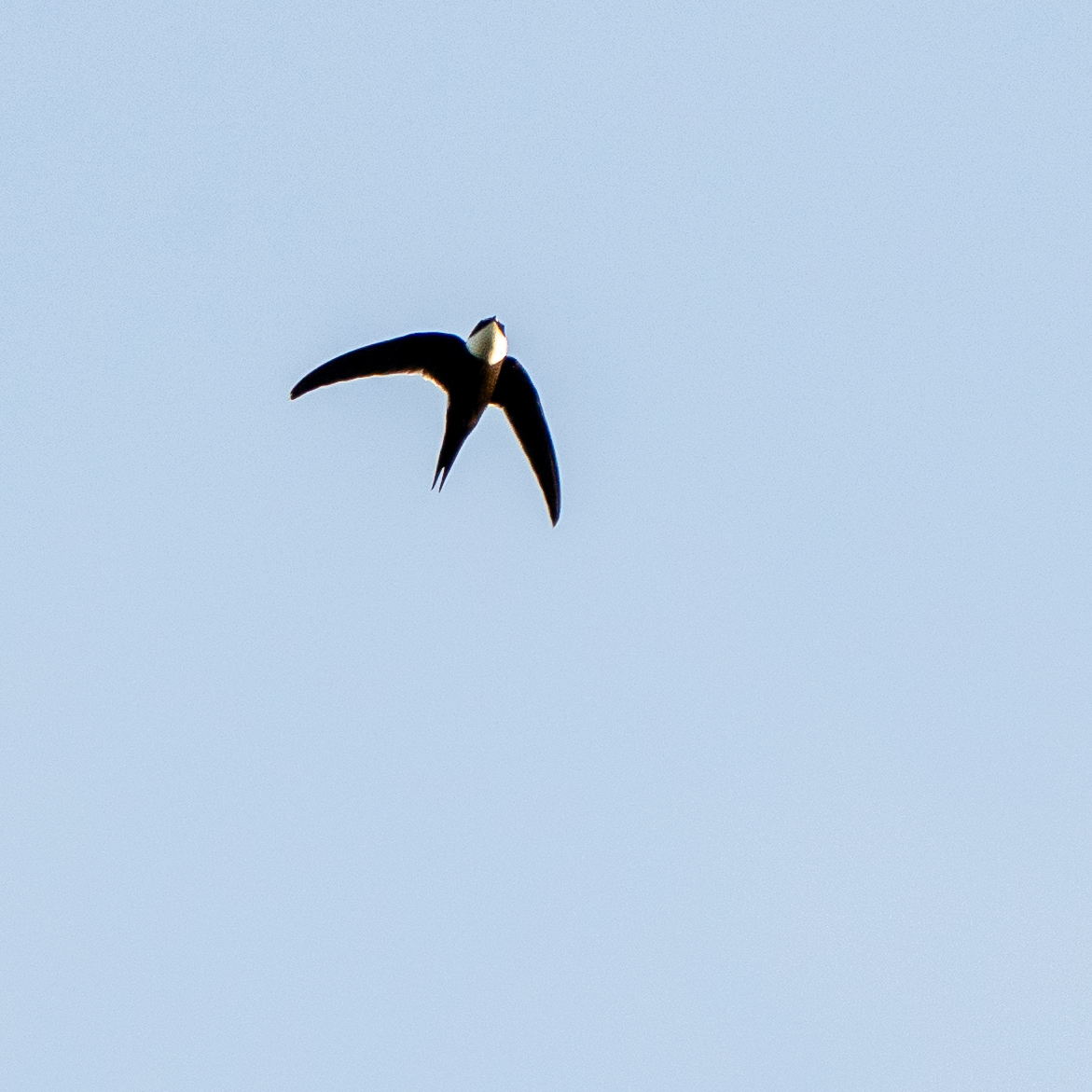
Lesser Swallow-tailed Swift is a slender, black-and-white swift with a long, usually closed tail that projects behind the bird as a thin point. Its nest is a long, hanging tube of plant down and saliva, glued to a tree trunk, a rock face or a building, with an entrance at the bottom. It usually flies singly or in pairs, often high over the forest.
Voice
Mostly silent. At the nest and in flight sometimes a high, thin, buzzy call.
Recording: Dante Buzzetti — CC BY-NC-SA 4.0 · xeno-canto
Identification
13 cm, with narrow, slightly curved wings and a long, deeply forked tail that opens when the bird turns. The plumage is black, with a white throat and upper breast continuing as a narrow white collar across the nape, a white patch on the rear flanks and a narrow white edge to the inner secondaries. The sexes are alike.
Confusion species
Fork-tailed Palm Swift Tachornis squamata is smaller and browner, with a greyish white throat and belly and no collar. White-tipped Swift Aeronautes montivagus has a white throat and white flank patches but no collar and a shorter, less forked tail, and lives higher in the mountains. White-collared Swift Streptoprocne zonaris is much larger, with a short tail.
Habitat
Humid lowland forest, forest edges, clearings, riverbanks and villages, also the lower slopes up to about 1000 m, locally higher. It hunts flying insects in the air, often high above the canopy. The tubular nest, often several tens of centimetres long, hangs from a tree trunk, an overhanging rock or a building.
Where the bird is most at home, classified by the vegetation units of Amazonia and the Guianas.





Range and movements
In Brazil throughout Amazonia and in the Atlantic Forest along the east coast, from the north-east south to about Santa Catarina. In Venezuela in the lowlands south of the Orinoco and locally in the north and the Maracaibo basin. In Guyana, Suriname and French Guiana scattered in the coastal belt and the forested interior. Outside the guide area from southern Mexico through Central America to Colombia, Ecuador, Peru and Bolivia, and on Trinidad.
- Resident
- dark = core range, pale = thinly spread
How and when to look
Look for the birds high over forest edges and rivers, often singly or in twos; the long, pointed tail and the white collar are then the main features. A nest tube under a bridge or eave sometimes marks a regular site.
Conservation status
Least Concern. The species is widespread and also uses buildings and bridges as nest sites.
Scientific name
Panyptila cayennensis | (Gmelin, 1789)
Gmelin described the species in 1789 as Hirundo cayennensis; because it was later moved to another genus, the author and year stand in brackets. The genus Panyptila was introduced in 1847 by Cabanis. Panyptila is Greek, from panu 'exceedingly, wholly' and ptilon 'feather': 'well-feathered', after the legs feathered down to the toes. cayennensis refers to Cayenne in French Guiana, where the species was described. The specimen the first description was based on came from Cayenne, French Guiana.