All species › Passerines › Ovenbirds and woodcreepers › Lineated Foliage-gleaner
Lineated Foliage-gleaner | Syndactyla subalaris
Gestreepte bladspeurder | Limpiafronda lineada | Limpa-folha-raiado
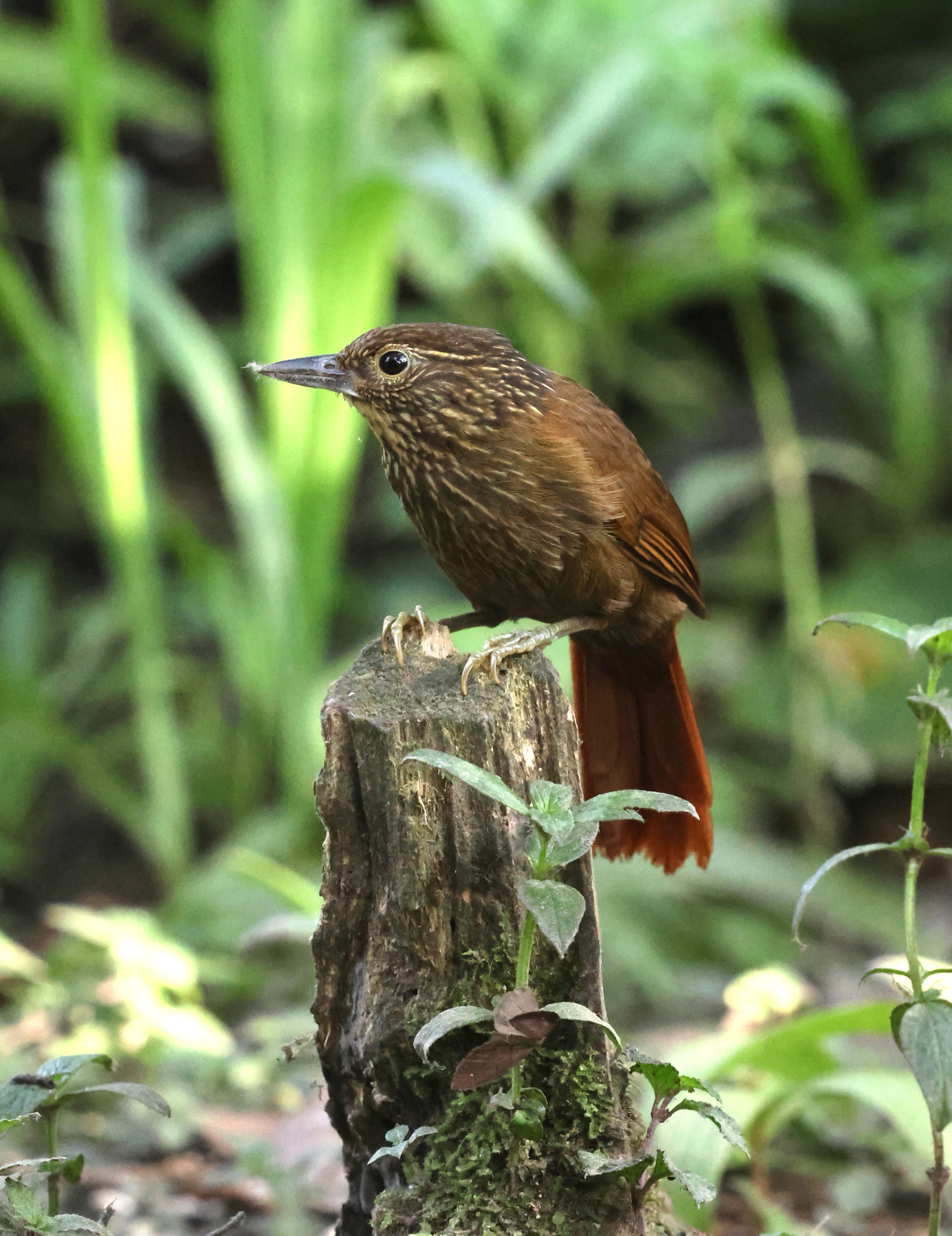
The Lineated Foliage-Gleaner is a dark brown, finely streaked foliage-gleaner of the understorey and mid-storey of humid montane forest. It rummages noisily through dead leaves and vine tangles, often in mixed flocks. In the guide area it lives only in the Venezuelan Andes and the Serranía de Perijá.
Voice
The song is a loud, dry, accelerating series of short, rasping, nasal notes that ends abruptly. The call is a hoarse, nasal kshek.
Recording: Juan Freile — CC BY-NC-SA 4.0 · converted to mono · xeno-canto
Identification
18–19 cm. Upperparts dark olive-brown with narrow pale streaks on crown, nape and mantle. A narrow ochre supercilium. Throat ochre. Underparts olive-brown with narrow ochre streaks, especially on the breast. Tail rufous. Bill fairly long and straight, with a pale lower mandible. Male and female alike.
Confusion species
Guttulate Foliage-Gleaner Syndactyla guttulata of the coastal range has an ochre throat and drop-shaped spots instead of streaks on the breast; the two species do not occur together. Flammulated Treehunter Thripadectes flammulatus is larger, with a heavier bill and a strongly black-and-ochre flammulated head and breast. Streak-Capped Treehunter Thripadectes virgaticeps is larger, with a stout bill and a streaked head but a plainer back. Montane Foliage-Gleaner Anabacerthia striaticollis is smaller, with whitish spectacles and an unstreaked back.
Habitat
Understorey and mid-storey of humid, mossy montane and cloud forest, especially in dense growth with lianas and bamboo, also forest edges, in Venezuela at about 1200 to 2500 m. It searches hanging dead leaves, moss and epiphytes for insects and other arthropods, often in mixed flocks. The nest is at the end of a burrow in an earth bank.
Where the bird is most at home, classified by the vegetation units of Amazonia and the Guianas.

Range and movements
Venezuela: in the Serranía de Perijá and in the Andes of Táchira, Mérida and Trujillo, with rather few records. Not in Brazil or the Guianas. Outside the guide area in the mountains of Costa Rica and Panama and in the Andes of Colombia and Ecuador to Peru.
- Resident
- dark = core range, pale = thinly spread
How and when to look
Look in mixed flocks in the cloud forest of the Andes of Táchira and Mérida. Watch for a streaked brown bird rustling through dead leaves in the understorey; the song is often the first sign.
Conservation status
Least Concern (IUCN). Fairly common in suitable montane forest within its range; clearing of mountain slopes is a local threat.
Scientific name
Syndactyla subalaris | (Sclater, 1859)
Sclater described the species in 1859 as Anabates subalaris; because it was later moved to another genus, the author and year stand in brackets. The genus Syndactyla was introduced in 1853 by Reichenbach. Syndactyla is Greek, from sun 'together' and daktulos 'toe', after the outer toe being fused to the middle toe up to the first joint. subalaris is Latin for 'under the wings', after the dark fawn underwing coverts noted by the describer. The specimen the first description was based on came from Pallatanga, Ecuador.