All species › Passerines › Ovenbirds and woodcreepers › Little Thornbird
Little Thornbird | Phacellodomus sibilatrix
Kleine stekelkruin | Espinero chico | Tio-tio-pequeno
The Little Thornbird is the smallest species of the genus Phacellodomus, a bird of the Chaco and adjacent dry woodland and parkland. In the guide area it is scarce and known only from far southwestern Rio Grande do Sul. Like other thornbirds it builds a nest of thorny sticks.
Voice
Pairs sing in duet a series of rapid, sharp, piercing notes, one bird singing faster than the other. The call is a sharp, often repeated chip.
Recording: Franco Vushurovich — CC BY-NC-SA 4.0 · xeno-canto
Identification
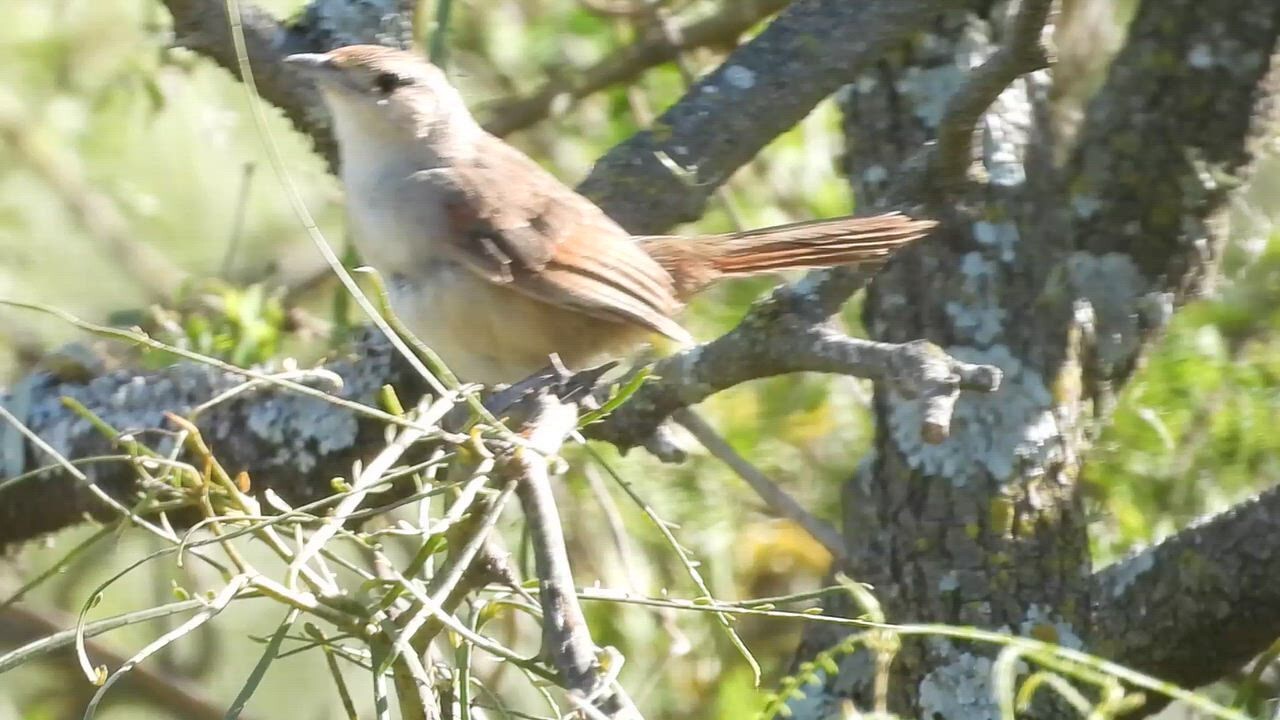
13–14 cm; a small, greyish-brown ovenbird with a straight, pointed bill. The forehead is pale rufous with fine pale streaks, the crown and back are dull brown. A broad, dull buffy-white supercilium. The outer tail feathers are bright rufous. The underparts are dingy white. The sexes are alike.
Confusion species
Freckle-breasted Thornbird Phacellodomus striaticollis is larger, with a rufous crown, a freckled breast and a rufous tail, and lives close to water. Stripe-crowned Spinetail Cranioleuca pyrrhophia has a streaked crown, a white supercilium and a rufous tail with spiny tips. Lark-like Brushrunner Coryphistera alaudina lives in the same parkland, but is larger, crested and streaked below.
Habitat
Dry woodland, Chaco woodland, savanna with scattered trees and scrub; in Rio Grande do Sul in espinilho parkland at low elevation. It forages in pairs or small groups in trees and shrubs for insects. The nest is a cone of thorny twigs up to about 40 cm tall, with a softly lined chamber, hanging from the tip of a branch, usually in an isolated tree or a small group of trees. Clutch usually 3 eggs.
Where the bird is most at home, classified by the vegetation units of Amazonia and the Guianas.


Range and movements
In Brazil known only from far southwestern Rio Grande do Sul, around Barra do Quaraí; scarce there. Not in the rest of Brazil, and not in Venezuela or the Guianas. Outside the guide area in northern and central Argentina, western Paraguay, southern Bolivia and western Uruguay.
- Resident
- dark = core range, pale = thinly spread
How and when to look
Search the espinilho parkland near Barra do Quaraí for small nests of thorny twigs at the tips of branches of isolated trees, and listen for the rapid duet.
Conservation status
Least Concern (IUCN). In Brazil only in a small area where the espinilho woodland has shrunk through conversion to cropland and pasture; widespread outside Brazil.
Scientific name
Phacellodomus sibilatrix | Sclater, 1879
Sclater described the species in 1879 and placed it straight away in the genus where it still stands. The genus Phacellodomus was introduced in 1853 by Reichenbach. Phacellodomus is Greek, from phakelos 'bundle (of sticks)' and domos 'house', after the large nests of bundled twigs. sibilatrix is Latin for 'whistler' (feminine), from sibilare 'to whistle', after the shrill call. The specimen the first description was based on came from presumably Córdoba, Argentina.