All species › Passerines › Ovenbirds and woodcreepers › Long-tailed Cinclodes
Long-tailed Cinclodes | Cinclodes pabsti
Pabsts wipstaart | Remolinera colilarga | Pedreiro
The Long-Tailed Cinclodes is the only cinclodes found solely in Brazil, far from the Andes where most of its relatives live. It is larger and longer-tailed than other cinclodes and lives on the high grasslands of the south, often close to farms. Its scientific name honours the German-Brazilian botanist Guido Pabst.
Voice
The song is a loud, fast, somewhat descending trill, often given from a rock, roof or post while the bird raises its wings. The call is a short, sharp cheek.
Recording: JAYRSON ARAUJO DE OLIVEIRA — CC BY-NC-SA 4.0 · xeno-canto
Identification
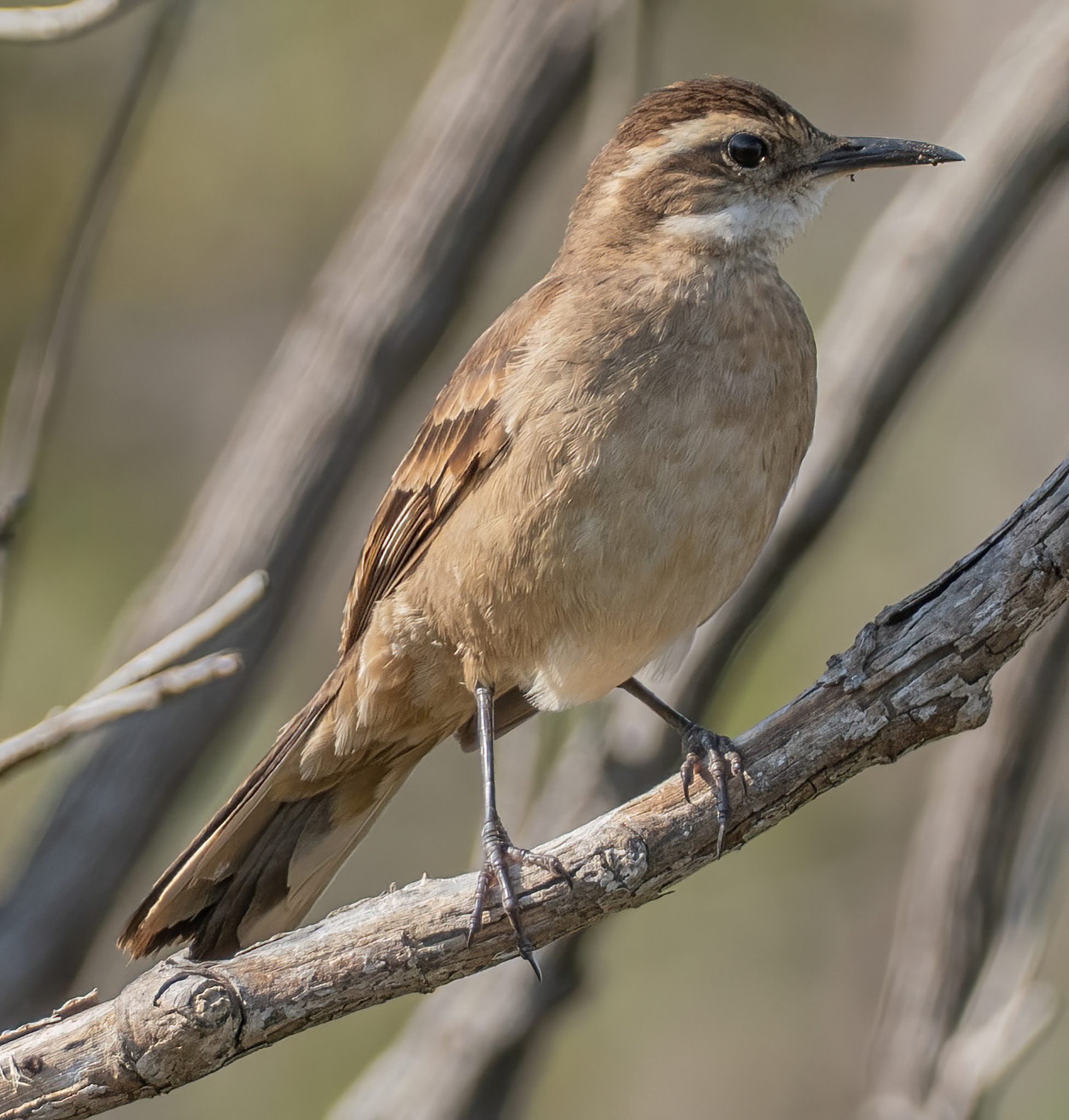
20–22 cm, with a fairly long, straight, dark bill and a long tail. The upperparts are uniform dark greyish brown, with a clear whitish supercilium. The throat is white, breast and belly greyish brown with pale mottling, the undertail coverts paler. In flight a rufous wing band is obvious; the outer tail feathers have pale tips. The sexes are alike. Birds from the Serra do Espinhaço in Minas Gerais are smaller and are sometimes treated as a separate species.
Confusion species
Buff-Winged Cinclodes Cinclodes fuscus, which appears in southern Brazil in the austral winter, is smaller, with a shorter tail, a shorter bill and a pale buff wing band. Common Miner Geositta cunicularia is paler and sandier, with a shorter tail, and lives mainly on short coastal grassland. Firewood-Gatherer Anumbius annumbi has a streaked back and a long, graduated tail.
Habitat
High, short-grazed grassland with rocks, streams and scattered stands of araucaria, and farmyards, pastures and roadsides around farms, mostly between 900 and 1800 m. It forages walking on the ground for insects and other invertebrates, also in dung and around buildings. The nest is in a crevice in a rock or bank, under a roof or in a hole in a wall.
Where the bird is most at home, classified by the vegetation units of Amazonia and the Guianas.



Range and movements
Brazil: endemic to the highlands of Santa Catarina and north-eastern Rio Grande do Sul, locally also in southern Paraná. A small, isolated population lives in the Serra do Espinhaço in Minas Gerais. Not in Venezuela or the Guianas. It does not occur outside the guide area.
- Resident
- dark = core range, pale = thinly spread
How and when to look
Seen on the plateau around São Joaquim and Urubici in Santa Catarina, along the Serra do Rio do Rastro and near Cambará do Sul in Rio Grande do Sul. The birds walk over pastures and farmyards and perch on rocks, posts and roofs.
Conservation status
Near Threatened (IUCN). The range is small, and the high grasslands are being converted to pine plantations and farmland. Because it also lives around farms and in pastures, the threat is locally smaller, but the habitat is shrinking.
Scientific name
Cinclodes pabsti | Sick, 1969
Sick described the species in 1969 and placed it straight away in the genus where it still stands. The genus Cinclodes was introduced in 1840 by Gray. Cinclodes means 'resembling Cinclus' (dipper), with Greek -oidēs 'resembling', after its life along streams and shores. pabsti honours the Brazilian botanist and orchid specialist Guido João Frederico Pabst (1914–1980), founding director of the Herbarium Bradeanum in Rio de Janeiro. The specimen the first description was based on came from between Tainhas and Taimbezinho, north-eastern Rio Grande do Sul, Brazil.