All species › Passerines › Tanagers and allies › Merida Flowerpiercer
Merida Flowerpiercer | Diglossa gloriosa
Méridaberghoningkruiper | Pinchaflor de Mérida | Fura-flor-de-mérida
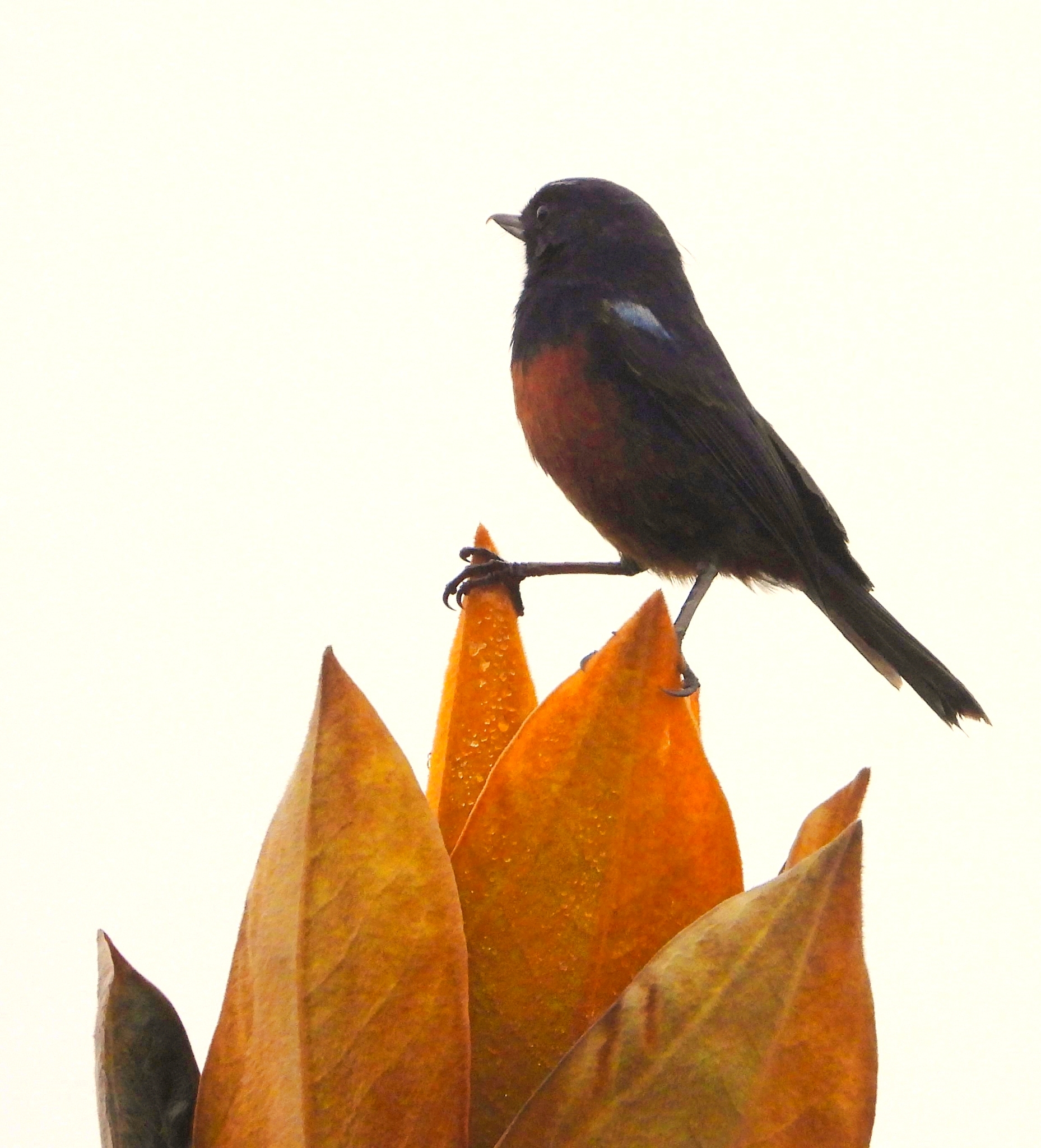
The Merida Flowerpiercer is a dark flowerpiercer with a chestnut belly that lives almost only in the Andes of Mérida and Trujillo in Venezuela. It is thus one of the few birds in the guide area endemic to the Venezuelan Andes. With its hooked bill it pierces corollas at the side and takes nectar without pollinating the flower.
Voice
The song is a rapid, high, twittering series of notes; the call is a thin tsit.
Recording: David Ricardo Rodríguez-Villamil — CC BY-NC-SA 4.0 · xeno-canto
Identification
14 cm, with a short, upturned bill with a small hook at the tip. Head, throat and upperparts are black, with a blue-grey shoulder patch and a greyish rump. Breast and belly are chestnut, the flanks greyer. The sexes are nearly alike; young birds are duller brown and streaked below.
Confusion species
Black Flowerpiercer Diglossa humeralis is entirely black, without a chestnut belly. Glossy Flowerpiercer Diglossa lafresnayii is larger and glossy black, with a blue-grey shoulder, and has no brown below. Rusty Flowerpiercer Diglossa sittoides also has rufous underparts, but blue-grey upperparts and a rufous throat, and usually lives lower.
Habitat
Scrub at the upper edge of cloud forest, forest edges, hedgerows and shrubby paramo, roughly between 2500 and 4100 m. It takes nectar by piercing corollas at the side and also eats insects. The nest is a cup low in a shrub.
Where the bird is most at home, classified by the vegetation units of Amazonia and the Guianas.

Range and movements
A resident of the Andes of Venezuela, mainly in Mérida and Trujillo, locally into northern Táchira. Absent from Brazil and the Guianas; a single report from Brazil is almost certainly an error. Outside the guide area only one record in 2024 on the Colombian side of the border near the Tamá massif.
- Resident
- dark = core range, pale = thinly spread
How and when to look
Scrub and hedgerows around the paramos of Mérida, such as at Pico El Águila, Laguna de Mucubají and the Páramo de La Culata. It forages low in flowering shrubs and is often the commonest flowerpiercer there.
Conservation status
Least Concern. The range is small, but the species is fairly common within it and tolerates scrub and hedgerows between fields. Fires and the spread of farming into the paramo are local threats.
Scientific name
Diglossa gloriosa | Sclater & Salvin, 1871
Sclater & Salvin described the species in 1871 and placed it straight away in the genus where it still stands. The genus Diglossa was introduced in 1832 by Wagler. Diglossa is Greek, from diglōssos 'double-tongued' (di- 'double', glōssa 'tongue'), after the split tongue of these nectar-feeders. gloriosa is Latin for 'glorious, splendid', from gloria 'fame, glory'. The specimen the first description was based on came from Páramo de La Culata, north of Mérida, Venezuela.