All species › Tubenoses › Petrels, shearwaters and diving petrels › Northern Giant Petrel
Northern Giant Petrel | Macronectes halli
Noordelijke reuzenstormvogel | Abanto Marino Subantártico | Petrel-gigante-do-norte
Northern Giant Petrel is the sister species of Southern Giant Petrel and breeds slightly further north, on subantarctic islands. Like that species it is both scavenger and predator. In the guide area it is a scarce winter visitor at sea off southern Brazil, much less numerous than Southern Giant Petrel.
Voice
Usually silent at sea; at food, croaking and whinnying sounds.
Recording: Hichem MACHOUK — CC BY-NC-SA 4.0 · xeno-canto
Identification
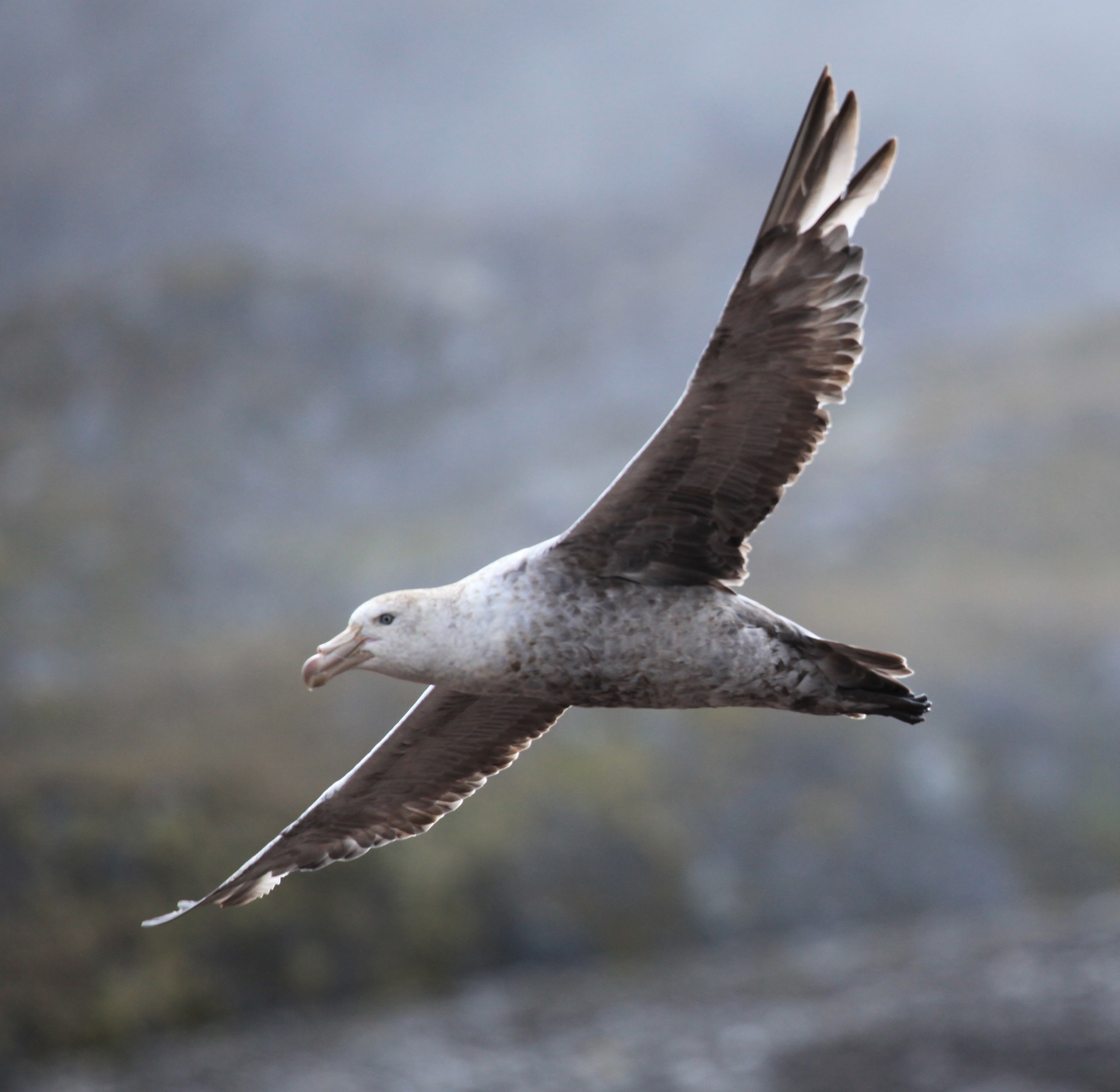
80–95 cm, built like Southern Giant Petrel, with a heavy, pale bill with a reddish-brown to pinkish-brown tip and a long nasal tube. Adults are grey-brown, with a paler, speckled head, a darker crown and face and often a pale eye; there is no white morph. Young birds are uniform blackish-brown, with a dark eye. The flight is stiff, with short series of wingbeats. The sexes are alike, the male is larger.
Confusion species
Southern Giant Petrel Macronectes giganteus has a greenish bill tip, and adults have a more uniformly white head without a dark face; young birds can only be separated by the bill tip, which is often hard to see well at a distance. Albatrosses, such as Black-Browed Albatross Thalassarche melanophris, have longer, narrower wings, a slimmer bill and a smoother gliding flight.
Habitat
Open ocean and cool water over the continental shelf, also at fishing boats. It eats carrion of marine mammals and penguins, fish offal, squid and seabirds. It does not breed in the guide area; outside it, it nests scattered among the vegetation on subantarctic islands, earlier in the year than Southern Giant Petrel.
Where the bird is most at home, classified by the vegetation units of Amazonia and the Guianas.


Range and movements
In Brazil a scarce winter visitor at sea off Rio Grande do Sul, Santa Catarina and Paraná, mainly from June to October; rare further north. At sea giant petrels are not always identified to species, so true numbers are uncertain. Not known from Venezuela, Guyana, Suriname or French Guiana. Outside the guide area it breeds on subantarctic islands in the Indian and Pacific Oceans, around New Zealand and on South Georgia; outside the breeding season it ranges over the southern oceans.
- Resident
- Summer visitor (c. Apr–Sep)
- Winter visitor (c. Oct–Mar)
- dark = core range, pale = thinly spread
How and when to look
Check giant petrels at fishing boats and harbour mouths in southern Brazil for the colour of the bill tip; take close-up photographs.
Conservation status
Least Concern. The population is increasing. Bycatch in longline fisheries is the main threat.
Scientific name
Macronectes halli | Mathews, 1912
Mathews described the species in 1912 and placed it straight away in the genus where it still stands. The genus Macronectes was introduced in 1905 by Richmond. Macronectes comes from the Greek makros, 'great', and nēktēs, 'swimmer' — 'great swimmer', for these huge petrels. halli honours the Australian ornithologist Robert Hall (1867–1949), who described the breeding birds of the Kerguelen Islands. The specimen the first description was based on came from Kerguelen Islands.