All species › Woodpeckers and allies › Woodpeckers › Ochraceous Piculet
Ochraceous Piculet | Picumnus limae
Okerdwergspecht | Carpinterito de Ceará | Picapauzinho-da-caatinga
Ochraceous Piculet is a piculet of north-eastern Brazil with ochre to rufous underparts. In its current treatment the species also includes the former Tawny Piculet (Picumnus fulvescens), so the colour of the underparts varies from region to region. It lives in dry forest, caatinga and the humid upland forests of Ceará and Pernambuco.

Voice
A high, fast trill and thin, high tsit calls. Also soft tapping on thin twigs and vines.
Recording: Guilherme Melo — CC BY-NC-SA 4.0 · converted to mono · xeno-canto
Identification
10 cm, with a short, straight, dark bill. The crown is black with white dots; the male has red feather tips on the forecrown, the female has no red on the head. The upperparts are grey-brown to ochre-brown, with little pattern. Birds from Ceará are pale ochre-yellow below with faint dark scales on the breast; further east and south the underparts are warmer rufous-brown with dark streaks or scales. The throat is paler. The tail is black with white inner webs to the central feathers.
Confusion species
Spotted Piculet Picumnus pygmaeus, in caatinga, is darker brown and densely covered with round white spots. White-barred Piculet Picumnus cirratus, at the edge of the range, is white below with black bars. Golden-spangled Piculet Picumnus exilis, in coastal forest, has a greenish back with pale spots and pale, dark-scaled underparts.
Habitat
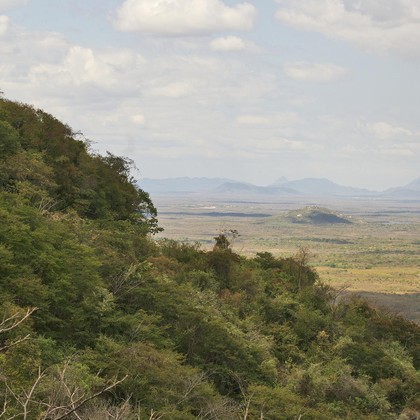
Brejos (humid upland forest on the plateaus and hills of the caatinga), dry and semi-deciduous forest, caatinga with taller trees and forest edges, also gardens and coffee plantations in the uplands, from the lowlands up to about 1000 m. It forages on thin twigs and vines in the lower and middle levels, often with mixed flocks. It eats small insects and their larvae. It nests in a self-excavated hole in a thin dead branch.
Where the bird is most at home, classified by the vegetation units of Amazonia and the Guianas.



Range and movements
In Brazil only in the north-east: in Ceará, among other places in the Serra de Baturité and on the Chapada do Araripe, and further through Piauí, Paraíba and Pernambuco to Alagoas, Sergipe and northern Bahia. Not in Venezuela or the Guianas. It does not occur outside Brazil.
- Resident
- dark = core range, pale = thinly spread
How and when to look
Search the upland forest and coffee plantations of the Serra de Baturité in Ceará, often with mixed flocks of small birds in vines along roads and gardens. The tapping on thin twigs is often heard before the bird is seen.
Conservation status
Least Concern. Forest in north-eastern Brazil has largely been cleared or fragmented, but the species tolerates forest edges, secondary forest and shaded plantations.
Scientific name
Picumnus limae | Snethlage, HMMEE, 1924
Snethlage, HMMEE described the species in 1924 and placed it straight away in the genus where it still stands. The genus Picumnus was introduced in 1825 by Temminck. Picumnus comes from French picumne 'piculet', after Picumnus, in Roman mythology the personification of the woodpecker. limae honours the collector 'F. Lima', who took the type specimens in Ceará in 1915; his exact identity (possibly Francisco de Queiroz Lima) is uncertain. The specimen the first description was based on came from Serra do Castelo, Ceará, Brazil.