All species › Passerines › Wagtails and pipits › Ochre-breasted Pipit
Ochre-breasted Pipit | Anthus nattereri
Okerborstpieper | Bisbita ocre | Caminheiro-grande
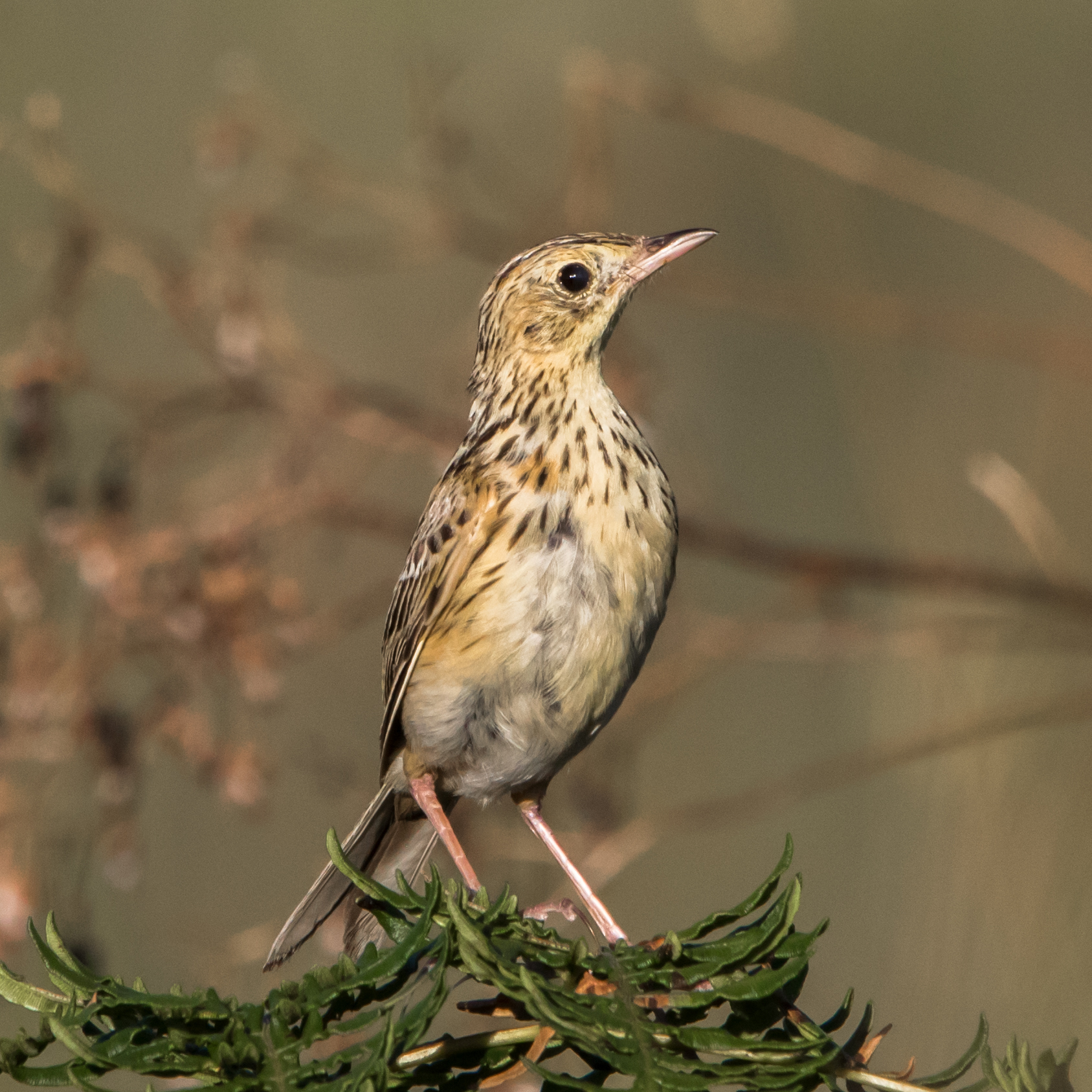
Ochre-breasted Pipit is one of the largest pipits in the guide area, with a warm ochre, coarsely streaked breast. It lives in natural grassland in southern and south-eastern Brazil, where it is scarce and local. The loss of that grassland makes it vulnerable.
Voice
Sings in a high song flight: a series of short, thin notes followed by a descending, buzzing trill as the bird drops. The call is a short tsip.
Recording: Luiz Gabriel Mazzoni — CC BY-NC-SA 4.0 · xeno-canto
Identification
15 cm. Fairly large and sturdy, with a long hind claw. Upperparts brown with broad black streaks and pale buff feather edges, so that the back looks strongly scaled. Throat and breast warm ochre, the breast with coarse black streaks that continue onto the flanks; belly paler, yellowish white. Pale supercilium. Outer tail feathers white. The sexes are alike; worn birds are less ochre.
Confusion species
Hellmayr's Pipit Anthus hellmayri is smaller and cinnamon below, with fine breast streaks and a short hind claw. Yellowish Pipit Anthus chii is smaller and slimmer, pale yellowish white below, with fine streaks. Correndera Pipit Anthus correndera has two white stripes on the mantle and whitish underparts. Short-billed Pipit Anthus furcatus has a short bill, a sharply defined breast band and a white belly.
Habitat
Natural, medium-tall grassland with few shrubs, often on rolling terrain: the campos of the plateaus of Paraná and Santa Catarina, the pampa of Rio Grande do Sul and the high grasslands of the Serra da Canastra. It avoids intensively grazed pasture and cropland. It searches the ground for insects. The nest is on the ground, hidden in the grass.
Where the bird is most at home, classified by the vegetation units of Amazonia and the Guianas.



Range and movements
In the guide area only in Brazil, scarce and local: in Minas Gerais mainly in the Serra da Canastra, further on the plateaus of Paraná and Santa Catarina and in Rio Grande do Sul; there are only a few reports from São Paulo. Most records fall between August and January, when the birds sing; outside that period little is known about possible movements. Absent from Venezuela, Guyana, Suriname and French Guiana. Outside the guide area in southern Paraguay and north-eastern Argentina.
- Resident
- dark = core range, pale = thinly spread
How and when to look
In the high grasslands of Serra da Canastra National Park in Minas Gerais, or on the natural campos of the plateaus in Paraná and Rio Grande do Sul. Visit from September to December, when the males hang singing over the grassland.
Conservation status
Vulnerable. The population is small and fragmented, and the natural grassland it depends on is disappearing through conversion to soy fields and pine and eucalyptus plantations, intensive grazing and too frequent burning.
Scientific name
Anthus nattereri | Sclater, 1878
Sclater described the species in 1878 and placed it straight away in the genus where it still stands. The genus Anthus was introduced in 1805 by Bechstein. Anthus is the Latin word for a small bird of grasslands mentioned by Pliny the Elder. nattereri honours the Austrian naturalist Johann Natterer (1787–1843), who collected in Brazil from 1817 to 1835. The specimen the first description was based on came from Rio Verde, São Paulo, Brazil.