All species › Swifts › Hummingbirds › Olive-spotted Hummingbird
Olive-spotted Hummingbird | Talaphorus chlorocercus
Olijfvlekkolibrie | Colibrí blanquioliva | Beija-flor-pintado
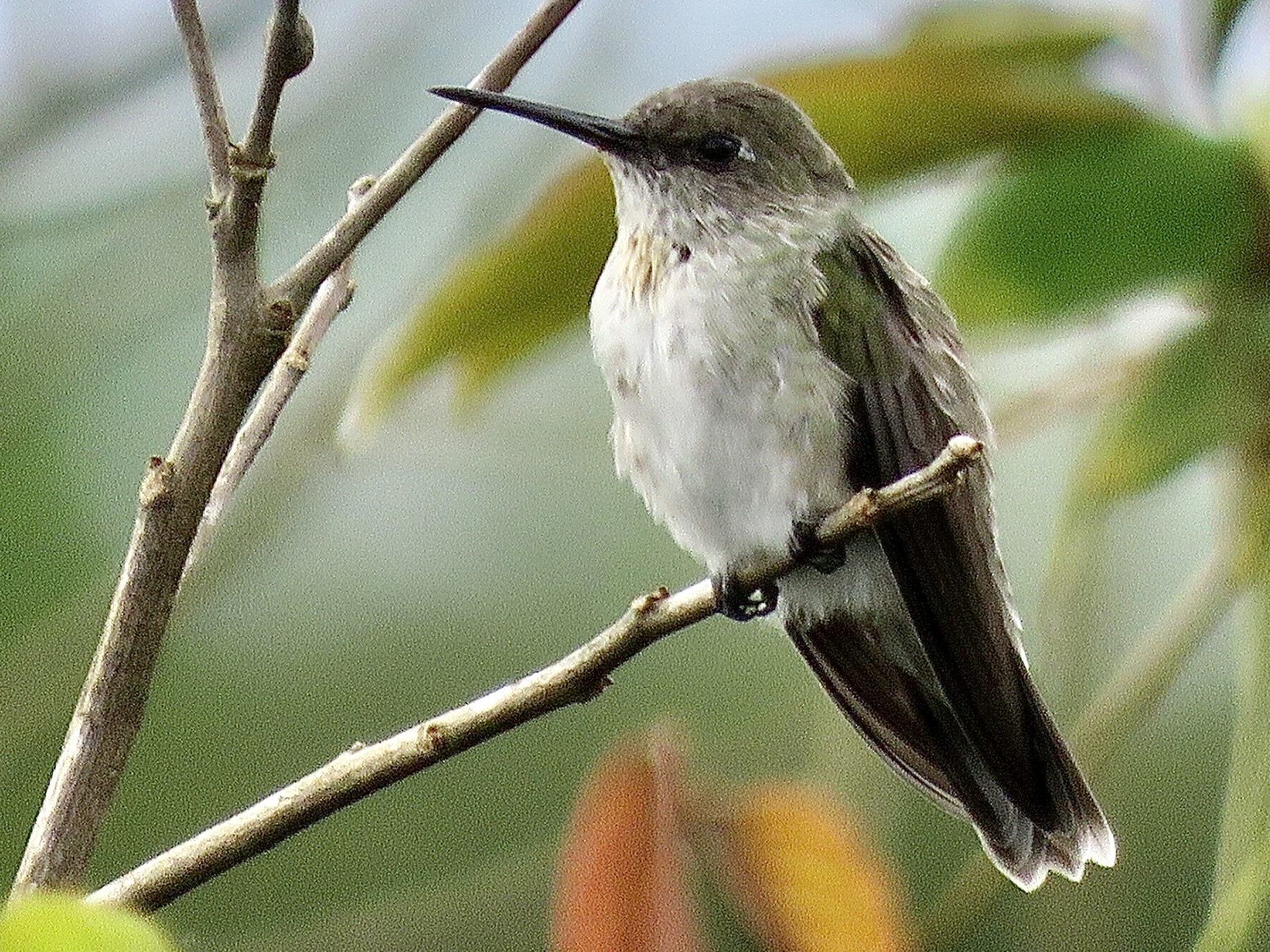
The Olive-spotted Hummingbird is a dull green-and-white hummingbird that lives almost exclusively on young river islands in the western Amazon Basin. It is tied to the pioneer scrub that grows on newly deposited sandbars. In the guide area it occurs only in western Brazilian Amazonia.
Voice
The song is a monotonous series of multisyllabic notes; calls are a sharp seek, a thin seeuwee, a full twitter and a hard tsjt.
Recording: JAYRSON ARAUJO DE OLIVEIRA — CC BY-NC-SA 4.0 · xeno-canto
Identification
11–12 cm, with a straight, blackish bill; the female has a slightly longer bill. Crown and nape are bronzy, the upperparts greyish green to bronze-green. There is a small white spot behind the eye. The throat is olive-green, sometimes with golden-green spots; the rest of the underparts is whitish. The tail is pale greyish green to olive, with grey tips to the central feathers and a dark band before the tip of the outer feathers. The sexes are nearly alike; juveniles are greyer brown below.
Confusion species
Glittering-throated Emerald Chionomesa fimbriata has a glittering green throat and breast, a pink lower mandible and a dark tail. Versicolored Emerald Chrysuronia versicolor is smaller, coppery green above, with a white central belly but green flanks. The female Fork-tailed Woodnymph Thalurania furcata is grey below, with a dark blue forked tail, and lives inside the forest.
Habitat
Pioneer scrub, young Tessaria and willow thickets, rank growth and open woodland on young river islands and sandbars, sometimes also on the adjacent bank, in the lowlands below 400 m. It forages at flowers of shrubs and vines in the scrub and catches small insects. The nest is a small cup of plant down on a branch above the ground.
Where the bird is most at home, classified by the vegetation units of Amazonia and the Guianas.



Range and movements
In Brazil only in the west of Amazonas state, on islands and banks of the Solimões and the lower reaches of large tributaries such as the Javari, the Içá and the Japurá; scarce further downstream. Absent from Venezuela and the Guianas. Outside the guide area in extreme south-eastern Colombia, eastern Ecuador and north-eastern Peru.
- Resident
- dark = core range, pale = thinly spread
How and when to look
Search young river islands of the Solimões covered with shrubs and young trees, for example near Tabatinga, reached by boat; the bird forages low in the scrub.
Conservation status
Least Concern. Its habitat is continually renewed by the dynamics of the rivers; the species therefore depends mainly on free-flowing rivers with natural sediment deposition.
Scientific name
Talaphorus chlorocercus | (Gould, 1866)
Gould described the species in 1866 as Leucippus chlorocercus; because it was later moved to another genus, the author and year stand in brackets. The genus Talaphorus was introduced in 1874 by Mulsant & Verreaux. The origin of Talaphorus is unclear; possibly Greek with -phoros 'bearing', but the first element cannot be explained. chlorocercus is Greek, from khlōros 'green' and kerkos 'tail', after the olive-green tail. The specimen the first description was based on came from upper Ucayali River, Peru.