All species › Waders, gulls and terns › Skimmers, noddies, terns and gulls › Olrog's Gull
Olrog's Gull | Larus atlanticus
Olrogs meeuw | Gaviota cangrejera | Gaivota-de-rabo-preto
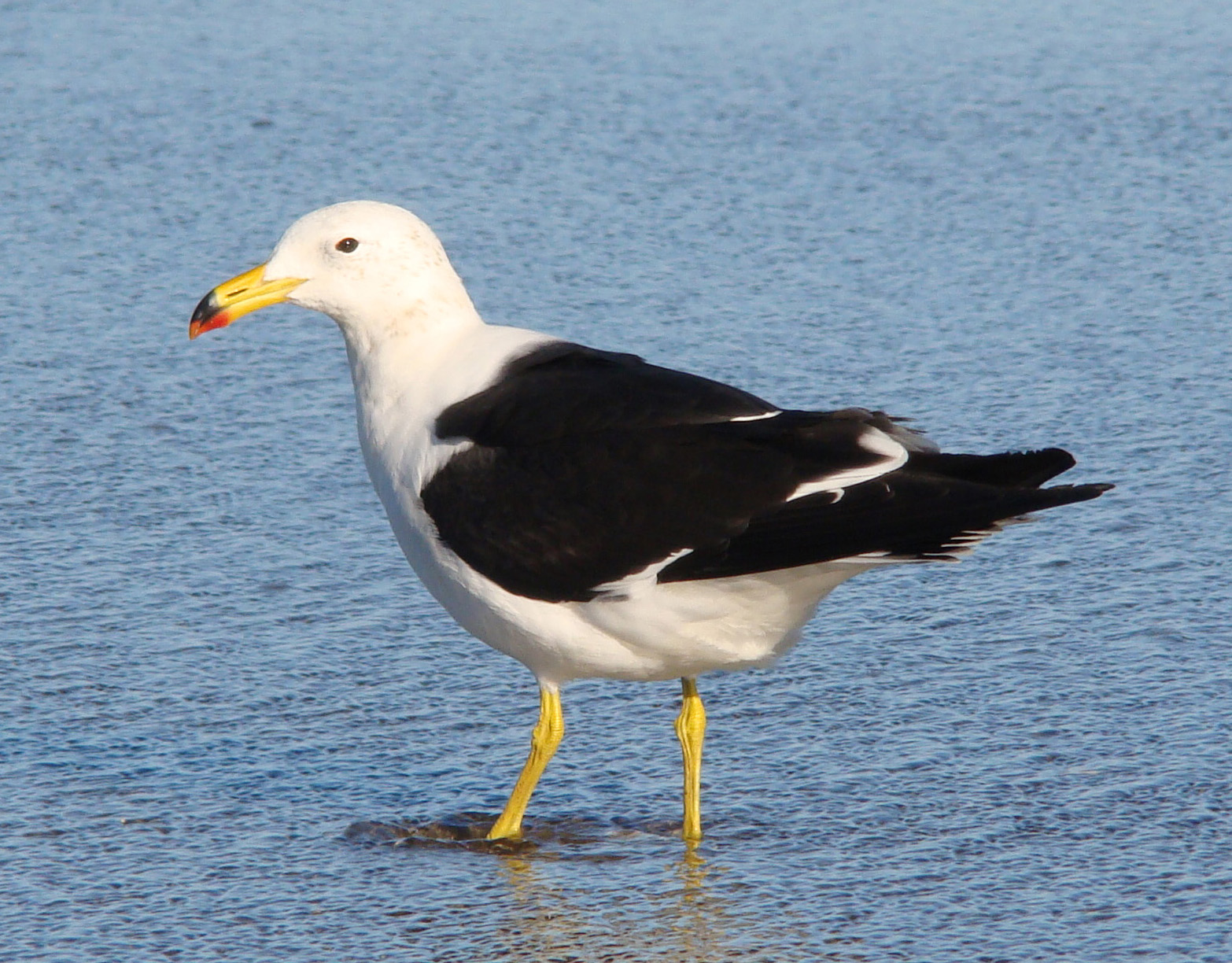
Olrog's Gull is a large, heavy-billed gull that breeds only on the Atlantic coast of South America, in Argentina. It specialises in crabs of mudflats and estuaries. Outside the breeding season birds move north and reach the coast of southern Brazil.
Voice
A deep, harsh kyaaow and a series of laughing calls, as in other large gulls, but somewhat lower.
Recording: Bernabe Lopez-Lanus — CC BY-NC-SA 3.0 · xeno-canto
Identification
50–56 cm, large, with a heavy, thick bill. Adults have a white head and white underparts, a black mantle and black wings with a white trailing edge, and a white tail with a narrow black subterminal band. The bill is yellow with a red spot on the lower mandible and a black subterminal band; the legs are yellow. In non-breeding plumage the head is streaked greyish brown. Juveniles are mottled brown, with a black tail and a dark bill; adult plumage is reached in the fourth year.
Confusion species
Kelp Gull Larus dominicanus is very similar but has a slimmer bill with only a red spot, greenish-yellow legs and, as an adult, no black tail band. Lesser Black-backed Gull Larus fuscus is slimmer, with a thinner bill, and has a paler, slate-grey mantle. Dolphin Gull Leucophaeus scoresbii, a rare vagrant, has a grey head and a red bill.
Habitat
Mudflats, estuaries, lagoons and sandy beaches; also harbours and rubbish dumps along the coast. It eats mainly crabs, which it catches on the mudflats at low tide, as well as fish, fish waste and other food. It breeds in colonies on islets in bays and estuaries, outside the guide area.
Where the bird is most at home, classified by the vegetation units of Amazonia and the Guianas.



Range and movements
In Brazil a winter visitor on the coast of Rio Grande do Sul, mainly around the mouth of the Lagoa dos Patos; rarer north to Santa Catarina. Many of the birds are immatures. Absent from Venezuela, Guyana, Suriname and French Guiana. Outside the guide area the species breeds only on the coast of Argentina, in Buenos Aires and Chubut; in winter also in Uruguay.
- Resident
- Summer visitor (c. Apr–Sep)
- dark = core range, pale = thinly spread
How and when to look
Search from about May to September on the beaches and mudflats around Rio Grande and Cassino, among flocks of Kelp Gulls. Look for the heavy bill with a black band and, in older birds, the black tail band.
Conservation status
Near Threatened. The world population is small and breeds in few colonies. Threats are disturbance and degradation of the colonies and feeding areas by coastal development, ports and tourism, and pollution of the estuaries.
Scientific name
Larus atlanticus | Olrog, 1958
Olrog described the species in 1958 and placed it straight away in the genus where it still stands. The genus Larus was introduced in 1758 by Linnaeus. Larus is Latin, from Ancient Greek laros, and appears to have referred to a gull or another large seabird. atlanticus is Latin for 'of the Atlantic Ocean', after the Atlantic coast of Argentina where the species lives. The specimen the first description was based on came from not stated.