All species › Passerines › Finches, euphonias and allies › Orange-bellied Euphonia
Orange-bellied Euphonia | Euphonia xanthogaster
Vuurbuikorganist | Eufonia ventrinaranja | Fim-fim-grande
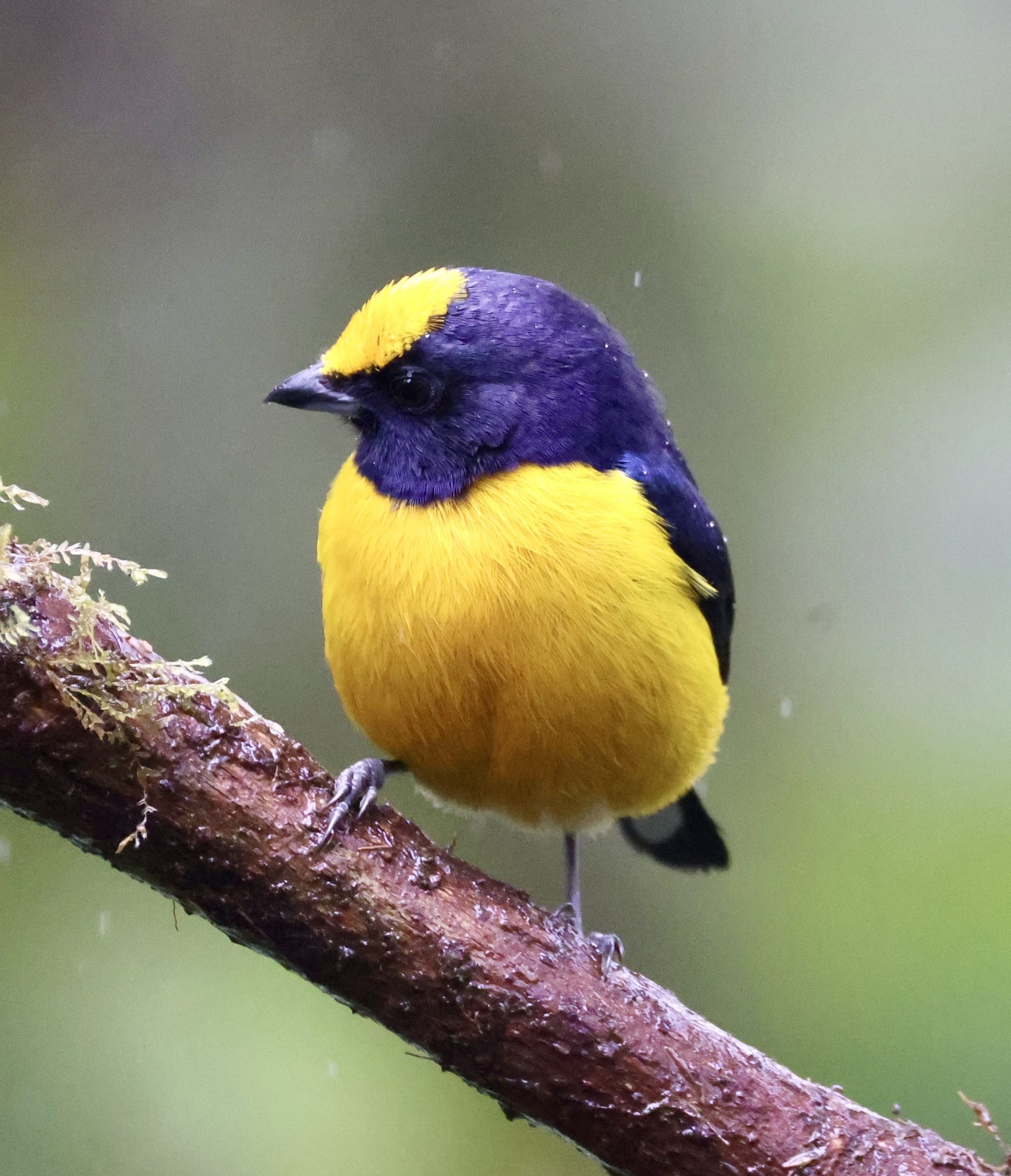
The Orange-bellied Euphonia is a small, stocky euphonia of humid forest that occurs in separate areas of the guide area: the montane forests of Venezuela, western Amazonia and the Atlantic Forest of eastern Brazil. It keeps mainly to the canopy and feeds largely on mistletoe berries. The female is identified by its rufous forehead and grey belly.
Voice
The call is a clear, nasal dee-dee or pee-pee, often repeated several times. The song is a short, rapid series of clear notes and twitters, incorporating imitated calls of other birds.
Recording: Juan Freile — CC BY-NC-SA 4.0 · shortened to the first 60 s, mono · xeno-canto
Identification
10–11 cm. Small and compact, with a short, thick bill and a short tail. The male is dark steel-blue above, on the head and on the throat; the forehead and forecrown are yellow to orange-yellow, and this yellow extends back above the eye. Breast and belly deep orange-yellow; the outer tail feathers have white on the underside. The female is olive-green above, with a rufous forehead and a grey nape; the underparts are grey in the centre and olive-yellow on the flanks. Immature males resemble the female.
Confusion species
Male Thick-billed Euphonia Euphonia laniirostris has a yellow throat instead of a dark one. Purple-throated Euphonia Euphonia chlorotica is smaller, with a purplish-black throat, a smaller yellow forehead patch and yellower, less orange underparts. In the Atlantic Forest Green-chinned Euphonia Euphonia chalybea has a greenish gloss and a small yellow forehead patch, and male Chestnut-bellied Euphonia Euphonia pectoralis has a chestnut belly; the female of that species is grey below with rufous undertail coverts. The female Orange-bellied Euphonia is identified by the rufous forehead combined with the grey belly.
Habitat
Humid lowland, foothill and montane forest, cloud forest, forest edges and tall secondary forest; in Venezuela mainly between about 500 and 2000 m, in Amazonia and the Atlantic Forest also low down. It lives in pairs or small groups in the canopy, often with tanagers in mixed flocks. It feeds mainly on mistletoe berries and other small fruits. The nest is a ball of moss with a side entrance, often in a mossy bank or among epiphytes.
Where the bird is most at home, classified by the vegetation units of Amazonia and the Guianas.







Range and movements
In Venezuela a common resident in the Serranía de Perijá, the Andes of Táchira, Mérida, Trujillo and Lara and the coastal mountains from Carabobo to Miranda, and south of the Orinoco locally in Bolívar and Amazonas. In Brazil in the western Amazon basin, mainly in Acre, Amazonas and Rondônia, and in the Atlantic Forest from southern Bahia to Rio de Janeiro. Scarce and local in Guyana; hardly known from Suriname and French Guiana. Outside the guide area from eastern Panama through the Andes of Colombia and Ecuador to Peru and Bolivia.
- Resident
- dark = core range, pale = thinly spread
How and when to look
Best found at fruiting mistletoes along the forest edge, for example in Henri Pittier National Park and in the cloud forest of Mérida, and in Brazil in the forests of the Serra do Mar in Rio de Janeiro. The nasal call usually gives the birds away before the plumage does.
Conservation status
Least Concern. Widespread and locally common. In the Atlantic Forest, where much forest has been lost, it is restricted to the remaining forest areas; deforestation is the main threat.
Scientific name
Euphonia xanthogaster | Sundevall, 1834
Sundevall described the species in 1834 and placed it straight away in the genus where it still stands. The genus Euphonia was introduced in 1806 by Desmarest, A-G. Euphonia is Greek, from eu 'good' and phōnē 'sound': 'sweet-voiced', after the pleasing calls. xanthogaster is Greek, from xanthos 'yellow' and gastēr 'belly', after the yellow to orange belly. The specimen the first description was based on came from Rio de Janeiro, Brazil.