All species › Falcons › Falcons and caracaras › Orange-breasted Falcon
Orange-breasted Falcon | Falco deiroleucus
Bonte slechtvalk | Halcón pecho rufo | Falcão-de-peito-laranja
The Orange-breasted Falcon is a powerful, rare falcon of forested country with tall rocks, breeding on cliffs above the forest, on inselbergs and at waterfalls. It closely resembles the much commoner Bat Falcon, but is larger and more heavily built. Throughout its range it is local and occurs at low density.

Voice
A harsh, repeated series kek-kek-kek, mainly at the breeding site.
Recording: Dante Buzzetti — CC BY-NC-SA 4.0 · xeno-canto
Identification
33–40 cm; the female is clearly larger than the male. Upperparts slate blue to blackish, the head black. The throat is white to cream and merges into a rufous-orange band on the upper breast and neck sides. Below this is a black vest with coarse cream to pale orange barring. Belly, thighs and undertail coverts are rufous-orange. Bill and feet are heavy, the feet yellow. Juveniles are browner above, with buffy tones below.
Confusion species
Bat Falcon Falco rufigularis is smaller and slimmer, with a smaller head and lighter feet; the throat is usually buffier or browner without a sharp white border, the orange upper-breast band is absent or narrow, and the black vest is more finely barred white. Female Bat Falcons and male Orange-breasted Falcons overlap in size; note the proportions of head and feet. Peregrine Falcon Falco peregrinus has pale, streaked or barred underparts without orange.
Habitat
Tall cliffs, inselbergs, gorges and waterfalls in humid lowland and hill forest, also steep river valleys and table mountains; from the lowlands to about 1500 m. It hunts from a high perch or in a fast stoop for medium-sized birds such as pigeons, parrots and also swifts. It nests in a niche or on a ledge on a cliff face, sometimes high in a tree.
Where the bird is most at home, classified by the vegetation units of Amazonia and the Guianas.
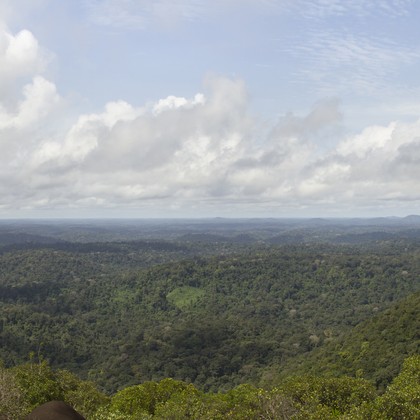


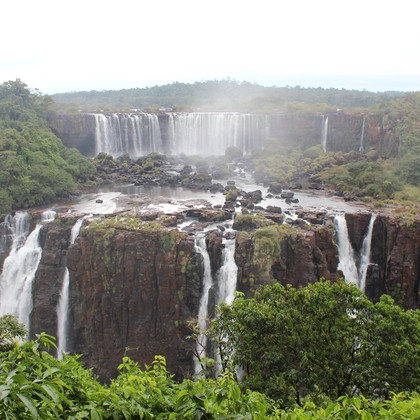
Range and movements
In Brazil scattered and local in Amazonia, among others in Amapá, Pará and Mato Grosso, and in the transition to the Cerrado; in the Atlantic Forest of the south-east very rare, with few recent records. In Guyana, Suriname and French Guiana local on inselbergs, cliffs and at waterfalls in the interior. In Venezuela only a few scattered records, mainly south of the Orinoco. Outside the guide area from southern Mexico to northern Argentina, rare and local everywhere.
- Resident
- dark = core range, pale = thinly spread
How and when to look
Known breeding cliffs, for example at large waterfalls and inselbergs in the Guianas, are occupied year after year; there the bird often sits for long periods on a projecting ledge or a dead tree above the forest. Check any Bat Falcon with a heavy head and large feet carefully.
Conservation status
Near Threatened. The species occurs at low density and depends on forest around suitable cliffs; deforestation and disturbance of breeding sites are the main threats. It has almost disappeared from the Atlantic Forest.
Scientific name
Falco deiroleucus | Temminck, 1825
Temminck described the species in 1825 and placed it straight away in the genus where it still stands. The genus Falco was introduced in 1758 by Linnaeus. Falco is Late Latin for 'falcon', from falx, falcis 'sickle', after the sickle-shaped claws of the bird. deiroleucus is Greek, from deirē 'neck, throat' and leukos 'white', after the white throat. The specimen the first description was based on came from São Francisco Island, Santa Catarina, Brazil.