All species › Passerines › New World warblers › Ovenbird
Ovenbird | Seiurus aurocapilla
Ovenvogel | Reinita hornera | Mariquita-forneira
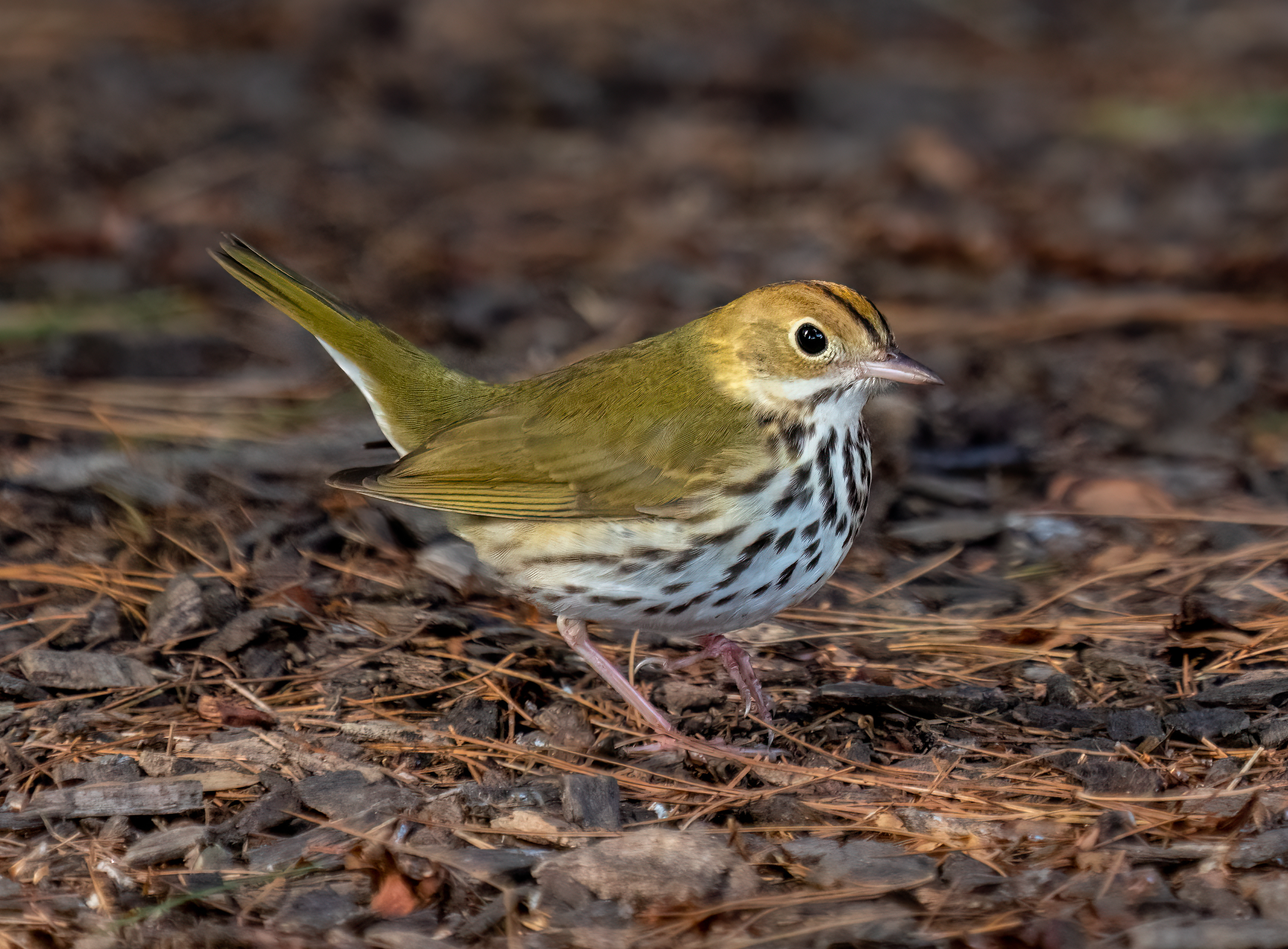
The Ovenbird is a North American warbler that behaves like a small thrush: it walks with measured steps over the forest floor, tail slightly cocked and head bobbing. The name refers to the nest, a covered dome of leaves and grass on the ground with a side entrance, like an old-fashioned oven. The guide area lies at the southern edge of its winter range; it is seen in small numbers only in north-western Venezuela.
Voice
The call on the wintering grounds is a dry, sharp chok or chip, often repeated when disturbed. The song, mainly on the breeding grounds, is a loud, swelling series tee-CHER tee-CHER tee-CHER.
Recording: Jeff Stewart — CC BY-NC-SA 4.0 · xeno-canto
Identification
14–16 cm, a rather stocky warbler with a short tail and pink legs. Upperparts plain olive green. An orange crown stripe, bordered on each side by a black stripe. A white eye-ring gives a large-eyed look. Underparts white, with black streaks on the breast and flanks and a black malar stripe. The sexes are alike; in winter the crown stripe is sometimes duller.
Confusion species
Northern Waterthrush Parkesia noveboracensis and Louisiana Waterthrush Parkesia motacilla have a long white or yellowish supercilium instead of an eye-ring, browner upperparts and no orange crown stripe; they bob the whole rear body and live near water. Swainson's Thrush Catharus ustulatus and Gray-cheeked Thrush Catharus minimus are larger, with a spotted rather than streaked breast and no crown stripe.
Habitat
On the floor of humid montane and cloud forest, forest edges and shade-coffee plantations, always where there is a thick layer of leaf litter; in Venezuela mainly between about 800 and 2000 m. It walks among the leaves searching for insects, spiders, snails and other invertebrates. Wintering birds hold their own territory. It does not breed in the guide area.
Where the bird is most at home, classified by the vegetation units of Amazonia and the Guianas.



Range and movements
In Venezuela a rare winter visitor in the north-west: in the Serranía de Perijá, the Andes of Táchira, Mérida and Trujillo and the western part of the coastal range; a few records elsewhere in the north. There are no or almost no records from Brazil, Guyana, Suriname and French Guiana. Breeds in Canada and the eastern United States and winters from Florida and Mexico through Central America and the Caribbean to northern Colombia and Venezuela.
- Winter visitor (c. Oct–Mar)
- dark = core range, pale = thinly spread
How and when to look
From October to April in montane forest and shade coffee in the Venezuelan Andes and Perijá: stand still on a forest trail with plenty of leaf litter and listen for the dry chok; the bird then often walks calmly into view.
Conservation status
Least Concern. The world population is large and fairly stable. Fragmentation of forest on the breeding grounds and loss of montane forest on the wintering grounds have local effects.
Scientific name
Seiurus aurocapilla | (Linnaeus, 1766)
Linnaeus described the species in 1766 as Motacilla aurocapilla; because it was later moved to another genus, the author and year stand in brackets. The genus Seiurus was introduced in 1827 by Swainson. Seiurus is Greek, from seiouros 'wag-tail', after the constant tail-bobbing. aurocapilla is Latin, from aurum 'gold' and -capillus '-crowned', after the orange crown stripe. The specimen the first description was based on came from Pennsylvania.