All species › Jacamars and puffbirds › Jacamars › Pale-headed Jacamar
Pale-headed Jacamar | Brachygalba goeringi
Grijskopglansvogel | Jacamará cabeciblanco | Ariramba-de-cabeça-pálida
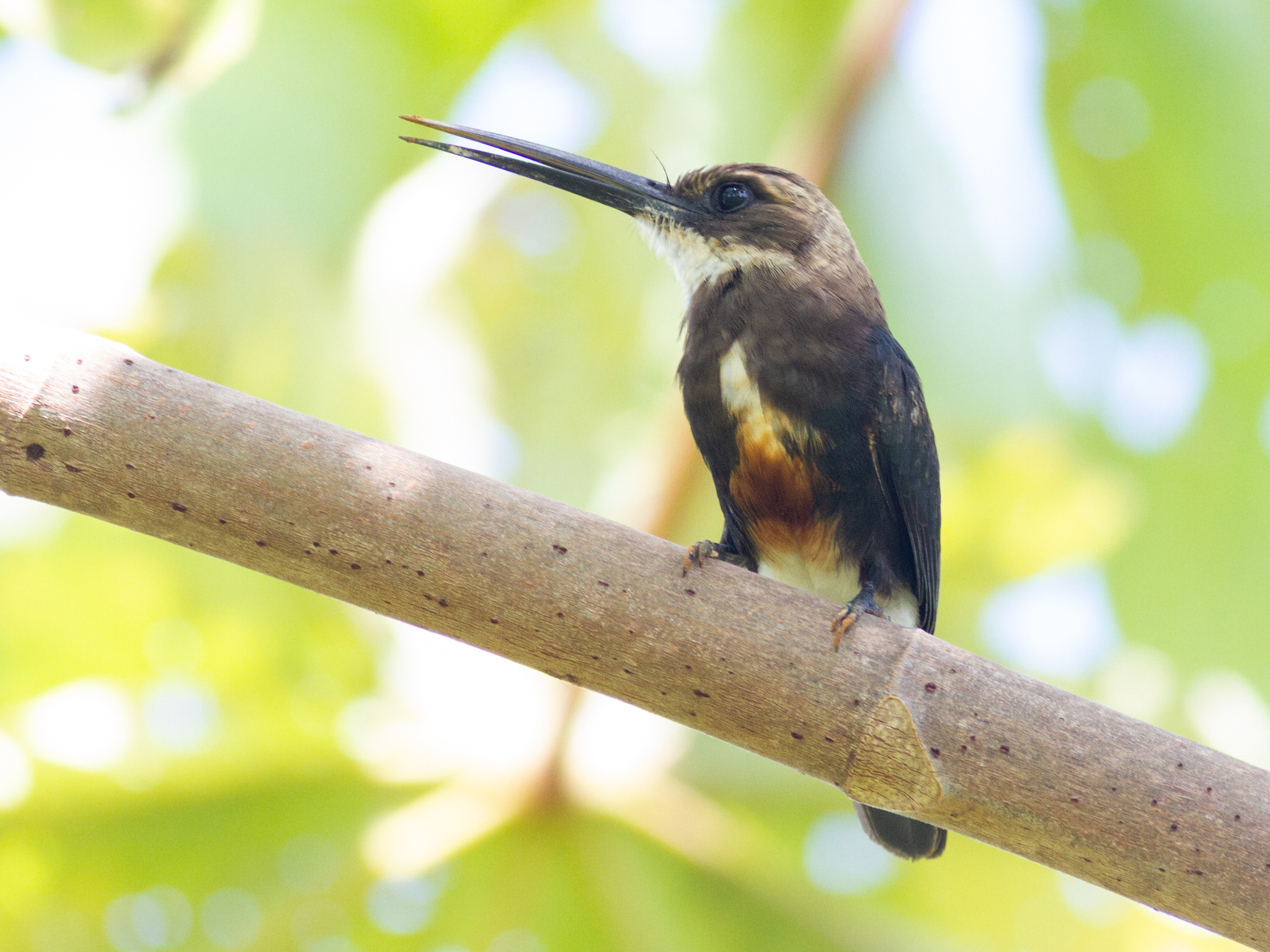
The Pale-headed Jacamar is a small jacamar with a pale, greyish-brown head, found in gallery forest and forest edges in the llanos of Colombia and Venezuela. It lives in pairs or family groups that hunt flying insects from exposed branches. In the guide area it occurs only in Venezuela, in the western and central llanos.
Voice
A series of high weet notes that speed up and rise in pitch, ending in a trill.
Recording: Iván Lau — CC BY-NC-SA 4.0 · shortened to the first 60 s, mono · xeno-canto
Identification
17–18 cm, with a long, straight black bill and a fairly short tail. The crown, nape and shoulders are ashy grey to greyish brown, and there is a pale supercilium. The rest of the upperparts are dark brown with a green gloss, blue-black in worn birds. The throat is buffy white, a chestnut band crosses the upper belly, the flanks are dark brown and the rest of the underparts are white. The sexes are nearly alike; juveniles have a greyer head and a stronger green gloss.
Confusion species
Brown Jacamar Brachygalba lugubris has a darker, brown head without a pale supercilium and lacks the chestnut belly band. Rufous-tailed Jacamar Galbula ruficauda is larger and glossy green, with a rufous belly and a longer tail.
Habitat
Mainly the edges of gallery forest and secondary forest in the llanos grasslands, also open country with scattered trees, mostly low, locally up to about 1100 m. It perches on projecting branches, often in pairs or small groups, and sallies for flying insects, mainly butterflies and dragonflies. It nests in a tunnel in an earth bank.
Where the bird is most at home, classified by the vegetation units of Amazonia and the Guianas.



Range and movements
In the guide area only in Venezuela, in the llanos and adjacent lowlands, mainly of Apure, Barinas, Portuguesa, Cojedes and Guárico. Absent from Brazil, Guyana, Suriname and French Guiana. Outside the guide area in the llanos of Arauca and Casanare in eastern Colombia.
- Resident
- dark = core range, pale = thinly spread
How and when to look
On the large cattle ranches (hatos) of the llanos of Apure and Cojedes, search the edges of gallery forest, woodlots and riverine forest for birds on bare, exposed branches.
Conservation status
Least Concern. The species has a limited range, but occurs at many sites within it and tolerates a landscape of cattle ranching and scattered woodland.
Scientific name
Brachygalba goeringi | Sclater & Salvin, 1869
Sclater & Salvin described the species in 1869 and placed it straight away in the genus where it still stands. The genus Brachygalba was introduced in 1854 by Bonaparte. Brachygalba combines Greek brakhus 'short' with galba, shortened from the genus Galbula: 'short jacamar', after the smaller size and shorter tail. goeringi honours the German artist and collector Anton Goering (1836–1905), who collected birds in Venezuela. The specimen the first description was based on came from near Maruria, north of Lake Valencia, Venezuela.