All species › Passerines › New World warblers › Palm Warbler
Palm Warbler | Setophaga palmarum
Palmzanger | Reinita palmera | Mariquita-das-palmeiras
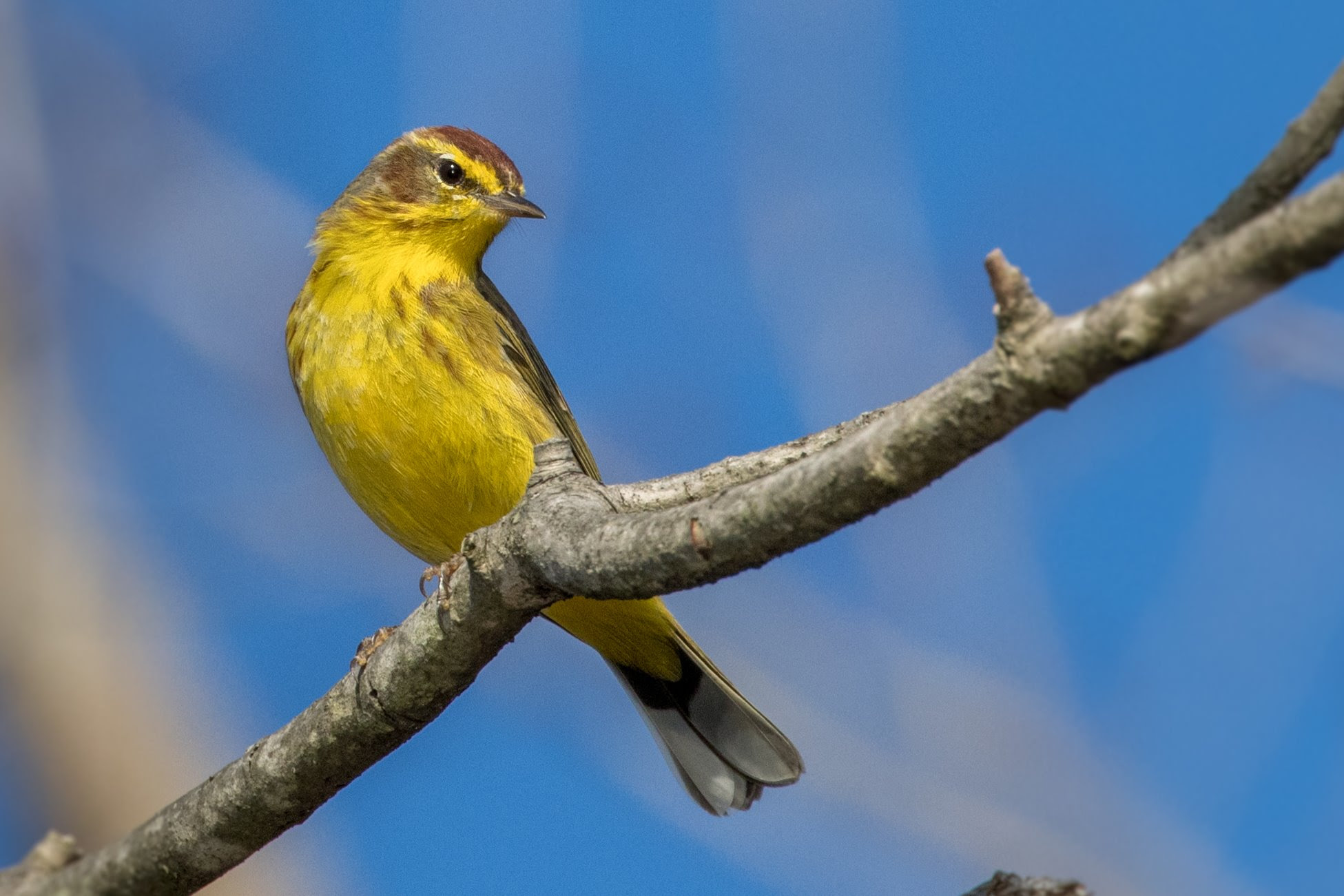
The Palm Warbler is a North American warbler that spends the winter mainly in the south-eastern United States and the north-western Caribbean. Unlike most warblers it forages much on the ground and in low vegetation, and it constantly pumps its tail up and down. In the guide area it is only a rare vagrant in northern Venezuela.
Voice
The call is a full, slightly nasal chik, often given when flushed; the flight call a thin see. The song, a buzzy trill on one pitch, is not to be expected in the guide area.
Recording: Stanislas Wroza — CC BY-NC-SA 4.0 · shortened to the first 60 s, mono · xeno-canto
Identification
12–14 cm, slim, with a fairly long tail. In winter brownish grey above with a pale supercilium and a dark eye-stripe, and dull white to yellowish below with faint brown breast streaks. Characteristic are the bright yellow undertail coverts, the olive-yellow rump and the constant tail-pumping. In spring many birds acquire a rufous crown. The western form palmarum is paler and greyer; the eastern form hypochrysea is entirely yellow below with rufous streaks.
Confusion species
Prairie Warbler Setophaga discolor also pumps its tail, but is bright yellow below with black flank streaks and a patterned yellow face. Cape May Warbler Setophaga tigrina has whitish undertail coverts and forages higher in trees. Pipits Anthus are larger, walk rather than hop and have no yellow.
Habitat
In the wintering range open ground with scattered shrubs: grassland and pasture, lawns, roadsides, coastal scrub, edges of mangroves and beaches, dry scrub and gardens. It forages much on the ground and in low shrubs for insects and also eats seeds and berries. It does not breed in the guide area.
Where the bird is most at home, classified by the vegetation units of Amazonia and the Guianas.



Range and movements
Vagrant: in Venezuela a small number of records in the north. Not known from Brazil, Guyana, Suriname and French Guiana. Breeds in the peat bogs of the boreal forest in Canada and the extreme northern United States and winters along the south-eastern coast of the United States, in the Caribbean and in smaller numbers on the Yucatán Peninsula and in Central America.
How and when to look
Not a bird to search for; a vagrant is most likely between October and April on open ground with short vegetation in northern Venezuela, including the islands. The tail-pumping and yellow undertail are visible even at a distance.
Conservation status
Least Concern. The species breeds in large, little-disturbed peatlands and in winter is adapted to open ground created by people. In the guide area the species plays no significant role.
Scientific name
Setophaga palmarum | (Gmelin, 1789)
Gmelin described the species in 1789 as Motacilla palmarum; because it was later moved to another genus, the author and year stand in brackets. The genus Setophaga was introduced in 1827 by Swainson. Setophaga is Greek, from sēs, sētos 'moth' and -phagos '-eating': 'moth-eater'. palmarum is Latin for 'of the palms', after the palm trees in which the species was observed on Hispaniola. The specimen the first description was based on came from Hispaniola.