All species › Passerines › Thrushes and allies › Pantepui Thrush
Pantepui Thrush | Turdus murinus
Pantepuilijster | Zorzal de Pantepui | Caraxué-dos-tepuis
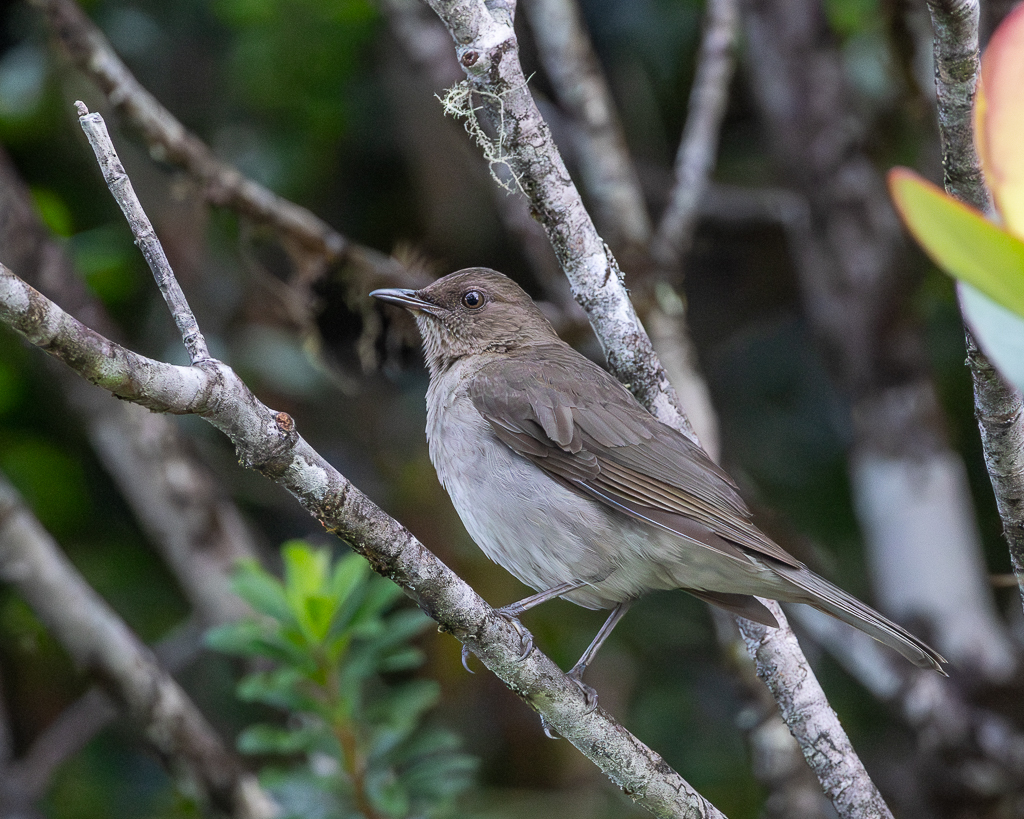
The Pantepui Thrush is a dark brown thrush of the lower slopes of the tepuis in southern Venezuela and adjacent parts of Guyana and Brazil. It was described in 1885 from Roraima, later treated as a subspecies of Black-billed Thrush Turdus ignobilis, and since genetic studies in the 2010s most classifications again recognise it as a separate species. Little is known of its behaviour.
Voice
The song is poorly known and probably resembles that of Black-billed Thrush. The calls are better described: a nasal, rising queek!, a soft prip and a louder quee-kipper series when the bird is flushed and flies off.
Recording: Luiz Fernando Carvalho — CC BY-NC-SA 4.0 · xeno-canto
Identification
20–21 cm. Head, upperparts, wings and tail are dark brown. The throat is white with dark streaks. The breast is paler brown, the belly dark ash grey, and the lower flanks and undertail coverts are white. The bill is black, the iris dark brown and the legs dark grey to blackish. The sexes are alike.
Confusion species
Campina Thrush Turdus arthuri is greyer and paler, with a dull grey belly, and lives lower down, in campina and white-sand savanna. Black-billed Thrush Turdus ignobilis is paler olive-brown, with a white belly, and does not occur in this area. Pale-breasted Thrush Turdus leucomelas has a grey head contrasting with the brown back, a pale breast and a yellowish lower mandible. Also on the tepuis are Black-hooded Thrush Turdus olivater, the male of which has a black hood and a yellow bill, and Pale-eyed Thrush Turdus leucops, the male of which is black with a white iris.
Habitat
Edges of humid montane forest, clearings and early successional growth on the lower slopes of the tepuis, also along roads and at the edges of savannas on the plateau. It forages on the ground and in trees for invertebrates and fruit. Its habitat and nest have been little studied.
Where the bird is most at home, classified by the vegetation units of Amazonia and the Guianas.



Range and movements
Venezuela: in south-eastern Bolívar and in Amazonas, on the slopes of Roraima, Auyán-tepui, Cerro Duida and Cerro de la Neblina, among others, locally fairly common. Guyana: the far west, in the Pakaraima Mountains around Roraima. Brazil: a few records from the far north, in Roraima and around Pico da Neblina in Amazonas. Suriname and French Guiana: not known. It does not occur outside the guide area.
- Resident
- dark = core range, pale = thinly spread
How and when to look
Found at forest edges and clearings along the road through the Sierra de Lema to the Gran Sabana in south-eastern Venezuela. Listen for the nasal queek! call of a bird flushing from the roadside.
Conservation status
Least Concern (IUCN). Its habitat on the tepuis is largely undisturbed and partly within national parks. Not all classifications recognise it as a separate species.
Scientific name
Turdus murinus | Salvin, 1885
Salvin described the species in 1885 and placed it straight away in the genus where it still stands. The genus Turdus was introduced in 1758 by Linnaeus. Turdus is the ordinary Latin word for 'thrush'. murinus is Latin for 'mouse-like, mouse-grey', from mus, muris 'mouse', after the greyish-brown plumage. The specimen the first description was based on came from Merume Mountains near Roraima, Guyana.