All species › Passerines › Tanagers and allies › Paramo Seedeater
Paramo Seedeater | Catamenia homochroa
Páramocatamenia | Semillero paramero | Patativa-da-amazônia
The Paramo Seedeater is a dark grey seedeater of scrub and elfin forest near the treeline in the northern Andes and on the tepuis. In the guide area it lives in the Venezuelan Andes and Perijá and, with its own subspecies, on the summits of the Guiana Highlands. It wanders and often appears in numbers where bamboo is seeding.
Voice
The song is a short, high, buzzy trill, sometimes preceded by a few separate notes. The call is a soft chip.
Recording: JAYRSON ARAUJO DE OLIVEIRA — CC BY-NC-SA 4.0 · xeno-canto
Identification
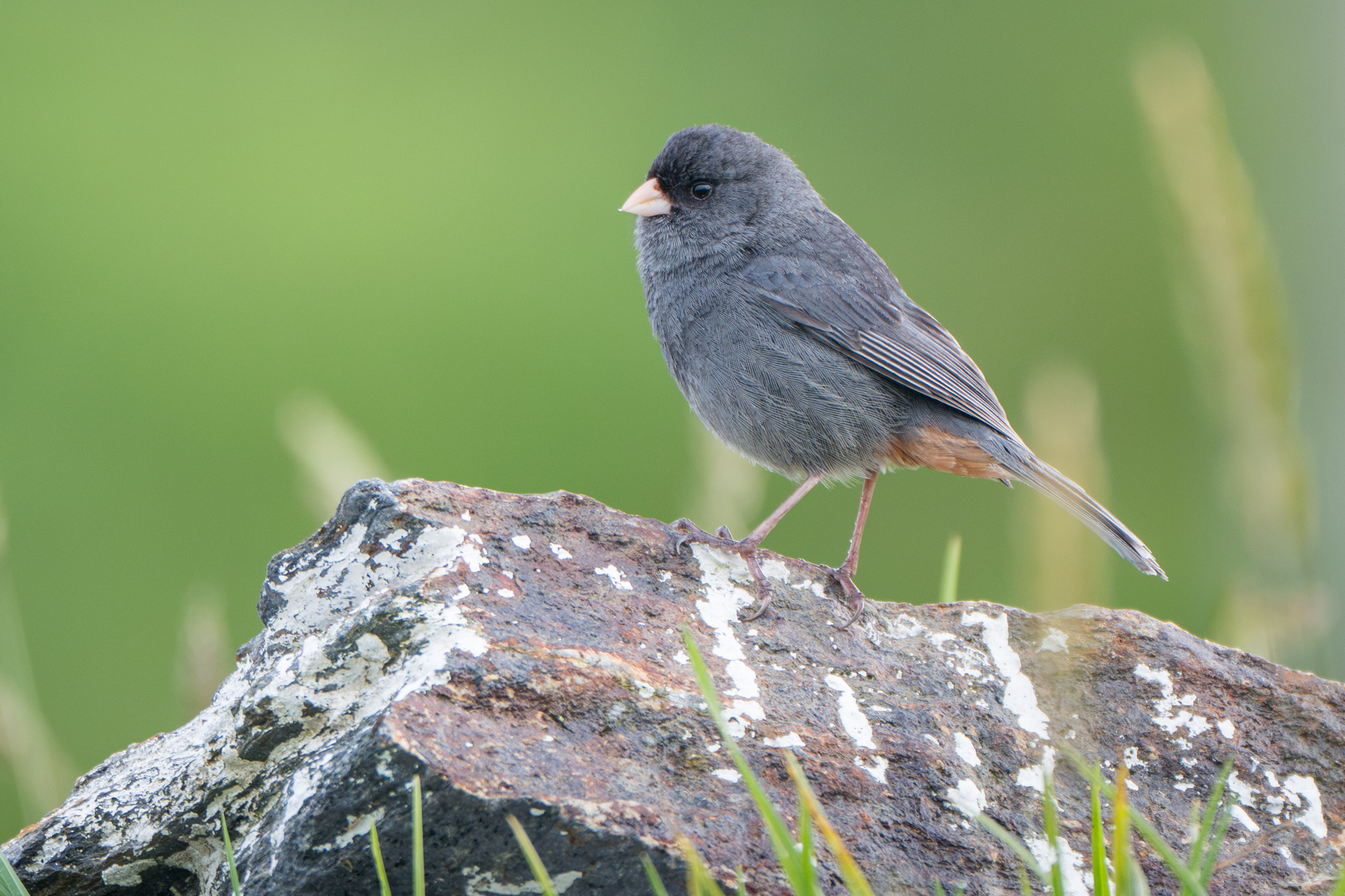
13 cm, with a short, thick, pink to pinkish-yellow bill. The male is uniform dark slate-grey, blackish around the bill base, unstreaked, with a chestnut vent. The female is dark olive-brown, streaked above and below, with a rufous vent. Young birds resemble the female.
Confusion species
Plain-colored Seedeater Catamenia inornata of the Venezuelan Andes is paler grey, with a streaked back, and lives in more open grassland and paramo. Band-tailed Seedeater Catamenia analis has a white band in the tail. No other Catamenia occurs on the tepuis; females of Sporophila seedeaters are browner, unstreaked and live lower in open country.
Habitat
Scrub and elfin forest near the treeline, edges of upper cloud forest, shrubby paramo and bamboo stands; on the tepuis in summit scrub and at the edge of montane forest. Roughly between 2000 and 3600 m in the Andes, on the tepuis from about 1500 m. It eats seeds, especially of grasses and bamboo, and wanders to places where seed is available. Little is known about the nest.
Where the bird is most at home, classified by the vegetation units of Amazonia and the Guianas.



Range and movements
In Venezuela locally in the Andes of Trujillo, Mérida and Táchira and in the Serranía de Perijá, and on the tepuis of Amazonas and Bolívar. A few records on the border tepuis, in western Guyana and in northern Roraima in Brazil. Absent from Suriname and French Guiana. Outside the guide area in the Andes from Colombia to Bolivia and in the Sierra Nevada de Santa Marta.
- Resident
- dark = core range, pale = thinly spread
How and when to look
In the Venezuelan Andes search scrub and bamboo just below the paramo, for example in the Parque Nacional Sierra Nevada; numbers vary from year to year with seed set. On the tepuis mainly on treks to the summits, such as Roraima.
Conservation status
Least Concern. The species is nomadic and often scarce, but its habitat in the high Andes and on the tepuis is largely intact.
Scientific name
Catamenia homochroa | Sclater, 1859
Sclater described the species in 1859 and placed it straight away in the genus where it still stands. The genus Catamenia was introduced in 1850 by Bonaparte. Catamenia is Greek katamēnia 'menses' (from mēn 'month'), after the chestnut undertail coverts. homochroa is Greek homokhrous 'of one colour', from homos 'same' and khroa 'colour', after the uniformly dark grey male. The specimen the first description was based on came from Matos, north of Riobamba, Ecuador.