All species › Passerines › New World sparrows › Paria Brushfinch
Paria Brushfinch | Arremon phygas
Pariastruikgors | Cerquero de Berlepsch | Tico-tico-de-paria
The Paria Brushfinch is a large, stripe-headed brushfinch found only in the mountains of north-eastern Venezuela. It was formerly included in Stripe-headed Brushfinch Arremon torquatus in the broad sense and has been recognised as a separate species since that group was split. It is known from a small number of scattered sites and lives in the understorey of montane forest.
Voice
Very high, thin calls, roughly tseet, with which the partners keep contact. The song is a short series of high, thin whistles; the voice is poorly described.
No recording with a suitable Creative Commons licence is available for this species yet.
Identification
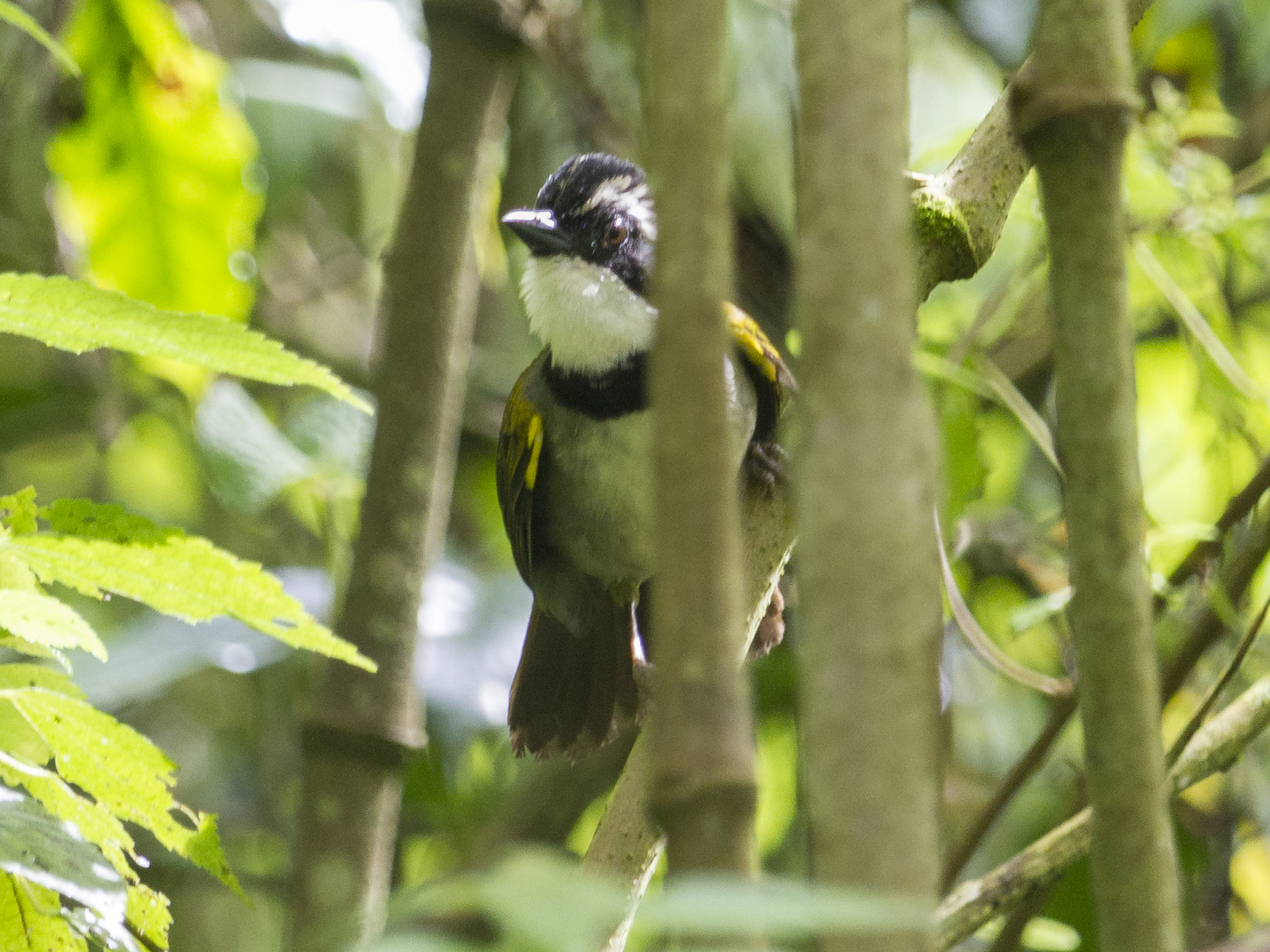
19 cm, sturdy, with a black bill and a fairly long tail. The crown is black, with at most a hint of a grey median stripe; a whitish supercilium starts behind the eye, and the rest of the face is black. Neck sides and breast sides are grey. The throat is white, with a black breast band below. Back, wings and tail are olive-green; the centre of the breast and belly is white, the flanks grey with a greenish tinge. The sexes are alike. Juveniles are dusky olive on the head and upperparts, with a pale olive supercilium and greyish-cinnamon underparts.
Confusion species
Caracas Brushfinch Arremon phaeopleurus of the central Coastal Range is very similar but has a distinct grey median crown stripe, a greyish-white supercilium that starts above the eye and olive-buff flanks; the two species are best separated by range. Chestnut-capped Brushfinch Arremon brunneinucha has a chestnut crown.
Habitat
Understorey in the interior of humid montane forest and cloud forest, sometimes at forest edges, roughly between 900 and 1500 m. It forages on and just above the ground for insects, other invertebrates and seeds. Little is known about the nest.
Where the bird is most at home, classified by the vegetation units of Amazonia and the Guianas.

Range and movements
A resident found only in Venezuela, in the eastern part of the Cordillera de la Costa: on the Paria Peninsula in Sucre and in the Turimiquire massif, in north-eastern Anzoátegui, northern Monagas and adjacent Sucre. Absent from Brazil and the Guianas. The central Coastal Range is occupied by Caracas Brushfinch.
- Resident
- dark = core range, pale = thinly spread
How and when to look
Search the montane forest of Parque Nacional Península de Paria, for example on Cerro Humo, or the Turimiquire highlands. The birds keep low in dense undergrowth; listen for high calls in the early morning.
Conservation status
Vulnerable. The range is small and the species is known from few sites, where it is scarce and local. Forest on the Paria Peninsula and in the Turimiquire massif is being cleared on a large scale for agriculture; the two national parks in which it occurs receive little effective protection. The population is thought to be declining.
Scientific name
Arremon phygas | (Berlepsch, 1912)
Berlepsch described the species in 1912 as Buarremon torquatus phygas; because it was later moved to another genus, the author and year stand in brackets. The genus Arremon was introduced in 1816 by Vieillot. Arremon is Greek, from arrhēmōn 'silent, speechless', after Buffon's 'Oiseau silencieux', a bird said to be rarely heard. phygas probably comes from the Greek phugas 'fugitive, exile'; why Berlepsch chose the name is unclear. The specimen the first description was based on came from Los Palmales, Sucre, Venezuela.