All species › Swifts › Hummingbirds › Peacock Coquette
Peacock Coquette | Lophornis pavoninus
Pauwkoketkolibrie | Coqueta pavonina | Topetinho-pavão
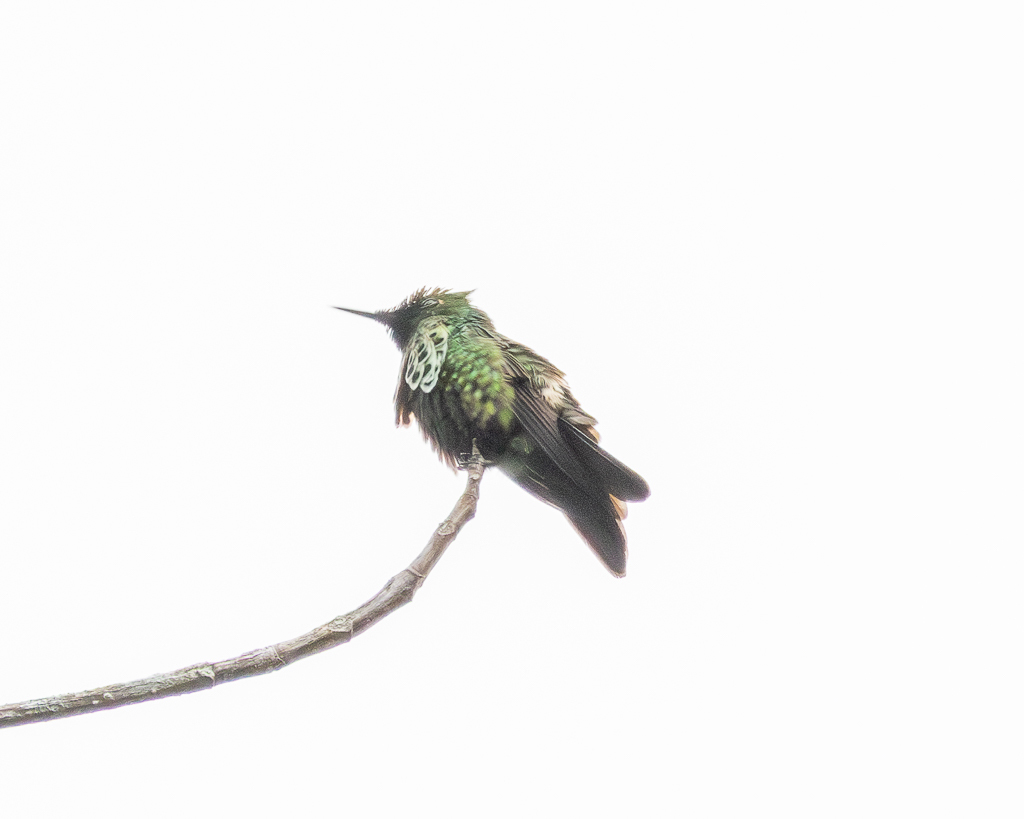
The Peacock Coquette is a small hummingbird of the montane forest on the tepuis of the Guiana Shield. The male has long, shining green cheek plumes that end in large, blue-black spots, like the eyes in a peacock's tail. It is the largest species of the genus Lophornis.
Voice
No description of the voice is known; there are hardly any recordings. Probably, like related species, mostly silent with short, high calls.
No recording with a suitable Creative Commons licence is available for this species yet.
Identification
9–10 cm, with a short, straight, black bill and a slightly forked, purplish-bronze tail. The male has a glittering golden-green head with a black line along the centre of the crown, dark green upperparts with a white rump band, a rufous cheek patch with a white dot behind the eye, long green cheek plumes with large blue-black spots at the tips and grey-green underparts. The female lacks the plumes; she is golden-bronze above with a buffy-white rump band, has a white throat with black streaks and black, white and green mottled underparts; the tail is grey with a broad purplish-bronze band before the tip and white tips to the outer pair. In the form duidae the crown line and the cheek patch are smaller.
Confusion species
Other coquettes live in the lowlands around the tepuis. Tufted Coquette Lophornis ornatus is smaller, with a red bill and, in the male, a rufous crest and rufous neck plumes. Butterfly Coquette Lophornis verreauxii has a white rump band, a chestnut tail and, in the male, green, white-tipped cheek plumes. The female Racket-tipped Thorntail Discosura longicaudus has a black throat with narrow white sides and a longer, forked tail.
Habitat
The interior, clearings and edges of rainforest and cloud forest on the slopes of the tepuis, between about 500 and 2000 m. It feeds at flowering trees and shrubs, often at the forest edge, and catches small insects. Little is known about the nest.
Where the bird is most at home, classified by the vegetation units of Amazonia and the Guianas.


Range and movements
In Venezuela in the south: the nominate form on Ptari-tepui and in the Sierra de Lema in Bolívar, the form duidae on Cerro Duida and nearby smaller tepuis in Amazonas. In Guyana in the Merumé Mountains, part of the Pakaraima Mountains. In Brazil known only from Mount Roraima, on the border of the three countries. Absent from Suriname and French Guiana. The species does not occur outside the guide area.
- Resident
- dark = core range, pale = thinly spread
How and when to look
At flowering trees and shrubs along the road through the Sierra de Lema in Bolívar, where the forest edge can be overlooked well. The bird is small and often stays a long time at a single flowering tree.
Conservation status
Least Concern. The range is small, but lies largely in remote, undisturbed country; locally mining and forest clearance are a threat.
Scientific name
Lophornis pavoninus | Salvin & Godman, 1882
Salvin & Godman described the species in 1882 and placed it straight away in the genus where it still stands. The genus Lophornis was introduced in 1829 by Lesson. Lophornis is Greek, from lophos 'crest' and ornis 'bird', after the males' crests. pavoninus is Latin for 'peacock-like', from pavo 'peacock', after the eye-spots on the male's plumes. The specimen the first description was based on came from the Merume Mountains, Guyana.