All species › Passerines › Tanagers and allies › Pearly-bellied Seedeater
Pearly-bellied Seedeater | Sporophila pileata
Bleek dikbekje | Capuchino boina negra | Caboclinho-branco
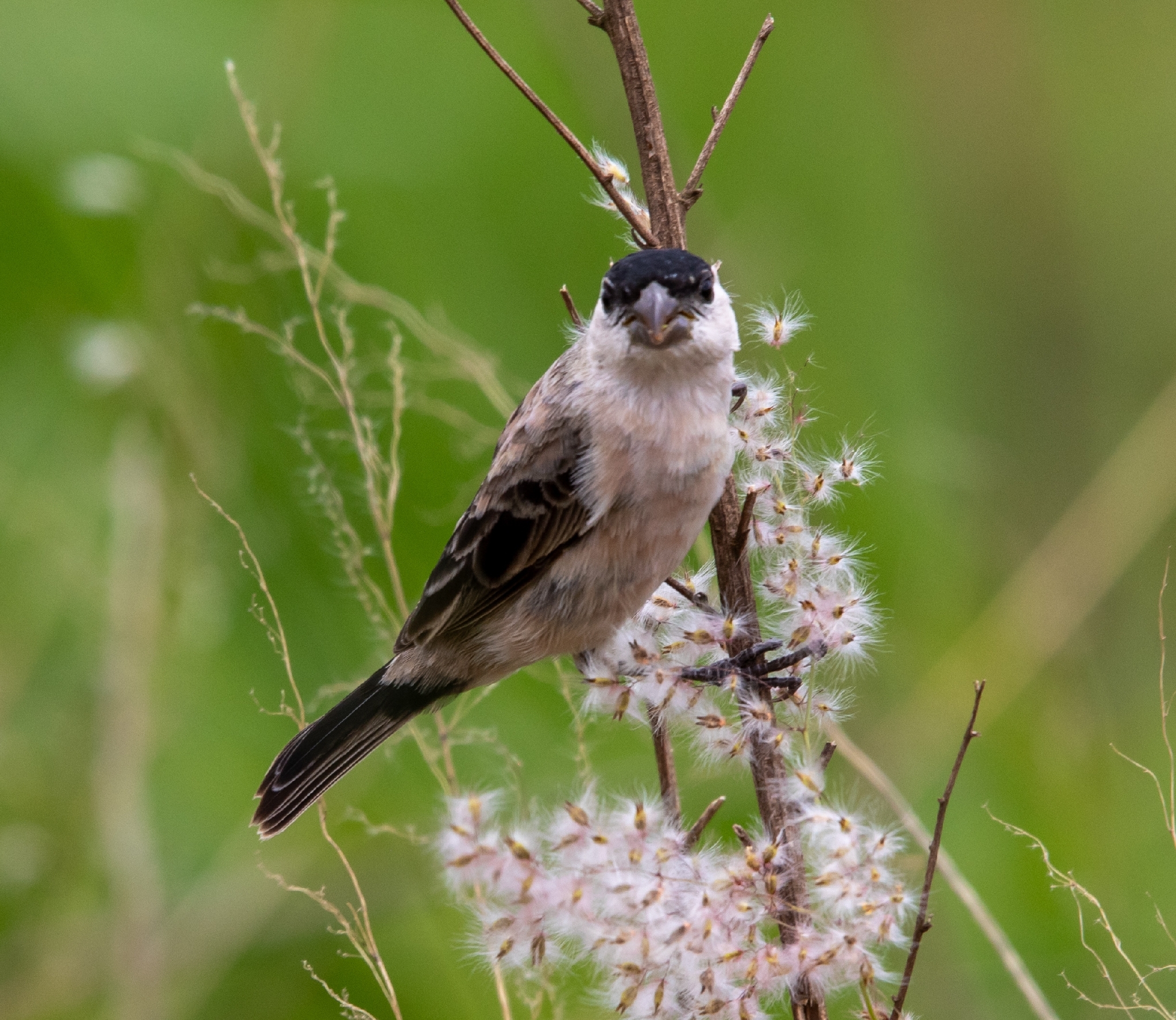
The Pearly-bellied Seedeater is a capuchino: one of the small, migratory seedeaters of the grasslands of southern and central South America. The male has a black cap and strikingly pale, pearly grey to whitish underparts. It was long treated as a subspecies of Copper Seedeater Sporophila bouvreuil. In Brazil it is trapped for its song.
Voice
The song is a fairly long, clear series of whistled notes and short trills that varies in tempo and pitch. The call is a soft, nasal tchew.
Recording: Eduardo Quintanilla — CC BY-NC-SA 4.0 · converted to mono · xeno-canto
Identification
10 cm, with a short, thick, rounded bill, dark in the male. The male has a black crown forming a small cap that reaches below the eye; nape and back are pale greyish brown, the wings darker with a small white wing speculum. Throat and underparts are whitish with a pearly grey to soft buff wash. The female is light brown above and buffy brown below, with a dark bill. Young males at first resemble the female.
Confusion species
The male Copper Seedeater Sporophila bouvreuil has the same black cap but a cinnamon-orange to pinkish-orange back and underparts. White-bellied Seedeater Sporophila leucoptera is larger and grey above, without a black cap. Double-collared Seedeater Sporophila caerulescens has a black throat and a black breast band. Female capuchinos are very similar and often cannot be separated with certainty in the field; look for the male in the flock.
Habitat
Natural grassland and open cerrado, especially wet grassland, veredas and marsh edges with tall grass; outside the breeding season also in seeding grass along roads and in abandoned pasture. From the lowlands up to about 1200 m. It feeds mainly on grass seeds, often taken directly from the seed heads. The nest is a small cup placed low in grass or a small shrub.
Where the bird is most at home, classified by the vegetation units of Amazonia and the Guianas.




Range and movements
Brazil: breeds in the austral summer in the centre and southeast, including Minas Gerais, São Paulo, Goiás, Mato Grosso do Sul and Paraná; winters farther north in the Cerrado. The exact wintering area is only partly known. Absent from Venezuela, Guyana, Suriname and French Guiana. Outside the guide area it breeds in eastern Paraguay and north-eastern Argentina.
- Resident
- Winter visitor (c. Oct–Mar)
- Passage (Mar–Apr, Oct–Nov)
- dark = core range, pale = thinly spread
How and when to look
Between November and February, search wet grasslands and veredas of the Cerrado in Minas Gerais or São Paulo, for example around Serra da Canastra, for males singing from a grass stem. Outside the breeding season the species often joins mixed flocks with other seedeaters.
Conservation status
Least Concern. The species has a large range but depends on natural grassland, which is disappearing rapidly in the Cerrado through agriculture. It is also trapped for the cage-bird trade.
Scientific name
Sporophila pileata | (Sclater, 1865)
Sclater described the species in 1865 as Spermophila pileata; because it was later moved to another genus, the author and year stand in brackets. The genus Sporophila was introduced in 1844 by Cabanis. Sporophila is Greek, from sporos 'seed' and philos 'lover': 'seed-lover'. pileata is Latin for 'capped', after the male's contrasting cap. The specimen the first description was based on came from Borda do Mato, eastern São Paulo, Brazil.