All species › Passerines › New World sparrows › Perija Brushfinch
Perija Brushfinch | Arremon perijanus
Perijástruikgors | Cerquero de Perijá | Tico-tico-de-perijá
The Perija Brushfinch is a large brushfinch of the Serranía de Perijá on the border of Venezuela and Colombia. It was formerly included in Stripe-headed Brushfinch Arremon torquatus in the broad sense and has been recognised as a separate species since that group was split. It lives in pairs close to the ground in the understorey of montane forest.
Voice
Very high, thin calls, roughly tseet, with which the partners keep contact. The song is a short series of high, thin whistles, mainly in the early morning.
Recording: Sue Riffe — CC BY-NC-SA 4.0 · xeno-canto
Identification
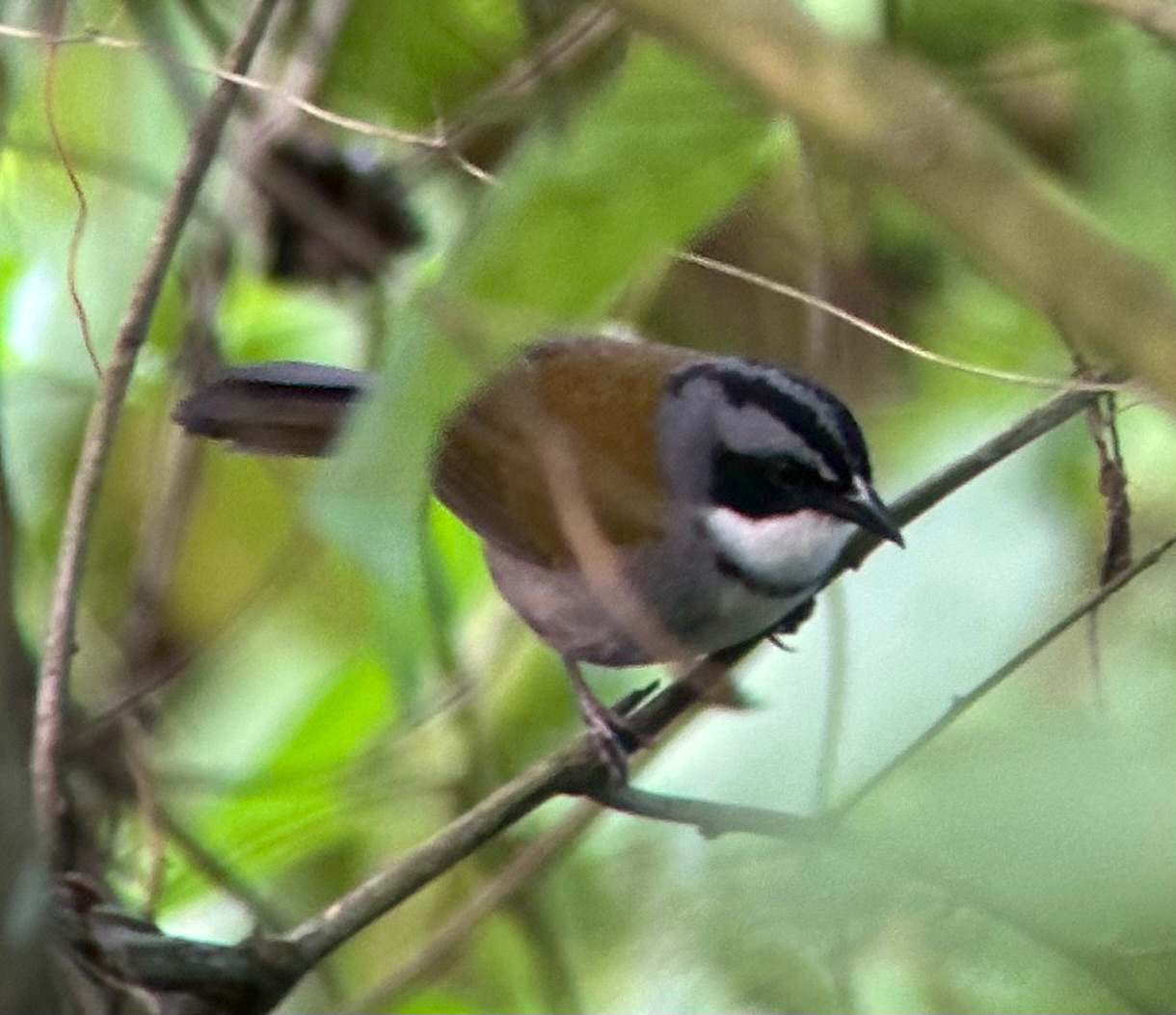
19 cm, sturdy, with a black bill and a fairly long tail. The head is black, with a grey median crown stripe and a grey supercilium. The throat is white; some birds have a narrow black band below the throat, others do not. Back, wings and tail are olive-green; breast and flanks are grey, the centre of the belly white. The sexes are alike. Juveniles are duller and browner, with a less sharp head pattern.
Confusion species
Black-fronted Brushfinch Atlapetes nigrifrons lives in the same mountains but has yellow underparts and no grey head stripes. Chestnut-capped Brushfinch Arremon brunneinucha has a chestnut crown and a black breast band. Grey-browed Brushfinch Arremon assimilis of the Venezuelan Andes is very similar but does not occur in the Perijá; the two species are best separated by range.
Habitat
Understorey of humid montane forest and cloud forest, forest edges and scrub, roughly between 1600 and 3200 m. It forages on and just above the ground for insects, other invertebrates and seeds. Little is known about the nest.
Where the bird is most at home, classified by the vegetation units of Amazonia and the Guianas.

Range and movements
A resident that in the guide area occurs only in the Serranía de Perijá in western Zulia, Venezuela. Absent from Brazil and the Guianas, and from the Venezuelan Andes, where Grey-browed Brushfinch lives. Outside the guide area only on the Colombian side of the same range, in Cesar and La Guajira.
- Resident
- dark = core range, pale = thinly spread
How and when to look
The montane forest of the Venezuelan Perijá, including the Parque Nacional Sierra de Perijá, is little visited; the Colombian side is more accessible. Pairs forage low along forest edges and reveal themselves by their high calls.
Conservation status
Least Concern. The range is small and much of the montane forest of the Perijá has been converted to fields and pasture, so the species depends on the remaining forest.
Scientific name
Arremon perijanus | (Phelps & Gilliard, 1940)
Phelps & Gilliard described the species in 1940 as Atlapetes torquatus perijanus; because it was later moved to another genus, the author and year stand in brackets. The genus Arremon was introduced in 1816 by Vieillot. Arremon is Greek, from arrhēmōn 'silent, speechless', after Buffon's 'Oiseau silencieux', a bird said to be rarely heard. perijanus refers to the Sierra de Perijá on the Venezuela–Colombia border, the only range of this species. The specimen the first description was based on came from La Sabana (1,200 m), Sierra de Perijá, Zulia, Venezuela.