All species › Pelicans, herons and ibises › Herons, egrets and bitterns › Pinnated Bittern
Pinnated Bittern | Botaurus pinnatus
Zuid-Amerikaanse roerdomp | Avetoro neotropical | Socó-boi-baio
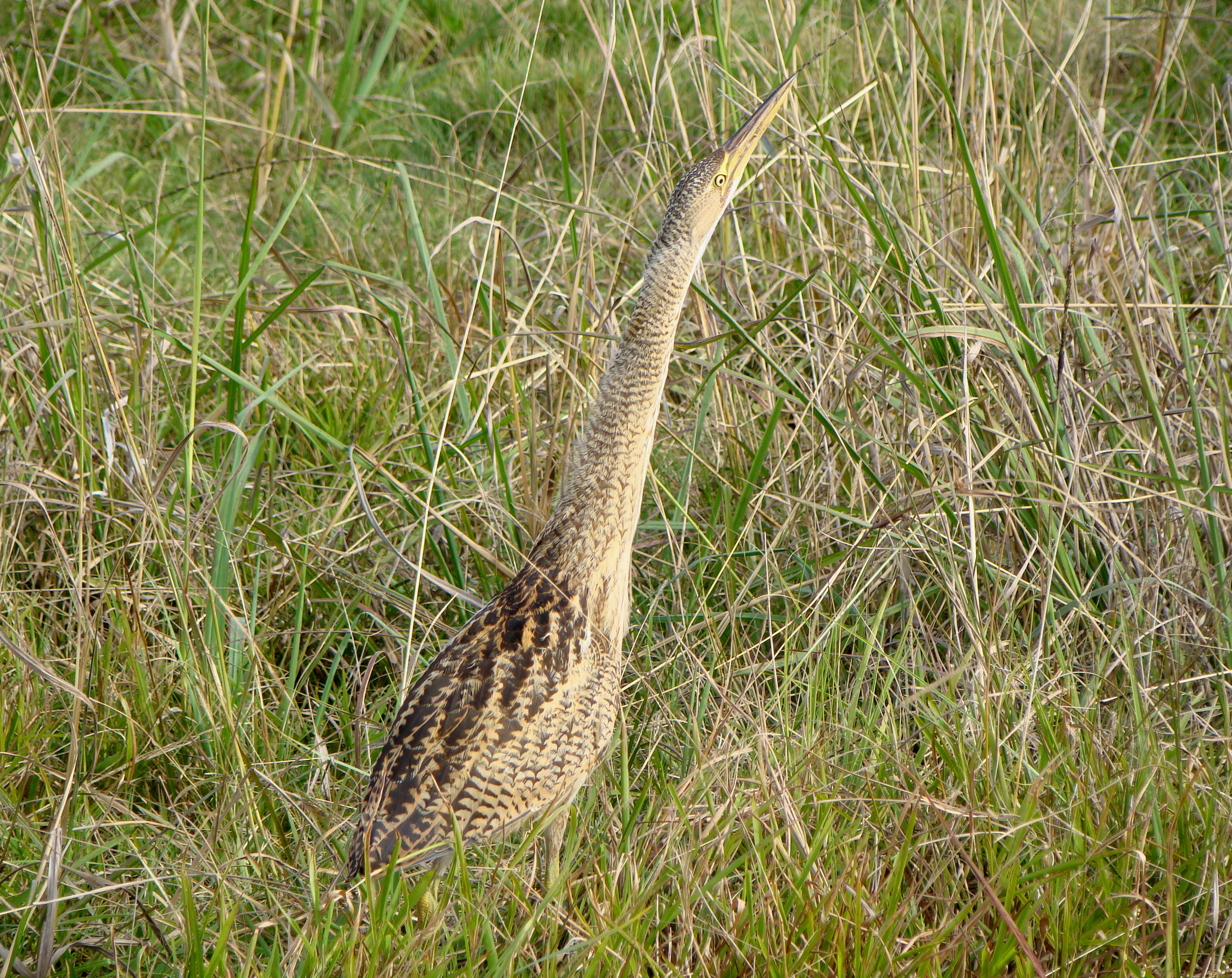
The Pinnated Bittern is the large brown bittern of the marshes of the Neotropical lowlands. It lives hidden in tall reedbeds and wet grassland and relies on its camouflage: when alarmed it points its neck and bill straight up and blends in with the stems. Its presence is often revealed only by its deep call at dusk.
Voice
In the breeding season a deep, hollow, far-carrying pumpf or woomp, mainly at dusk and at night, often repeated a few times. When disturbed a hoarse croak.
Recording: Paul Lenrumé — CC BY-NC-SA 4.0 · xeno-canto
Identification
64–76 cm, a heavy, stocky heron with a thick neck and a fairly short, pointed bill. The upperparts are buff with fine black barring and vermiculation; the crown is dark. The neck and breast are pale brown with broad brown streaks, and the throat is white with a dark central stripe. The bill and legs are yellowish green. In flight the dark flight feathers contrast with the buff wing coverts. The sexes are alike; juveniles are slightly warmer and more diffusely marked.
Confusion species
Juvenile tiger herons, especially Rufescent Tiger Heron Tigrisoma lineatum, are buff and heavily barred, but have a longer neck and bill and a barred rather than streaked breast, and more often sit along forest rivers. Stripe-backed Bittern Botaurus involucris is much smaller, with a streaked back and rufous wings. Juvenile Black-Crowned Night-Heron Nycticorax nycticorax is spotted rather than barred and has red to orange eyes. American Bittern Botaurus lentiginosus, a rare vagrant in northern Venezuela, has a black stripe down the side of the neck.
Habitat
Freshwater marshes with tall reeds, cattails and rushes, wet and flooded grassland and savanna, lake edges and rice fields in the lowlands, mostly below 500 m. It hunts standing still or stalking slowly for fish, frogs, snakes, insects and small mammals. The nest is a platform of plant material low in dense marsh vegetation.
Where the bird is most at home, classified by the vegetation units of Amazonia and the Guianas.





Range and movements
In Venezuela in the Llanos, the marshes of the north and the Maracaibo Basin. In Guyana on the coastal plain and in the Rupununi, in Suriname and French Guiana in marshes and wet savannas of the coastal plain. In Brazil scattered and local: in the north in Roraima, Amapá and on Marajó, and further in the Pantanal, the Cerrado, the east and the south to Rio Grande do Sul; largely absent from interior Amazonia. Outside the guide area from southern Mexico to Colombia, Ecuador, Bolivia, Paraguay and northern Argentina.
- Resident
- dark = core range, pale = thinly spread
How and when to look
Search marsh edges at dusk in the Llanos of Venezuela, the Rupununi or the Pantanal, or in the Taim marshes of Rio Grande do Sul. Listen for the deep call; by day it sometimes flies up briefly over the reeds and drops back in.
Conservation status
Least Concern. The species depends on large, undisturbed marshes; drainage and the burning of marsh vegetation cause local declines.
Scientific name
Botaurus pinnatus | (Wagler, 1829)
Wagler described the species in 1829 as Ardea pinnata; because it was later moved to another genus, the author and year stand in brackets. The genus Botaurus was introduced in 1819 by Stephens. Botaurus is Medieval Latin for a bittern; the word combines Latin bos 'ox' with taurus 'bull', after the booming call (compare butire 'to boom'). pinnatus is Latin for 'feathered, plumed'; exactly what Wagler was referring to has not been established. The specimen the first description was based on came from state of Bahia, Brazil.