All species › Passerines › Tyrant flycatchers and allies › Plain Inezia
Plain Inezia | Inezia inornata
Grijskopinezia | Piojito picudo | Alegrinho-do-chaco
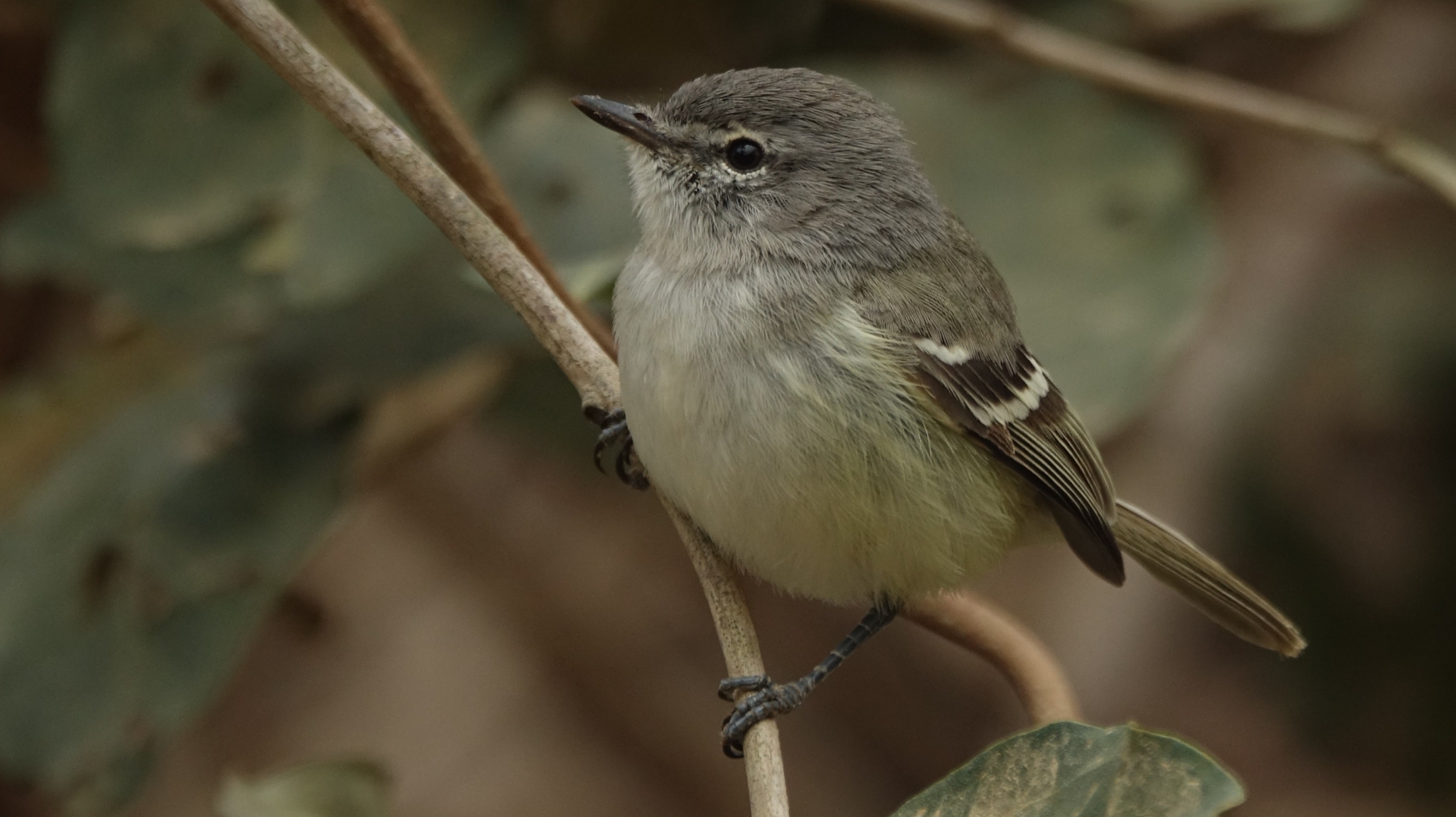
Plain Inezia is a small, greyish tyrant of dry forest, the Chaco and the woodland of the Pantanal, which after breeding partly moves north, into western Amazonia. There it then lives in scrub along rivers. The plumage is plain, with white spectacles and two wing-bars.
Voice
A fairly melodious series of thin whistled notes, introduced by an emphatic first note.
Recording: Guilherme Melo — CC BY-NC-SA 4.0 · converted to mono · xeno-canto
Identification
9–10 cm, with a thin, black bill, sometimes with a paler base to the lower mandible. Crown, back and rump grey to olive-grey. Face largely whitish, with a narrow white brow and eye-ring. Wings dark, with white edges and two whitish wing-bars. Throat whitish, breast and belly dingy grey, with a pale yellow wash on the lower belly and undertail coverts. Iris dark brown. Sexes alike.
Confusion species
Amazonian Inezia Inezia subflava is larger, bright yellow below, with a broader white brow, and nearly always lives near water. River Tyrannulet Serpophaga hypoleuca shares the scrub on river islands, but has no wing-bars and a longer tail. White-crested Tyrannulet Serpophaga subcristata has a grey crown with a black-bordered white crest patch. Southern Beardless Tyrannulet Camptostoma obsoletum has a ragged crest and often cocks its tail.
Habitat
In the breeding season deciduous and semi-deciduous forest, Chaco woodland and gallery forest and woodlots in the Pantanal; outside the breeding season mainly young scrub along rivers, on river islands and at forest edges. From the lowlands to about 700 m. It searches for small insects among leaves and twigs in shrubs and low trees, often with mixed flocks. The nest is a small cup in a bush.
Where the bird is most at home, classified by the vegetation units of Amazonia and the Guianas.




Range and movements
Brazil: in the southwest, in the Pantanal and elsewhere in Mato Grosso do Sul and southern Mato Grosso, where it breeds and is partly present all year; in the austral winter birds move north and west, into Rondônia, Acre and southern Amazonas. Absent from Venezuela, Guyana, Suriname and French Guiana. Outside the guide area breeding in Bolivia, Paraguay and northern Argentina; in the austral winter also in the Amazonian lowlands of Bolivia and southeastern Peru.
- Resident
- Summer visitor (c. Apr–Sep)
- Winter visitor (c. Oct–Mar)
- dark = core range, pale = thinly spread
How and when to look
In the Pantanal it can be found all year in gallery forest and woodlots along the roads, in Rondônia and Acre mainly from May to September in scrub along rivers. Listen for the melodious song and watch for small, grey birds in mixed flocks.
Conservation status
Least Concern. Widespread and locally common. Clearance of dry forest and of the Chaco reduces the breeding range outside the guide area; in the Pantanal and along the Amazonian rivers the habitat is largely intact.
Scientific name
Inezia inornata | (Salvadori, 1897)
Salvadori described the species in 1897 as Serphophaga inornata; because it was later moved to another genus, the author and year stand in brackets. The genus Inezia was introduced in 1909 by Cherrie. Inezia honours Enriqueta Inez Cherrie (1898–1943), daughter of the American ornithologist George Cherrie, who described the genus in 1909. inornata is Latin for 'unadorned', after the plain, unmarked plumage. The specimen the first description was based on came from San Francisco, Tarija Chaco, Bolivia.