All species › Swifts › Hummingbirds › Planalto Hermit
Planalto Hermit | Phaethornis pretrei
Brilheremietkolibrie | Ermitaño del Planalto | Rabo-branco-acanelado
The Planalto Hermit is a large hermit of the open, dry interior of Brazil, from the cerrado and caatinga to the inland Atlantic Forest. It lives less in closed forest than most hermits and also visits gardens and parks, even in cities. The nest is often placed in a sheltered spot, such as under an overhanging rock or on a building.

Voice
The song is a high, repeated, squeaky phrase. The call is a sharp tseep, often in flight.
Recording: JAYRSON ARAUJO DE OLIVEIRA — CC BY-NC-SA 4.0 · xeno-canto
Identification
15–16 cm, with a long, decurved bill and long, white-tipped central tail feathers. The upperparts are bronzy green, the rump bright rufous. The head has a dark mask with a pale supercilium and malar stripe. The underparts are cinnamon to buffy brown. The outer tail feathers are dark with white tips. The sexes are nearly alike.
Confusion species
Buff-bellied Hermit Phaethornis subochraceus of south-western Brazil is smaller, with a less rufous rump and paler, ochre-buff underparts, and lives mainly in forest. Cinnamon-throated Hermit Phaethornis nattereri is much smaller, with a shorter tail and a cinnamon throat. Scale-throated Hermit Phaethornis eurynome of the Atlantic Forest has a scaled throat, greyer underparts and no rufous rump.
Habitat
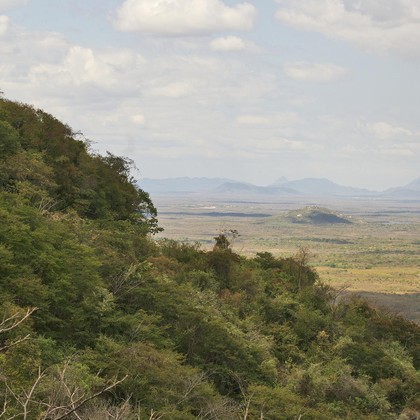
Dry and semi-humid forest, gallery forest, forest edges, cerrado, caatinga, rocky slopes and gardens, from the lowlands into the hills and mountains. It visits flowers of shrubs and herbs, including garden plants, and catches small arthropods. The cone-shaped nest hangs in a sheltered spot, under an overhanging rock, in a cave or under a roof or bridge.
Where the bird is most at home, classified by the vegetation units of Amazonia and the Guianas.




Range and movements
In Brazil widespread in the centre and east, from Maranhão, Piauí and Ceará through Bahia, Goiás, the Federal District and Minas Gerais to Mato Grosso, Mato Grosso do Sul, São Paulo, Rio de Janeiro and northern Paraná. Absent from Amazonia proper, Venezuela and the Guianas. Outside the guide area in eastern Bolivia and Paraguay.
- Resident
- dark = core range, pale = thinly spread
How and when to look
Check gardens and parks in cities such as Brasília and Goiânia, and flowering shrubs on rocky slopes in the cerrado, such as in the Chapada dos Veadeiros and the Serra do Cipó. Also look under bridges and eaves for the hanging nest.
Conservation status
Least Concern. It tolerates a semi-open, human-shaped landscape and often nests on buildings.
Scientific name
Phaethornis pretrei | (Lesson & Delattre, 1839)
Lesson & Delattre described the species in 1839 as Trochilus Pretrei; because it was later moved to another genus, the author and year stand in brackets. The genus Phaethornis was introduced in 1827 by Swainson. Phaethornis is Greek, from phaethōn 'sun, shining' and ornis 'bird': 'sun-bird'. pretrei honours the French natural-history artist Jean-Gabriel Prêtre (1768–1849). The specimen the first description was based on came from Minas Gerais, Brazil.