All species › Passerines › Finches, euphonias and allies › Purple-throated Euphonia
Purple-throated Euphonia | Euphonia chlorotica
Purperkeelorganist | Eufonia golipúrpura | Fim-fim
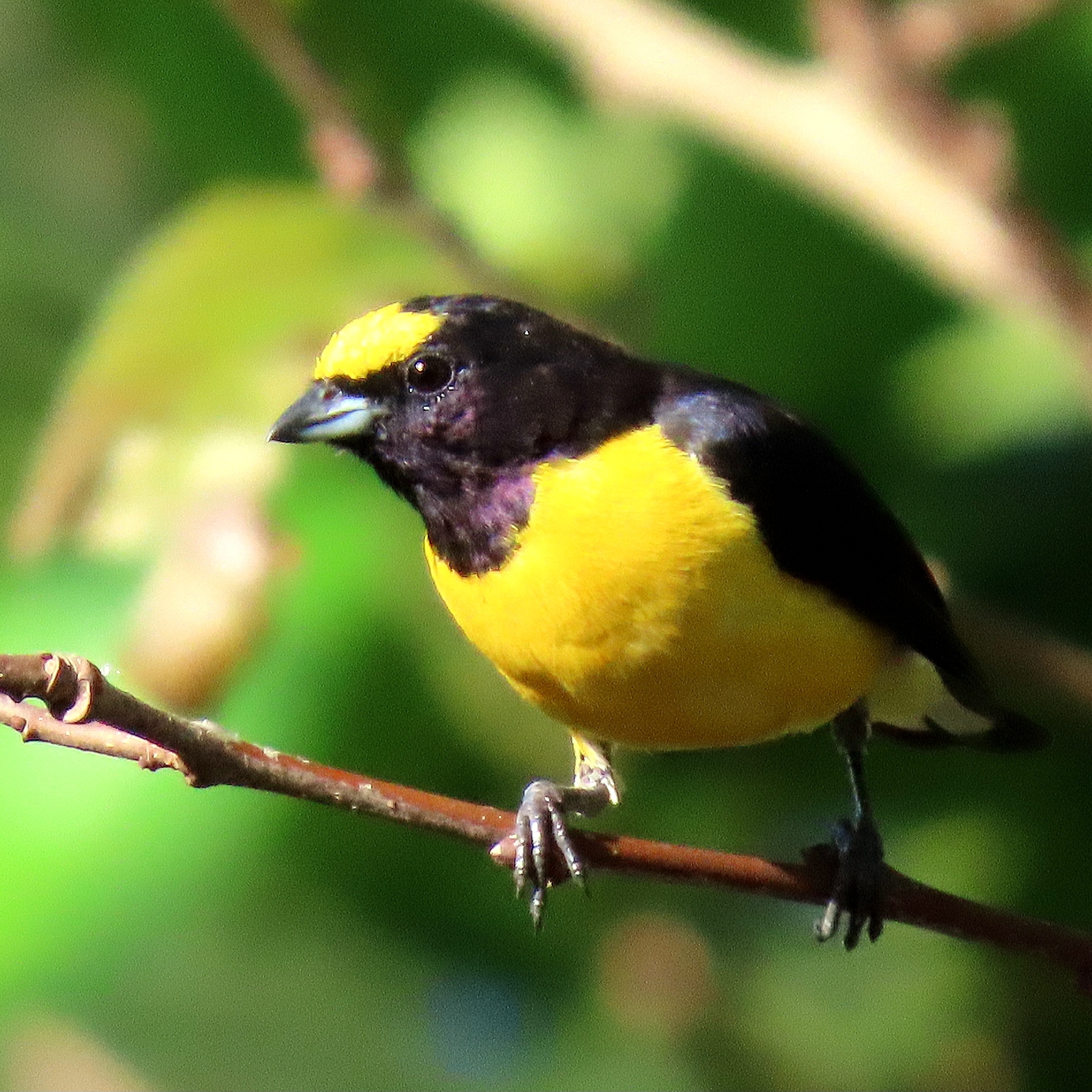
The Purple-throated Euphonia is the most widespread euphonia in Brazil, a small blue-black and yellow bird of open woodland, cerrado, caatinga, forest edges and gardens. In Brazil it is named after its two-note call. The male has a dark, purplish-glossed throat, which separates it from Violaceous and Thick-billed Euphonias.
Voice
The call is a clear, two-note feem-feem or bee-bee, often repeated. The song is a fast series of clear notes, chirps and chatter, with imitations of other birds woven in.
Recording: JAYRSON ARAUJO DE OLIVEIRA — CC BY-NC-SA 4.0 · xeno-canto
Identification
9–10 cm, small and compact, with a short, thick bill and a short tail. The male is glossy steel-blue above, on the head and on the throat, with a purplish sheen; a yellow forehead patch reaches to in front of the eye. The breast and belly are bright yellow; the outer tail feathers have white spots on the underside. The female is olive-green above, with a yellowish forehead, and yellowish olive below, greyish white in the centre of the belly. Immature males resemble the female, with the first dark feathers on the throat.
Confusion species
Violaceous Euphonia Euphonia violacea and Thick-billed Euphonia Euphonia laniirostris have a yellow throat. Trinidad Euphonia Euphonia trinitatis in northern Venezuela is very similar, but has a larger yellow crown patch that extends behind the eye; the two replace each other roughly along the Orinoco. Finsch's Euphonia Euphonia finschi in the Guianas has orange-yellow to ochre underparts. Orange-bellied Euphonia Euphonia xanthogaster is larger and deeper orange below. White-vented Euphonia Euphonia minuta has a white belly and undertail.
Habitat
Semi-open and open woodland, cerrado and cerradão, caatinga, gallery forest, forest edges, várzea along rivers, plantations, parks and gardens, from sea level to about 1500 m. It avoids the interior of closed humid forest. It lives in pairs or small groups and feeds mainly on mistletoe berries, also other small fruits and sometimes insects. The nest is a small ball with a side entrance, in a cavity, a dense shrub or a clump of epiphytes.
Where the bird is most at home, classified by the vegetation units of Amazonia and the Guianas.







Range and movements
In Brazil a common resident over almost the whole country, from the north-east and the Caatinga through the Cerrado and the Pantanal to the Atlantic Forest and Rio Grande do Sul; in the Amazon basin mainly along large rivers, in savannas and in open and disturbed country. In Venezuela mainly south of the Orinoco, in Bolívar and Amazonas. Local in Guyana, Suriname and French Guiana, mainly in savannas in the interior. Outside the guide area from eastern Colombia to Peru, Bolivia, Paraguay, Uruguay and northern Argentina.
- Resident
- dark = core range, pale = thinly spread
How and when to look
In Brazil the feem-feem call reveals the birds in gardens, parks and forest edges; then search the crowns for mistletoe with ripe berries. In the Cerrado and the Pantanal it also visits feeders with fruit.
Conservation status
Least Concern. Common and tolerant of open and disturbed country. It is trapped in Brazil for the illegal cage-bird trade, but this has little effect on the population as a whole.
Scientific name
Euphonia chlorotica | (Linnaeus, 1766)
Linnaeus described the species in 1766 as Tanagra chlorotica; because it was later moved to another genus, the author and year stand in brackets. The genus Euphonia was introduced in 1806 by Desmarest, A-G. Euphonia is Greek, from eu 'good' and phōnē 'sound': 'sweet-voiced', after the pleasing calls. chlorotica is New Latin for 'greenish-yellow', from Greek khlōros 'green, yellowish green', after the yellow underparts and the greenish female. The specimen the first description was based on came from Cayenne, French Guiana.