All species › Passerines › Tanagers and allies › Red-shouldered Tanager
Red-shouldered Tanager | Tachyphonus phoenicius
Roodschoudertangare | Tangara de galones | Tem-tem-de-dragona-vermelha
The Red-shouldered Tanager is a small, black tanager of open, shrubby vegetation on poor sandy and sandstone soils: savannas, white-sand scrub and the slopes and summits of tepuis. The male has a red shoulder patch with white below it, which is often largely hidden when perched. Its distribution is therefore patchy, following the poor soils of the Guiana Shield and Amazonia.

Voice
The call is a dry, short chip; the song is a series of high, hurried, sputtering notes, often at dawn.
Recording: Mauricio Cuéllar Ramírez — CC BY-NC-SA 4.0 · xeno-canto
Identification
16 cm, with a pointed, blackish bill. The male is glossy black, with a small red patch on the lesser wing coverts, white below that, and white underwing coverts; the red and white show mainly when it moves its wings or flies. The female is dark slate-grey to brownish grey above, with a darker cheek, and pale grey to whitish below, with a white throat. Young birds resemble the female.
Confusion species
The male White-lined Tanager Tachyphonus rufus is larger, with only white in the wing; the female is uniform rufous-brown. The male White-shouldered Tanager Loriotus luctuosus has a large white shoulder patch and lives in forest. The female resembles that of Black-faced Tanager Schistochlamys melanopis, but that species is larger and more uniformly grey, with a thicker bill.
Habitat
Savannas with scattered bushes, campina and low white-sand forest, scrub on sandstone and rock, inselbergs and the slopes and summits of tepuis, from the lowlands to about 2000 m. It lives in pairs or family groups in bushes and low trees and forages for insects and small fruit, sometimes with other species of open country.
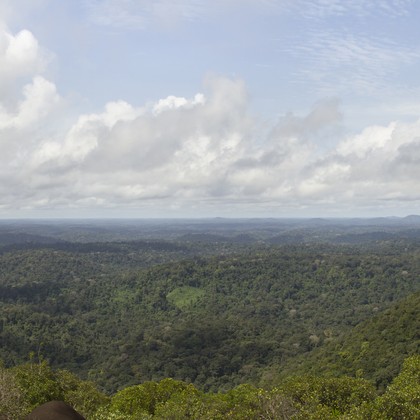
Where the bird is most at home, classified by the vegetation units of Amazonia and the Guianas.



Range and movements
In Venezuela south of the Orinoco, in Bolívar and Amazonas, on the tepuis and in the Gran Sabana. In Guyana in the Rupununi savannas and on the slopes of the Pakaraima Mountains; in Suriname and French Guiana locally in sand savannas and on inselbergs. In Brazil scattered and local, in Roraima, Amapá, along the upper Rio Negro, in the savannas of northern Pará and on other isolated savannas and campinas. Outside the guide area in eastern Colombia and north-eastern Peru.
- Resident
- dark = core range, pale = thinly spread
How and when to look
In the Gran Sabana in Venezuela and on the Rupununi savannas in Guyana, in low scrub along roads and trails. Watch for a black tanager flying from a bush and briefly showing the red and white in the wing.
Conservation status
Least Concern. Its habitat is fragmented but extensive and in part little disturbed.
Scientific name
Tachyphonus phoenicius | Swainson, 1838
Swainson described the species in 1838 and placed it straight away in the genus where it still stands. The genus Tachyphonus was introduced in 1816 by Vieillot. Tachyphonus is Greek, from takhus 'fast' and phōneō 'to speak': 'fast talker'. phoenicius is from Greek phoinikeos 'crimson', after the red shoulder patch. The specimen the first description was based on came from given as Bioko (Fernando Po), in error; probably eastern Peru.