All species › Passerines › Tyrant flycatchers and allies › Ringed Antpipit
Ringed Antpipit | Corythopis torquatus
Geringde piepertiran | Corotopo fajeado | Estalador-do-norte
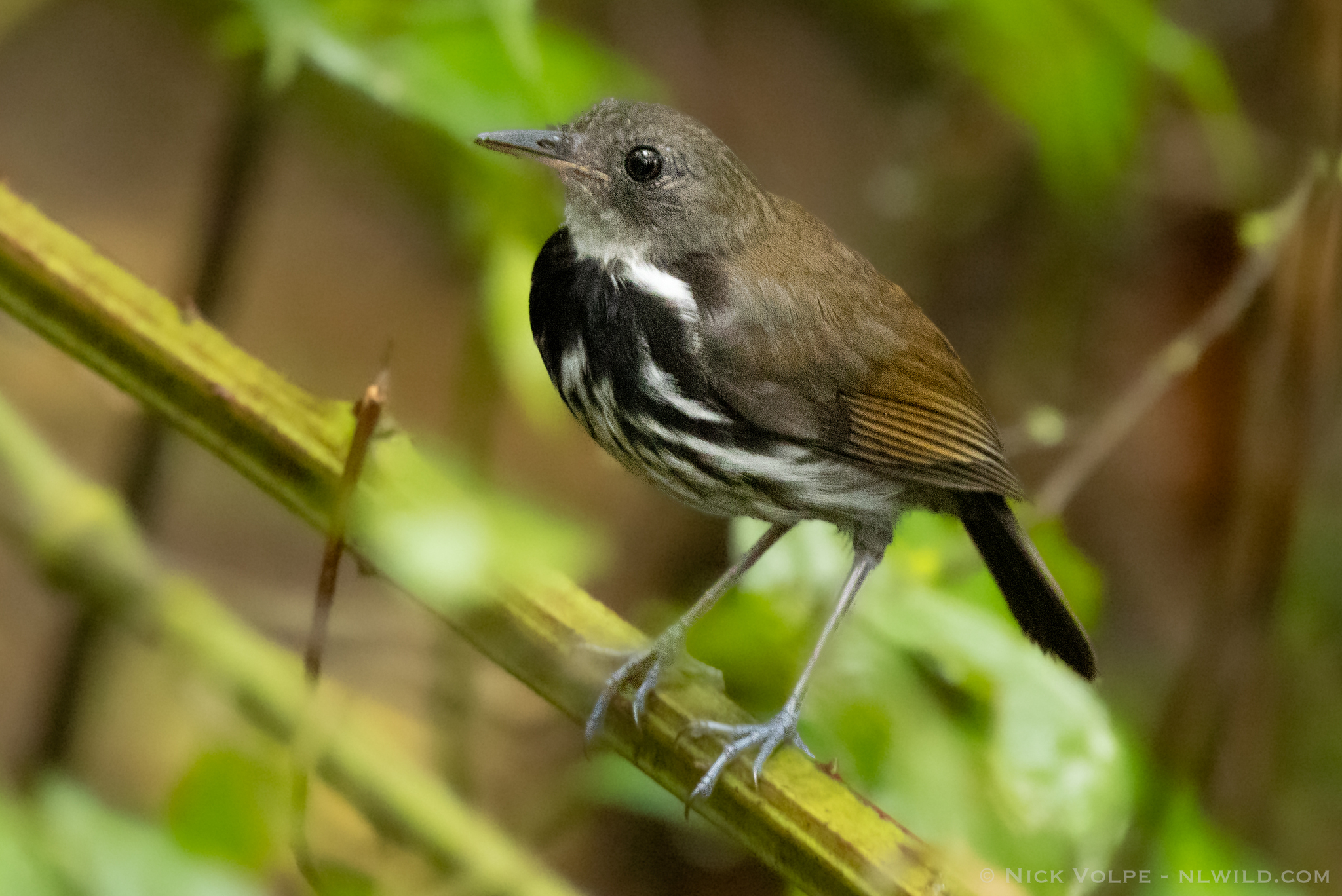
The Ringed Antpipit is a tyrant flycatcher that walks over the floor of Amazonian forest like a pipit. It wags its tail constantly, gives a clear whistle and snaps its bill. With its black breast band and long, pale legs it has no counterpart among the other lowland tyrant flycatchers.
Voice
A clear, whistled series of two or three notes, for example pee-pee-peeuw, the last falling. Also dry bill-snapping sounds, especially when disturbed.
Recording: Jacob Wijpkema — CC BY-NC-SA 4.0 · shortened to the first 60 s, mono · xeno-canto
Identification
13–14 cm, with a straight, fairly fine bill with a pale lower mandible, and long, pale legs. The upperparts are dark olive brown, the crown and head slightly greyer and darker. The throat and belly are white; across the breast runs a broad band of black streaks, which becomes streaking towards the flanks. The wings and tail are plain brown. The sexes are alike; juveniles are browner, with a fainter breast band.
Confusion species
Southern Antpipit Corythopis delalandi is very similar, but has an olive-brown crown that does not contrast with the back and a narrower breast band; it lives south of Amazonia, in central and southern Brazil. Leaftossers such as Black-tailed Leaftosser Sclerurus caudacutus also live on the forest floor, but are larger and dark brown, without a white belly and breast band, and do not walk about wagging the tail.
Habitat
The floor of tall, humid terra firme lowland forest, also forest on sandy soil, less often in seasonally flooded forest, up to about 1000 m on the slopes of the Guiana Shield. It walks over the leaf litter and along fallen trunks and takes insects and spiders from the ground, sometimes with a short jump into the air. The nest is a domed ball of moss on the ground or on a low, sloping trunk.
Where the bird is most at home, classified by the vegetation units of Amazonia and the Guianas.



Range and movements
In Brazil across much of Amazonia, north and south of the Amazon, east to eastern Pará and south to Rondônia and northern Mato Grosso. In Venezuela in the south, in Amazonas and Bolívar. Widespread in Guyana, Suriname and French Guiana. Outside the guide area in the Amazonian lowlands of Colombia, Ecuador, Peru and northern Bolivia.
- Resident
- dark = core range, pale = thinly spread
How and when to look
In the early morning, follow trails through tall terra firme forest, for example around Manaus or in the interior of French Guiana, and listen for the whistles; a bird usually walks ahead of you along the trail and then perches on a low branch, wagging its tail.
Conservation status
Least Concern. The species is widespread in Amazonian forest, but disappears where forest is cleared or strongly fragmented.
Scientific name
Corythopis torquatus | Tschudi, 1844
Tschudi described the species in 1844 and placed it straight away in the genus where it still stands. The genus Corythopis was introduced in 1836 by Sundevall. Corythopis is Greek, from koruthōn 'lark' and ōps 'appearance': 'lark-like', after this walking, streak-breasted ground bird. torquatus is Latin for 'collared', after the black-streaked breast band. The specimen the first description was based on came from Chanchamayo Valley, Junín, Peru.