All species › Passerines › Tyrant flycatchers and allies › Ruddy Tody-Flycatcher
Ruddy Tody-Flycatcher | Poecilotriccus russatus
Rosse schoffelsnavel | Titirijí bermejo | Ferreirinho-ferrugem
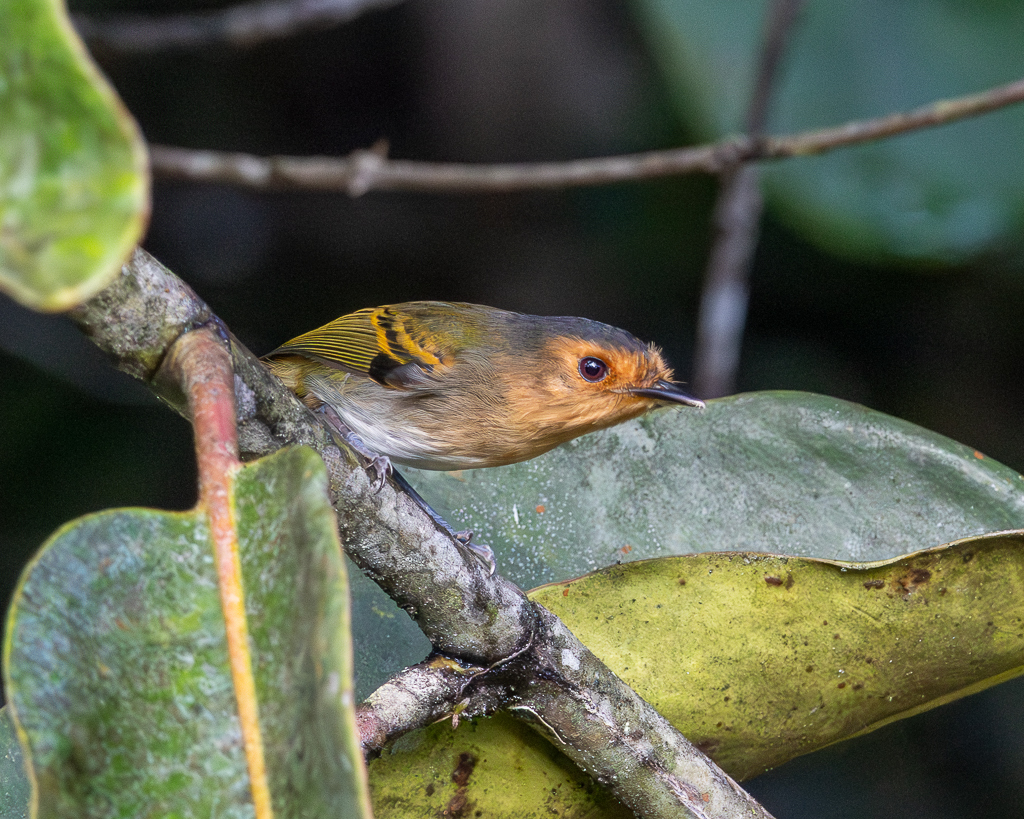
The Ruddy Tody-Flycatcher is a small tody-flycatcher of the tepuis, the table mountains of the Guiana Shield. It lives there in montane forest and scrub on the slopes and occurs nowhere else. The rufous face and breast set it apart from the other tody-flycatchers of the guide area.
Voice
Short, dry, rattling trills and single chip notes, low in the vegetation.
Recording: Joe Klaiber — CC BY-NC-SA 4.0 · xeno-canto
Identification
9.5 cm, with a flat bill and a fairly short tail. The crown is grey, the forehead, lores and sides of the head are rufous. Throat and breast are warm rusty to ochre, the belly is paler. The back is olive-green, the wings are blackish with cinnamon to ochre wing bars and edges. The sexes are almost alike.
Confusion species
Slate-headed Tody-Flycatcher Poecilotriccus sylvia has a grey head with white lores and greyish-white underparts, and lives in the lowlands. Pearly-vented Tody-Tyrant Hemitriccus margaritaceiventer, which also occurs on tepui slopes, is brownish olive above, with a pale eye, a streaked throat and whitish underparts. The rufous throat and breast are distinctive.
Habitat
Forest edges, scrub and dense growth in montane forest and on the slopes of tepuis, also in disturbed patches with young growth, from about 1000 to 2400 m. It forages in pairs low to mid-level for insects, which it picks from leaves in short sallies.
Where the bird is most at home, classified by the vegetation units of Amazonia and the Guianas.


Range and movements
Venezuela: in south-eastern Bolívar, on the tepuis and in the mountains of the Gran Sabana. Guyana: in the mountains of the Pakaraima range. Brazil: only in the far north of Roraima, on the border with Venezuela and Guyana. Absent from Suriname and French Guiana. Does not occur outside the guide area.
- Resident
- dark = core range, pale = thinly spread
How and when to look
Search in the Gran Sabana, for example along the road to Santa Elena de Uairén around the Sierra de Lema, in scrub and forest edges above 1000 m; listen for dry trills low in the vegetation.
Conservation status
Least Concern. The range is small, but lies largely in remote, little-disturbed mountain country; fires in the Gran Sabana can damage the habitat locally.
Scientific name
Poecilotriccus russatus | (Salvin & Godman, 1884)
Salvin & Godman described the species in 1884 as Euscarthmus russatus; because it was later moved to another genus, the author and year stand in brackets. The genus Poecilotriccus was introduced in 1884 by Berlepsch. Poecilotriccus is Greek, from poikilos 'variegated' and trikkos, an unidentified small bird; in ornithology triccus denotes a tyrant flycatcher. russatus is Latin for 'clothed in red', after the rufous plumage. The specimen the first description was based on came from Mount Roraima (c. 1,800 m), Venezuela.