All species › Passerines › Ovenbirds and woodcreepers › Rufous-breasted Leaftosser
Rufous-breasted Leaftosser | Sclerurus scansor
Roodborstbladkrabber | Tirahojas ogarití | Vira-folha
The Rufous-breasted Leaftosser is the leaftosser of the Atlantic Forest: a robust, dark brown ground bird with a whitish throat, a bright rufous breast and a rufous rump. In eastern and southern Brazil it is the most frequently recorded species of its genus.

Voice
The song is a series of five to ten sharp, whistled notes that first rise and then fall in pitch, chee-chee-chee-chew-chew, often at first light. The call is a loud, sharp cheek or a dry chak, especially when flushed.
Recording: Ricardo José Mitidieri — CC BY-NC-SA 4.0 · xeno-canto
Identification
18–20 cm, robust, with a long, straight, thin blackish bill, a short black tail and short legs. The upperparts are olive-brown to dark rufous-brown, the rump bright rufous and contrasting with the black tail. The throat is whitish to pale grey with fine dark scales, the breast bright rufous and the belly greyish brown. Birds from Ceará are smaller and paler. The sexes are alike; juveniles are duller, with a scaled breast.
Confusion species
Dusky Leaftosser Sclerurus obscurior is smaller, with an ochre throat and a dark chestnut breast, and occurs only locally in the Atlantic Forest. Black-tailed Leaftosser Sclerurus caudacutus also has a whitish, scaled throat, but a dark brown breast without rufous and a rump that contrasts little. Antthrushes of the genus Chamaeza also walk on the forest floor, but have streaked or scaled underparts and a longer tail.
Habitat
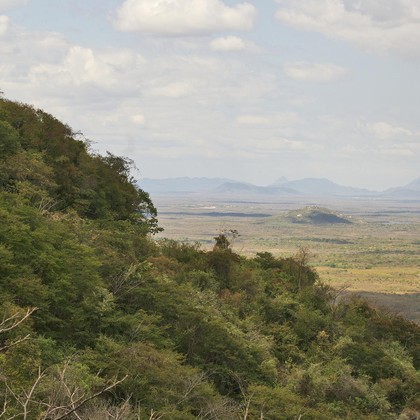
Humid evergreen and semi-deciduous forest with a thick layer of leaf litter, from the lowlands to the montane forest of the Serra do Mar up to about 1800 m, also Araucaria forest, gallery forest in the Cerrado and the humid highland forests (brejos) of the north-east. It forages alone on the ground, tossing leaves aside with quick strokes and picking up insects, spiders and other invertebrates. It breeds in a self-dug burrow in an earth bank or in the wall of a hollow, with a leaf-lined chamber at the end.
Where the bird is most at home, classified by the vegetation units of Amazonia and the Guianas.





Range and movements
Brazil: widespread in the Atlantic Forest from Pernambuco and Alagoas south to Rio Grande do Sul, inland to Minas Gerais, Goiás, the Distrito Federal and Mato Grosso do Sul; an isolated population in the humid highland forests of Ceará. Absent from Venezuela, Guyana, Suriname and French Guiana. Outside the guide area in eastern Paraguay and north-eastern Argentina.
- Resident
- dark = core range, pale = thinly spread
How and when to look
In forest reserves of the Serra do Mar and the Serra da Mantiqueira, for example Itatiaia National Park or Intervales State Park, along shady forest trails in the early morning. A bird that flies up low from the trail with a sharp call and shows a rufous rump is often this species; if you stand still, it often returns to the ground.
Conservation status
Least Concern. The species is sensitive to fragmentation of the Atlantic Forest and disappears from small or heavily disturbed forest remnants, but remains common in larger forest blocks; the isolated Ceará form has a small range.
Scientific name
Sclerurus scansor | (Ménétries, 1835)
Ménétries described the species in 1835 as Oxypyga scansor; because it was later moved to another genus, the author and year stand in brackets. The genus Sclerurus was introduced in 1827 by Swainson. Sclerurus is Greek, from sklēros 'stiff, hard' and oura 'tail', after the stiff tail feathers. scansor is Latin for 'climber', from scandere 'to climb'. The specimen the first description was based on came from Rio de Janeiro and Minas Gerais, Brazil.