All species › Passerines › Tyrant flycatchers and allies › Rufous-browed Tyrannulet
Rufous-browed Tyrannulet | Phylloscartes superciliaris
Roodbrauwlooftiran | Orejerito cejirrufo | Borboletinha-de-sobrancelha-ruiva
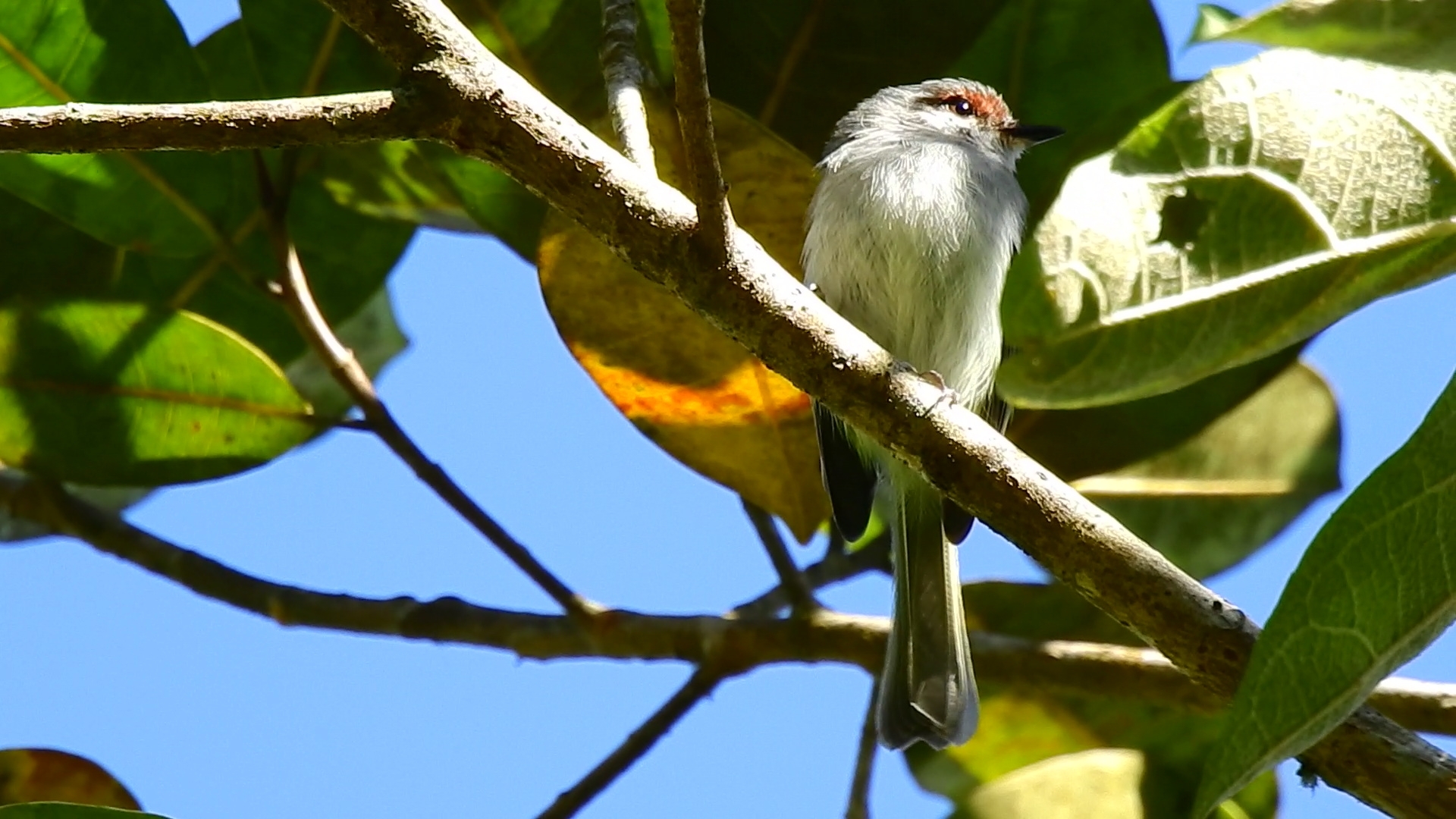
The Rufous-browed Tyrannulet is a small tyrant flycatcher with a striking head pattern: a grey crown, a white cheek framed by a black crescent and a narrow rufous eyebrow. It lives very locally in montane forest from Costa Rica to northern Peru. In the guide area it is known only from the Serranía de Perijá on the border between Venezuela and Colombia, with very few records.
Voice
Sharp, high tseet calls and a fast, chattering duet or short series tsi-tsi-tsi-tsrrr.
Recording: Johan Chaves — CC BY-NC-SA 4.0 · xeno-canto
Identification
11 cm, with a short, narrow black bill. Crown and nape slaty grey; a narrow rufous stripe above and in front of the eye. Cheek white with a black crescent along the rear of the ear-coverts. Back and wings olive-green, the wings without distinct wing-bars. Throat and belly white, breast greyish, flanks and undertail coverts pale yellowish. Sexes alike; juveniles duller, with less rufous in the brow.
Confusion species
Slaty-capped Flycatcher Leptopogon superciliaris has a similar head pattern, but is larger, has buff wing-bars, a yellow belly and perches upright in the understorey. Variegated Bristle Tyrant Pogonotriccus poecilotis has cinnamon wing-bars and a yellow belly. Golden-faced Tyrannulet Zimmerius chrysops has a yellow face and a short, stubby bill.
Habitat
The canopy and upper storey of humid, mossy montane forest, often on ridges with shorter forest, roughly between 1000 and 2000 m. It hops quickly along twigs and leaves, holds the tail slightly raised and picks insects from foliage. Almost always in mixed flocks.
Where the bird is most at home, classified by the vegetation units of Amazonia and the Guianas.

Range and movements
Venezuela: only in the Serranía de Perijá in Zulia, on the Colombian border, with just a few records. Absent from the Venezuelan Andes, the coastal range, south of the Orinoco and from Brazil, Guyana, Suriname and French Guiana. Outside the guide area in Costa Rica, Panama, Colombia, Ecuador and the far north of Peru.
- Resident
- dark = core range, pale = thinly spread
How and when to look
The chance of finding the species in the guide area is small, and the Venezuelan side of the Serranía de Perijá has limited access. In mossy montane forest at about 1300–1900 m, check every mixed flock in the canopy for the black-and-white cheek pattern.
Conservation status
Least Concern. The range is fragmented and the species is local everywhere. In the guide area the population is very small and poorly known; deforestation in the Serranía de Perijá is a threat.
Scientific name
Phylloscartes superciliaris | (Sclater & Salvin, 1868)
Sclater & Salvin described the species in 1868 as Leptotriccus superciliaris; because it was later moved to another genus, the author and year stand in brackets. The genus Phylloscartes was introduced in 1860 by Cabanis & Heine. Phylloscartes is Greek, from phullon 'leaf' and skairō 'to skip, to dance', after its restless foraging among foliage. superciliaris is Latin for 'eyebrowed', from supercilium 'eyebrow', after the rufous eyebrow stripe. The specimen the first description was based on came from Chitra, Veraguas, Panama.