All species › Passerines › Tanagers and allies › Rufous-crested Tanager
Rufous-crested Tanager | Creurgops verticalis
Okerkuiftangare | Tangara crestirrufa | Sanhaço-de-crista-ruiva
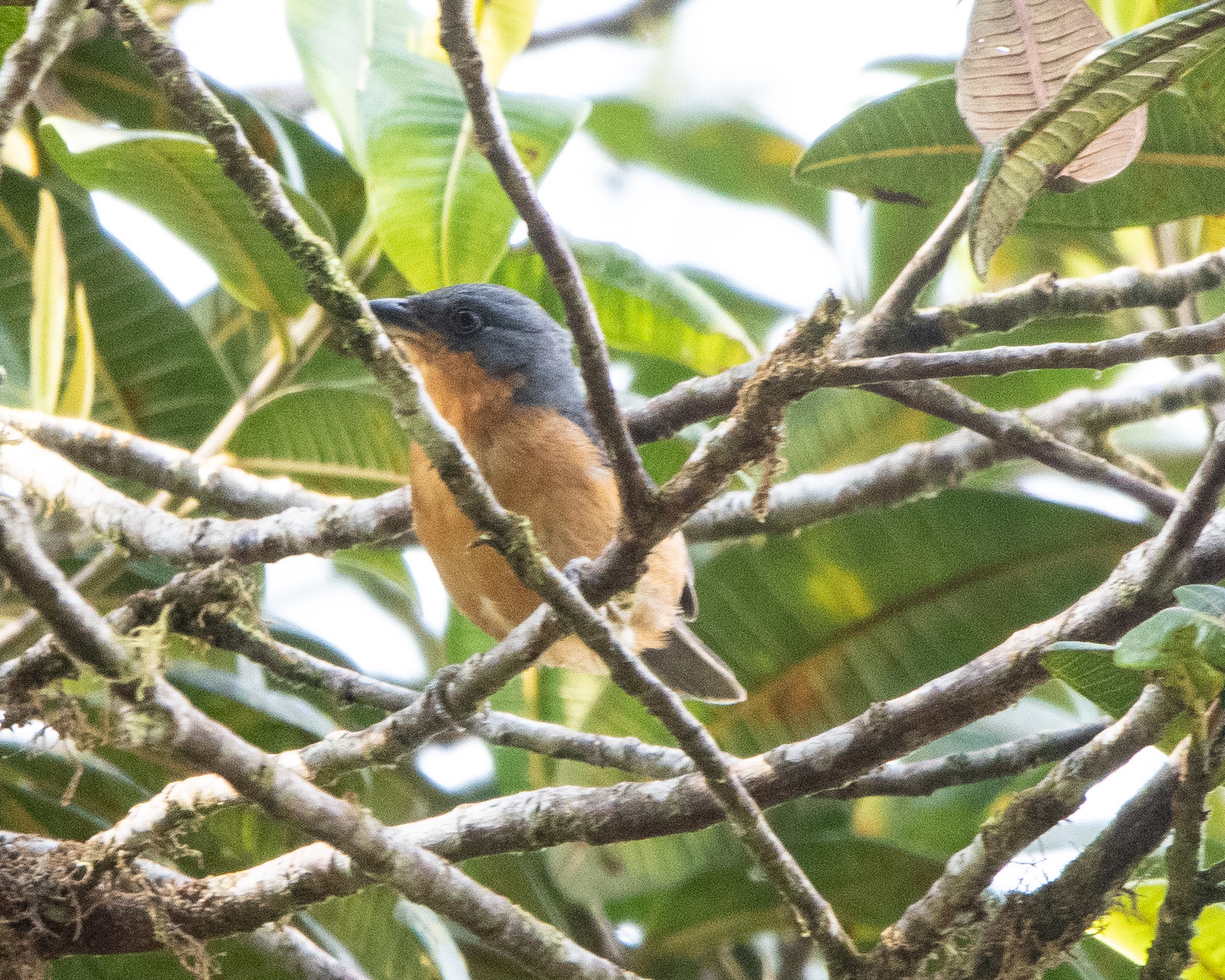
The Rufous-crested Tanager is a tanager of Andean cloud forest, slate-grey above and cinnamon below. The male has a rufous crown patch bordered with black that it can raise. In the guide area it occurs only in the Venezuelan Andes.
Voice
Little known and inconspicuous. The calls are thin, high tsit notes; the song is described as a short series of high, thin notes.
Recording: Mitch Lysinger — CC BY-NC-SA 4.0 · xeno-canto
Identification
15 cm, with a fairly stout bill with a small tooth near the tip. The male is slate-grey above and cinnamon to rufous below; on the crown is a rufous patch with black sides, usually held flat but erectile. The female is likewise slate-grey above and cinnamon below, but lacks the crown patch. Young birds resemble the female.
Confusion species
Rusty Flowerpiercer Diglossa sittoides is also grey above and cinnamon below, but is smaller and has an upturned, hooked bill. Fawn-breasted Tanager Pipraeidea melanonota is blue above with a black mask. Hemispingus-type tanagers (Thlypopsis, Sphenopsis) are more olive and often have a supercilium.
Habitat
Humid, mossy montane forest and cloud forest and their edges; in the guide area mainly between about 1500 and 2500 m. It lives in the middle storey and canopy, usually in pairs within mixed tanager flocks, and searches branches, moss and the undersides of leaves for insects and other invertebrates; it also eats small fruit. Little is known about the nest.
Where the bird is most at home, classified by the vegetation units of Amazonia and the Guianas.

Range and movements
Venezuela: only in the Andes of the west, mainly in Táchira and Mérida; the exact limits of its range in Venezuela are poorly known. Absent from Brazil, Guyana, Suriname and French Guiana. Outside the guide area in the Andes of Colombia, Ecuador and Peru.
- Resident
- dark = core range, pale = thinly spread
How and when to look
Follow mixed tanager flocks in the cloud forest of the Venezuelan Andes; the Rufous-crested Tanager often searches the undersides of mossy branches. Look for the combination of a grey back and cinnamon underparts without a mask.
Conservation status
Least Concern (IUCN). A rather scarce but widespread species of Andean forest; in Venezuela the conversion of montane forest to farmland locally threatens its habitat.
Scientific name
Creurgops verticalis | Sclater, 1858
Sclater described the species in 1858 and placed it straight away in the genus where it still stands. He introduced the genus Creurgops in that same work. Creurgops is Greek: the shrike genus Creurgus (from kreourgos 'butcher') and ōps 'appearance': 'shrike-like'. verticalis is Late Latin for 'of the crown', from vertex 'crown of the head', after the rufous crown. The specimen the first description was based on came from Río Napo, eastern Ecuador.