All species › Passerines › Tyrant flycatchers and allies › Rufous-crowned Elaenia
Rufous-crowned Elaenia | Elaenia ruficeps
Roodkruinelenia | Fiofío crestirrufo | Guaracava-de-topete-vermelho
Rufous-crowned Elaenia is a dark elaenia of savannas and scrub on poor sandy soils in northern South America. A rufous patch on the rear crown is characteristic, showing mainly when the bird raises its crest. Its range is patchy and follows the islands of white-sand savanna and campina within the forest.

Voice
A hoarse, rolling trrr-jeer and short, rasping calls; the dawn song consists of repeated, scratchy phrases.
Recording: JAYRSON ARAUJO DE OLIVEIRA — CC BY-NC-SA 4.0 · xeno-canto
Identification
14.5 cm. Upperparts dark olive-brown, head slightly darker, with a short crest and a rufous to cinnamon patch on the rear crown, which is partly concealed. Faint pale eye-ring. Wings dark with two whitish wing-bars and pale edges to the tertials. Throat greyish, breast greyish with faint dark streaks, belly dull yellow. Bill short, dark with a pale base to the lower mandible. Sexes alike; juveniles lack the rufous crown patch.
Confusion species
Plain-crested Elaenia Elaenia cristata is paler, has an entirely dark crest without rufous, and an unstreaked breast. Yellow-bellied Elaenia Elaenia flavogaster is larger, with a white crown patch and a fuller, divided crest. Lesser Elaenia Elaenia chiriquensis is smaller and paler, with a white crown patch. Small-billed Elaenia Elaenia parvirostris has a rounded head, a white crown patch and a whitish belly.
Habitat
Savannas with scattered shrubs and low trees on white sand, campina and low scrub on sand and sandstone, clearings on inselbergs and the edges of gallery forest, from the lowlands up to about 1400 m in the Gran Sabana. It eats insects and many small fruits. The nest is an open cup low in a shrub.
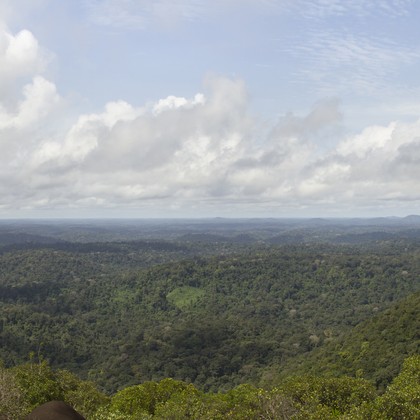
Where the bird is most at home, classified by the vegetation units of Amazonia and the Guianas.



Range and movements
Venezuela: south of the Orinoco, in Bolívar (including the Gran Sabana) and Amazonas. Guyana: in the interior and coastal savannas. Suriname and French Guiana: in the savannas of the coastal plain and locally in the interior. Brazil: scattered in savannas and campinas of Roraima, Amazonas, Pará and Amapá, on both sides of the Amazon. Outside the guide area in eastern Colombia.
- Resident
- dark = core range, pale = thinly spread
How and when to look
Look for it in the savannas of the coastal plain of Suriname, for example around Zanderij, in the Gran Sabana in Venezuela, or in the campinas near Manaus and in Viruá National Park in Roraima. Watch for a dark elaenia perching on shrub tops and raising its crest when excited.
Conservation status
Least Concern. Its habitat is naturally fragmented. Locally threatened by sand mining, fires and the conversion of coastal savannas to farmland and housing.
Scientific name
Elaenia ruficeps | Pelzeln, 1868
Pelzeln described the species in 1868 and placed it straight away in the genus where it still stands. The genus Elaenia was introduced in 1836 by Sundevall. Elaenia comes from Greek elaineos 'oily, olive-coloured', after the olive-green plumage. ruficeps is Latin for 'rufous-headed', from rufus 'rufous' and -ceps '-headed', after the rufous crown. The specimen the first description was based on came from Borba, Amazonas, Brazil.