All species › Woodpeckers and allies › Woodpeckers › Rufous-headed Woodpecker
Rufous-headed Woodpecker | Celeus spectabilis
Oranjekopspecht | Carpintero cabecirrufo | Pica-pau-lindo
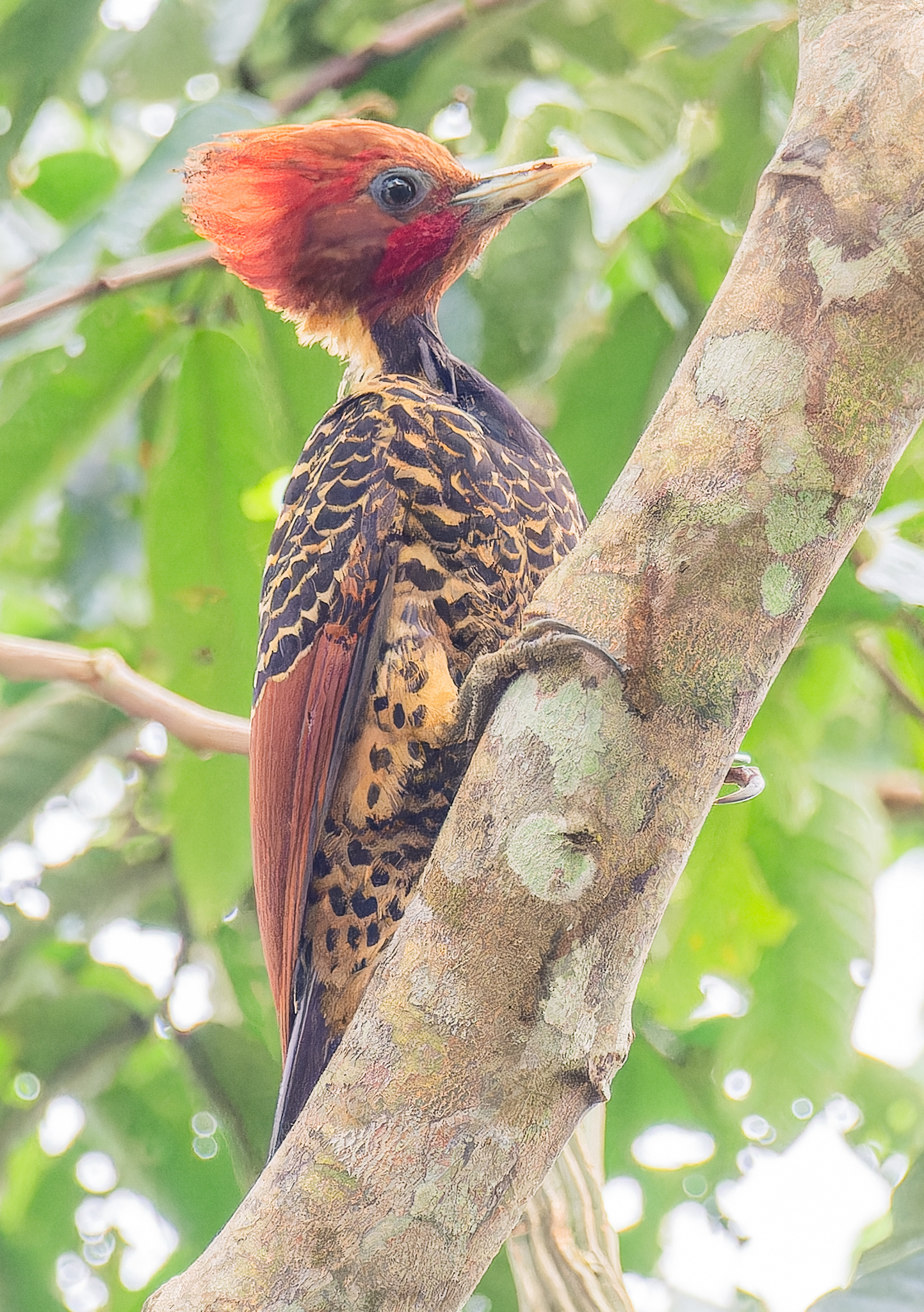
Rufous-headed Woodpecker is a large Celeus woodpecker of western Amazonia, with a rufous head and crest. In the guide area it occurs only in the far south-west of Brazil. It lives mainly in Guadua bamboo forest and takes much of its food from hollow bamboo stems and dead wood.
Voice
A loud, nasal, laughing series of a few notes and a short, harsh call, similar to those of other Celeus woodpeckers.
Recording: Juan Freile — CC BY-NC-SA 4.0 · converted to mono · xeno-canto
Identification
26–28 cm, with a full, rufous crest and a pale, yellowish bill. The head and neck are rufous. The back is cream-yellow with black bars, the rump plain pale yellow. A broad black band crosses the breast; the rest of the underparts are cream-yellow with black spots. The flight feathers are rufous, the tail is black. The male has a red moustache; the female lacks the red.
Confusion species
Chestnut Woodpecker Celeus elegans is entirely dark chestnut, without a black breast or barred back. Ringed Woodpecker Celeus torquatus also has a black breast, but a paler, cinnamon head and a rufous, black-barred back. Cream-colored Woodpecker Celeus flavus is cream-yellow, including the head and crest. Variable Woodpecker Celeus undatus is smaller and densely barred throughout.
Habitat
Guadua bamboo forest, also as understorey in tall lowland forest, and scrub, Cecropia woodland and young forest on river islands and along rivers, in Brazil in the lowlands. It eats ants and their larvae and other insects, which it often chisels out of bamboo stems. It nests in a hole in a tree.
Where the bird is most at home, classified by the vegetation units of Amazonia and the Guianas.



Range and movements
In Brazil only in the south-west: in Acre and locally in adjacent south-western Amazonas, mainly in bamboo forest. Not in Venezuela or the Guianas. Outside the guide area in eastern Ecuador, southern Colombia, locally in Peru and in north-western Bolivia.
- Resident
- dark = core range, pale = thinly spread
How and when to look
Search bamboo forest in eastern Acre, for example around Rio Branco. Listen for tapping on bamboo stems and for the nasal call.
Conservation status
Least Concern. The species is local and tied to bamboo forest and river islands; in Acre part of the bamboo forest is being lost to deforestation.
Scientific name
Celeus spectabilis | Sclater & Salvin, 1880
Sclater & Salvin described the species in 1880 and placed it straight away in the genus where it still stands. The genus Celeus was introduced in 1831 by Boie. Celeus comes from Greek keleos, a name for a green woodpecker. spectabilis is Latin for 'remarkable, showy', after the handsome plumage with its rufous head. The specimen the first description was based on came from Sarayacu, Ecuador.